

Predicting Freight Rates: Useful Models (and Common Misconceptions)
The freight rates may change overnight in world trade.Necessary expenses to transport a cargo by container ship can vary depending on the cost of oil, geopolitical conflict, container shortages, seasonal demands, etc., all of them impacting prices of transportation of cargo: container forwarding service by sea, containers, or air freight services.
To exporters in both India and USA, these changes are not optional but crucial to pricing, budgeting and profit makers. At FAK Cargo, data, algorithms, and many years of experience in the industry are united to assist our clients in making predictions of market turns and making confident plans.
What Really Matters to Freight Rates
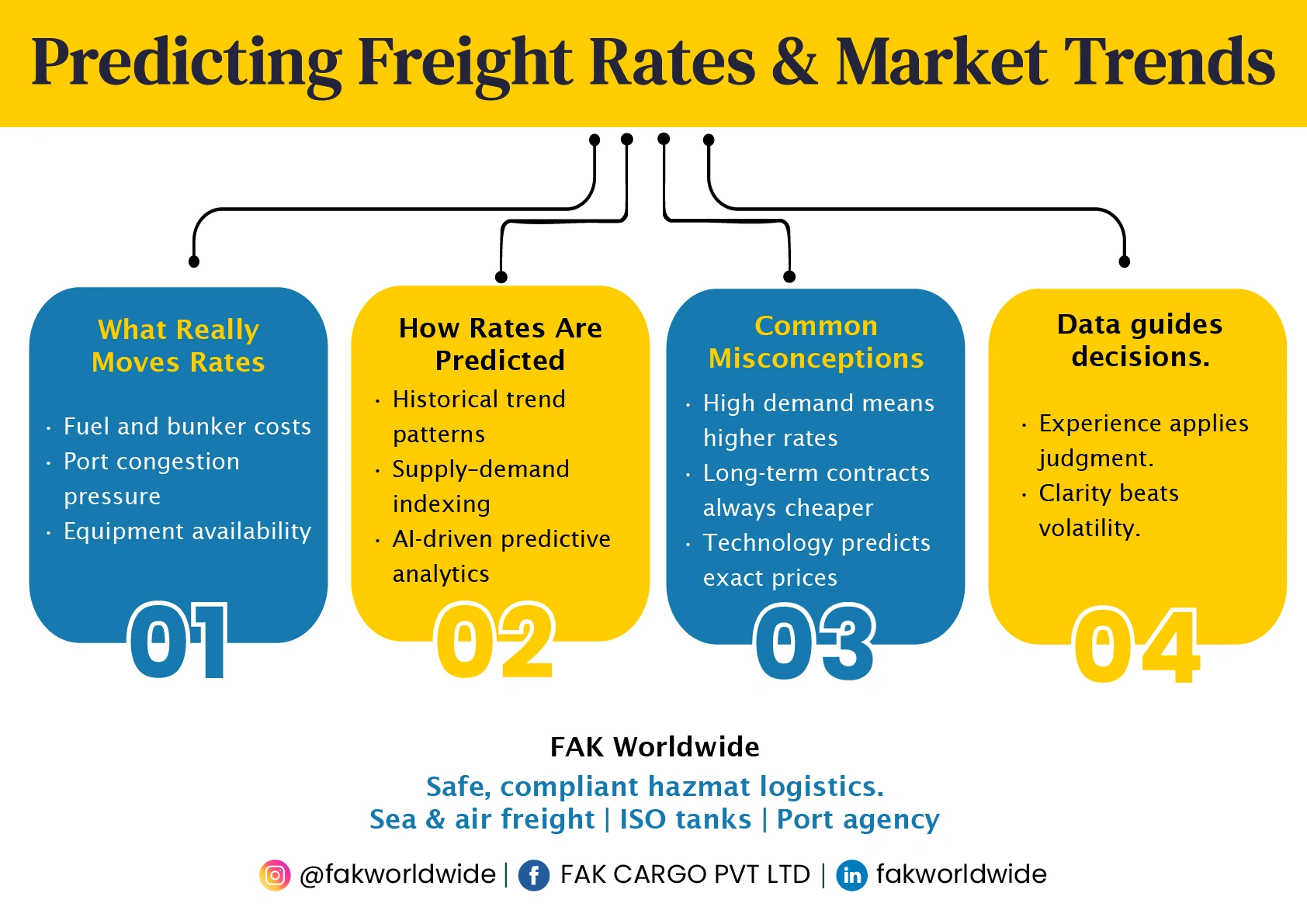
Exporters need to be aware of the levers that cause the rate volatility before implementing prediction models.
Key Factors:
- Fuel Costs: Direct effect on the sea and air freight.
- Trade Imbalances: Containers repositioning charges are a result of excess imports.
- Port Congestion: Holding Costs, Nhava Sheva or Los Angeles is a bottleneck hub that increases holding costs.
- Availability of Equipment: The lack of the ISO tanks, trailers, or reefers increases the rates.
- Regulatory Fees: Costs relating to carbon surcharges and compliance with ESGs change long term prices.
Understanding these variables will enable the exporters to price in a realistic manner and to evade last-minute cost shocks.
How Do Logistics Companies Predict Freight Rates Today?
The contemporary logistics firms have turned to forecasting that is informed by data.
A. Historical Trend Analysis
Check the multi-year rate data in order to learn about seasonal peaks and declines.
Anticipates before-festival or before-holiday, e.g. Diwali or Christmas.
B. Indexing of Supply-Demand in the Market
Makes vessel capacity and bookings comparison to predict short-term pressure.
C. Predictive Analytics of an AI Nature
Monitors real-time conditions like port congestion, bunker fuel and demand cycles.
Offers quicker and more precise information, compared to Excel sheets.
D. Cost-Based Modeling
Separates freight into bunker cost, terminal charges and inland transport.
Exporters help negotiate clear-cut rate structure with carriers.
At FAK Cargo, we combine these models with real-time information around the world to provide forecasts that are specific to each trade lane and profile of a client.
What Is Historical Trend Analysis in Freight Forecasting?
Marketing myths that distort planning are also experienced with advanced analytics.
Myth 1: It is always true that when the demand is high, the rates increase.
Not necessarily, prices can be fixed by extra capacity or subsidies.
Myth 2: “The long-term contracts save money.”
True only when clauses are adjusted to changes in bunkers and congestions.
Myth 3: There is a myth that technology can determine precise prices.
Algorithms are predictive, but not deterministic; market surprises still happen as a result of sudden attacks or wars.
Myth 4: Cargo has the same price curve.
Dry boxes have different formulae of cost in comparison to use of hazardous or bulk liquids in ISO tank containers.
These subtleties would help exporters not to respond emotionally to transitory spikes.
Why Is AI-Based Predictive Analytics Changing Freight Forecasting?
Forecasting is only important when it is acted upon intelligently.
Exporters: Best Practices:
- Measure weekly rate index through reliable dashboards.
- Establish a slot with the Best logistics agents in India.
- Combine ocean freight forwarding with air freight logistics of emergency cargo.
- Port agency services will be used to check the vessel schedules and prevent rollovers.
- Half-yearly check of pricing in accordance with oil or currency changes.
Exporters who look at forecasting as a process and not a one-time event enjoy better margins and relationships with suppliers.
What Makes the FAK Cargo Forecasting Approach Different?
In the case of FAK Cargo, forecasting is a tactful plan.
We integrate:
- Carrier and terminal global rate information.
- Short-term and the quarterly trend prediction algorithms.
- Intelligence on the ground provided by the iso tank operators in India and foreign partners.
- Clear boards that can be used and understood by everyone.
This combination of technology and human skill will help our clients to budget, route and negotiate rates confidently instead of randomly.
What to Expect in the Future: Intelligent Market Visibility
Forecasting of freight is developing at a rapid pace. Oil futures, weather disruptions, and trade policies have now been analyzed in-time using Artificial Intelligence and predictive supply-chain networks.
There will also soon come the time when the exporters will automatically be alerted as the rates fall above or below pre-set exporter limits; enabling immediate booking decisions.
The digital tools that FAK Cargo will invest in will allow them to bring market forecasting to all the exporters, no matter the size of the shipments.
What Is the Key Takeaway for Exporters Navigating Freight Volatility?
Prediction of freight-rates is art and science. Models make sense; experience puts in judgment.
Bidirectional exporters can overcome volatility, cost surprises and usually get the best shipping windows.
One way that we convert uncertainty into clarity at FAK Cargo is to empower our clients to make data-driven decisions and not decisions based on fear.Be it in handling ISO tank containers, bulk cargo or airfreight, we understand what is going on and that keeps you a step ahead of the market.Be updated on the world logistic trend and pricing:
Instagram, LinkedIn, and Facebook
Related posts

Trends to Watch 2025-26 in Multimodal Freight: Cost, Emissions, Regulation & Digitalization
Freight that is multimodal, i.e. sea, air and land transport- is critical in lin

Navigating the Challenges of Cross-Border Shipping: FAK Worldwide’s Expertise
In an increasingly globalized world, cross-border shipping has become a fundamen

The Real Cost of Container Dwell Time: How to Minimize Port Delays
When your cargo reaches the port, the goal is simple. Clear it fast and keep you