
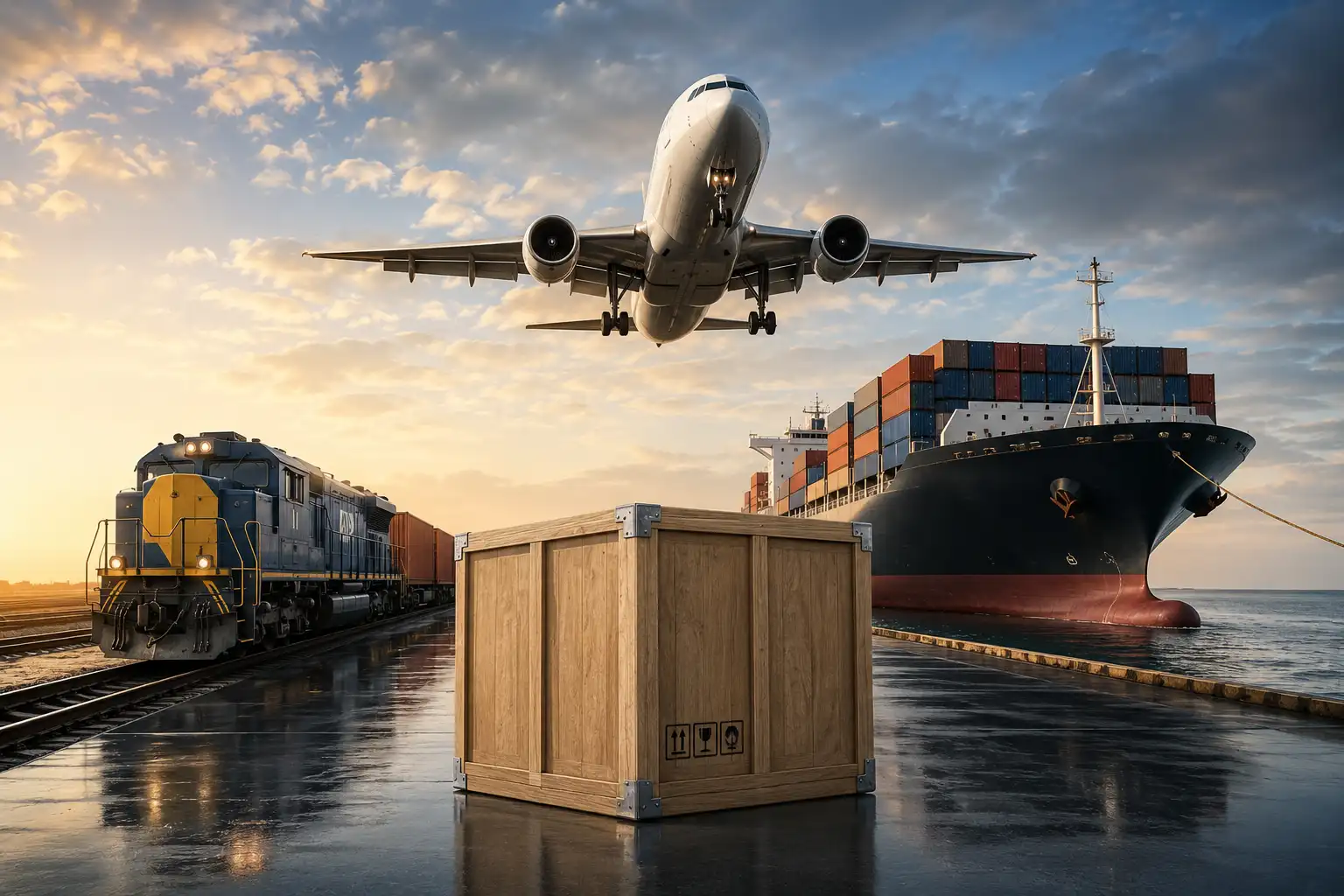
How to Choose Between Air Freight, Sea Freight, and Multimodal Transport for High-Value Cargo
The shipment is worth eighty lakh rupees.
Twelve thousand units of a specialty electronic component, ordered by a buyer in Germany who needs delivery in twenty-eight days. The CFO sees the freight quote for air and the freight quote for sea side by side. Air is six times the cost. Sea is fourteen days slower on transit but seven days slower on door-to-door. The CFO defaults to sea because the saving is large. The operations head pushes back because the cargo value, the customer relationship, and the insurance exposure all change the math.
This is the conversation that happens around high-value cargo every week. The right answer is rarely the cheapest mode. The right answer is the mode that matches the cargo profile, the time pressure, and the total cost of risk.
The Decision Most High-Value Shippers Get Wrong
The mode decision for high-value cargo is the single most impactful logistics choice the shipper makes. It drives:
- Transit time, which drives customer satisfaction
- Inventory holding cost during transit, which is real for high-value cargo
- Insurance exposure, which scales with transit time and risk per kilometre
- Damage risk, which differs sharply by mode
- Total landed cost, which is not just freight rate
The shipper who picks mode on freight rate alone usually picks wrong on high-value cargo. The shipper who weighs all five factors picks the mode that protects the business outcome.
What “High-Value Cargo” Means in Freight Terms
High-value cargo is not just expensive cargo. The definition that matters for mode selection includes four characteristics, any one of which qualifies:
- Per-unit value above the freight rate per unit by 20× or more. A shipment where the freight is one to two percent of cargo value behaves differently from one where freight is fifteen percent.
- High inventory holding cost during transit. Cargo where the working capital tied up in transit is meaningful at the company’s cost of capital.
- High customer-relationship stakes. Cargo where the customer’s manufacturing line, retail launch, or end-customer delivery commitment depends on this specific shipment.
- High damage or theft sensitivity. Cargo where loss or damage exceeds the cost of premium handling.
Each characteristic changes the mode math differently. The cargo that has all four — high value, high holding cost, high customer stakes, high sensitivity — almost always justifies the premium mode.
Air Freight: When Speed Justifies the Premium
Air freight is the fastest mode and the most expensive. The case for air on high-value cargo:
- Transit time. India to Europe in 2–4 days; India to the US in 3–5 days; India to the Middle East in 1–2 days.
- Lower handling. Fewer touches between origin and destination usually means lower damage risk.
- Lower inventory holding. Two weeks less working capital tied up in transit on a high-value shipment is a real number.
- Better insurance economics. Shorter transit means shorter exposure window means lower premium-to-value ratio.
Air freight rates from India to major destinations are quoted per kilogram, with a minimum based on chargeable weight (the greater of actual or volumetric). Typical rate bands as a directional reference:
| Destination | Indicative air freight band (₹/kg) |
| Dubai / Sharjah | ₹120–180 |
| Frankfurt / Hamburg | ₹240–350 |
| New York / JFK | ₹280–400 |
| Hong Kong / Singapore | ₹150–220 |
Rates fluctuate with peak season, fuel cost, and capacity. The Vile Parle desk runs current rate lookups on request for serious quotes.
Air freight makes sense when cargo value per kilogram is high enough that the freight rate is a small percentage of cargo value, transit time is critical, and the cargo can take air handling.
Sea Freight: When the Container Is Worth the Wait
Sea freight is the slowest mode and the cheapest. The case for sea on high-value cargo:
- Cost. A full container of high-value cargo to Europe might cost forty thousand to seventy thousand rupees by sea versus six to ten lakh by air for the same volume.
- Volume. A 40-foot container holds far more than air freight is practical for above a certain volume.
- Container security. A sealed container with proper security protocol is often safer than air handling for theft-sensitive cargo.
- Predictability for committed lanes. A regular sea freight programme on a stable lane has fewer surprises than air, where capacity is more volatile.
Sea freight transit times from India:
| Destination | Indicative transit (days, port-to-port) |
| Dubai / Jebel Ali | 4–6 |
| Singapore | 5–7 |
| Hong Kong | 10–14 |
| Hamburg / Rotterdam | 20–28 |
| New York / Norfolk | 28–35 |
Door-to-door times are typically seven to fourteen days longer than port-to-port, depending on origin inland, customs, and destination inland.
Sea makes sense when the cargo can absorb the transit time, the value-to-volume ratio justifies container shipping, and the cost saving over air is large enough to fund the inventory holding and accept the risk window.
Multimodal: The Underused Middle Option
Multimodal is sea or rail for the long leg and air or road for the short leg, combined under one bill of lading. It is the middle mode and the most underused by Indian exporters.
The two most common multimodal patterns for India outbound:
- Sea-air via Dubai. Cargo sails from Indian port to Jebel Ali, transfers to air for the long international leg. Transit cuts seven to ten days off pure sea, costs roughly half of pure air. Useful for India-to-Europe and India-to-Africa cargo where pure air is too expensive but pure sea is too slow.
- Sea-road via Suez or Rotterdam. Cargo sails to a European hub, transfers to road for inland European distribution. Useful for India-to-inland-Europe destinations where the final leg by road is faster than waiting for inland river or rail transit.
Multimodal works well when:
- The cargo is time-pressured but not critical (a five-day saving matters but a ten-day saving is not required)
- The cost saving over pure air is meaningful (typically 40–50%)
- The forwarder has multimodal capability with one BL covering all legs
The forwarder capability is the bottleneck. Many Indian forwarders quote sea or air but cannot quote a clean multimodal product. A specialist multimodal forwarder is worth seeking out for high-value cargo where the middle mode is the right answer.
The Cost-vs-Time Decision Matrix
Plot the shipment on two axes — cargo time-pressure and cargo value-per-volume — and the right mode often becomes obvious:
| Cargo profile | Time pressure | Value density | Recommended mode |
| Specialty pharma to Europe | High | Very high | Air |
| Bulk specialty chemical to UAE | Low | Medium | Sea |
| Electronic components to Germany | Medium | High | Sea-air multimodal |
| Premium fashion to US for season launch | High | High | Air |
| Industrial machinery to Africa | Low | High | Sea |
| Precision instruments to Singapore | Medium | Very high | Sea-air multimodal |
The matrix is directional. The actual decision for any specific shipment also factors in carrier capacity, destination handling capability, and the customer’s contractual expectations on delivery date.
Insurance Implications by Mode
Insurance economics differ sharply by mode. The same cargo value will price differently depending on how long it is in transit and what handling it goes through.
- Air freight insurance is typically priced as a low premium per shipment value, because transit is short and handling is contained. ICC(A) policies are standard.
- Sea freight insurance is typically higher premium because transit is longer and exposure is broader (weather, transhipment, port handling). General Average exposure on container ships is a real risk on high-value cargo.
- Multimodal insurance needs a through-policy that covers all legs under one BL. Some standard policies have coverage gaps at the mode transition points.
For high-value cargo, the insurance gap analysis is part of the mode decision. A cheaper mode with a five-percent insurance gap on cargo value can be the more expensive total decision.
Five Cargo Profiles and Their Right Mode
From the high-value lanes the Vile Parle desk handles regularly:
- Specialty chemicals to Europe. Pure sea in ISO tank for bulk; air for samples and time-critical small lots; multimodal underused but available for mid-volume.
- Pharma APIs and finished formulations. Air dominant for time-critical, sea for committed annual volumes with cold chain capability.
- Engineering and industrial components for OEM lines. Sea for committed monthly volumes; air for production line stoppage emergencies; multimodal for the gap between.
- Premium textiles and fashion for season launches. Sea for bulk pre-season; air for in-season replenishment.
- Precision instruments and electronic test equipment. Air dominant for single units; sea for committed programmes with proper packaging.
The mode mix often shifts across the year for the same customer. A serious export operation runs all three modes in rotation, depending on the shipment profile.
Comparison Table (Air vs Sea vs Multimodal)
| Factor | Air freight | Sea freight | Multimodal (sea-air) |
| Transit time India-Europe | 2–4 days | 20–28 days | 10–15 days |
| Cost vs sea baseline | 6–10× | Baseline | 2–3× |
| Cargo volume per shipment | Limited | Highest | Medium-high |
| Damage risk | Lowest | Medium | Medium |
| Insurance premium ratio | Lowest | Highest | Medium |
| Inventory holding cost | Lowest | Highest | Medium |
| Best for | Time-critical, very-high-value | Bulk, committed volume | Time-pressured, high-value, mid-volume |
The table is directional. Specific shipment decisions need the actual rate, current capacity, and destination handling capability on the day.
The Question to Ask Before You Book
The single question that resolves most mode decisions for high-value cargo:
“What is the total cost of this shipment, including freight, insurance, inventory holding during transit, and the risk-weighted cost of delivery delay, across each of the three modes?”
When the question is asked properly, the cheapest freight mode is often not the cheapest total mode. A four-times-more-expensive air shipment that saves three weeks of inventory holding, reduces insurance premium, and protects a major customer relationship is often the cheaper commercial decision.
The shippers who run this calculation as a standard pre-booking step usually shift twenty to thirty percent of their high-value cargo from sea to air or multimodal and improve the customer-relationship outcomes meaningfully.
Final Thoughts
The choice between air, sea, and multimodal for high-value cargo is one of the highest-leverage logistics decisions a serious exporter or importer makes. The right answer changes by shipment, by season, by carrier capacity, and by the customer’s expectation.
The shippers who run the cost-and-risk calculation properly find that all three modes have a place in their network. The shippers who default to one mode usually overpay in places they cannot easily see.
For Indian shippers who want their high-value cargo mode strategy reviewed across the next twelve months of expected shipments, the Vile Parle desk runs a mode-mix optimisation engagement.
Request a high-value cargo mode review from FAK Cargo — Vile Parle East, Mumbai.
Related posts

Ship Backup at Southern California Ports Is Receding
Cargo has increasingly generated significant revenue for Indian airlines, especi

From Farm to Table: ISO Tanks in the Food and Beverage Industry
When you pour a glass of fresh juice or drizzle oil onto your salad, you might n

Optimizing Inventory Management: FAK Worldwide’s Data-Driven Approach to Warehousing
Effective inventory management is a cornerstone of streamlined logistics and sup