

Port Health, Safety & Environment (HSE) Audits: What Chemical Exporters Must Prepare For
Health, Safety and Environment (HSE) inspections at ports are no longer five-minute-inspections. They have become common in 2026, and more rigid, as a regular feature of chemical export business in India and USA. In the case of exporters, who process hazardous or bulk liquid goods, a failed audit may have an impact of shipment delays, fines or even loss of ports entry.
Knowledge of the items that the port authorities seek as well as planning ahead is a requirement to the exporters who desire smooth operations that comply with the law.
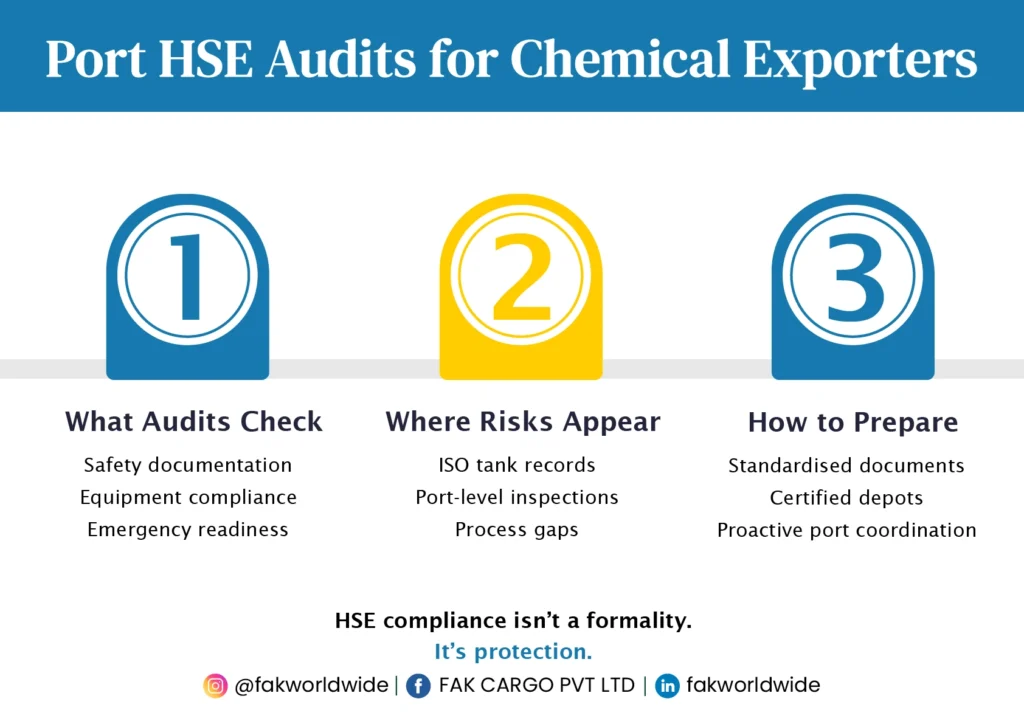
What Is a Port HSE Audit and Why Are They Getting More?
Port HSE audits refer to inspections performed by the port authorities, the terminal operators or the regulatory bodies to ascertain and confirm that the handling of cargo is safe and environmental. These audits are on the spill prevention, emergency preparedness, accuracy of documentations and equipment compliance.
The increased number of audits is influenced by the stricter international laws, the increase in cargo flow, and the possibility of more attention to the security of chemical work following a number of major safety accidents all over the world. In the case of exporters dealing between India and the USA, the compliance requirements are currently being balanced to the international safety standards.
What Areas are the most targeted by HSE Audits?
Audits are usually viewed as looking into three areas which include documentation, equipment condition and operational procedures.
It comprises documentation of safety data sheets, dangerous goods declarations and transport approvals. Exporters who use iso tank containers are particularly keen on checking their equipment because inspectors check the integrity of tank, pressure rating and cleanliness certificates.
The operational processes including loading, sealing and emergency response preparedness are scrutinized well to make sure that the staff and partners adhere to endorsed safety measures.
Why Does ISO Tank Shipment Come under a keener scrutiny?
High-risk cargo is transported through ISO tanks, thus it is a primary target when conducting HSE audits. Any discrepancy in inspection validity, cleaning records or labeling may instigate automatic shipment holding.
Exporters dealing with iso tank operators in India will be obliged to make sure that tanks are procured in the depots which are in compliance with the required standards and that they are also checked within the stipulated timeframes. The facilities of certified ISO tank depot services also has minimal impact on audit risk because it assures the tanks comply with international standards prior to port arrival.
Audit enforcement in ports such as Nhava Sheva, Mundra and Hazira has been particularly tough in the past one year.
What are the Ways that Bad HSE Preparation Results in Costs and Delays?
Failures in the audit can seldom be limited to warning of violation. Shipments can be quarantined which results in storage fees, loss of sailings and re-scheduling expenses.
To exporters who have been using sea freight, these delays will upset the bookings of the vessels and commitments to make deliveries downstream. In the USA, unsuccessful audits can also lead to the practice of further checks by customs or environment, which can further increase the delays.
Financial consequences of one failed audit may significantly outweigh the cost of right preparation.
How Do Port Agencies Prepare in Auditing?
Port agencies play a very important role in HSE audits. They also organize the inspections, communicate with the terminal authorities and ensure that documentation is in place prior to cargo arriving at the gate.
Professional port agency services provide exporters with the insight into audit requirements and local enforcement patterns early on. This proactive coordination frequently helps to avoid the minor issues and transformations into shipment holds.
What can the Exporters do to prepare in advance for HSE Auditing in 2026?
Ahead of cargo getting to the port, preparation starts way back. Exporters are advised to standardize documentation procedures, have audit equipment preparedness, and internal compliance checks done frequently.
Collaboration with the partners in logistics that know how to manage the supply chain of the ISO tanks will make sure that safety and compliance become part and parcel of each movement, rather than a last-minute inspection.
Long-term compliance also involves training the teams and partners on the changes in regulations.
In Conclusion: HSE Compliance Is a Business Protection, Not a Formality
The audit of Port HSE is not a deterrent, it is a protection. Those exporters who consider safety and environmental compliance to be the main operational principles have fewer disruptions and reduced costs and increased credibility among the regulators and customers.
Proactive HSE preparedness is one of the cleverest investments that a chemical exporter can make in an age of increased scrutiny.
On Instagram, LinkedIn, and Facebook, follow us to get real-life updates on logistics, industry insights, and smarter shipping on a case-by-case basis.
Related posts

Digital Transformation in Logistics: FAK Worldwide’s Leading Role
The logistics industry has seen remarkable advancements with the integration of

Digital Revolution: How IoT and Blockchain Are Changing ISO Tank Services
Gone are the days of relying on physical tracking sheets and manual work. Today,

Real-Time Visibility and Tracking: FAK Worldwide’s Digital Solutions
In today’s fast-paced logistics industry, real-time visibility and tracking ha