
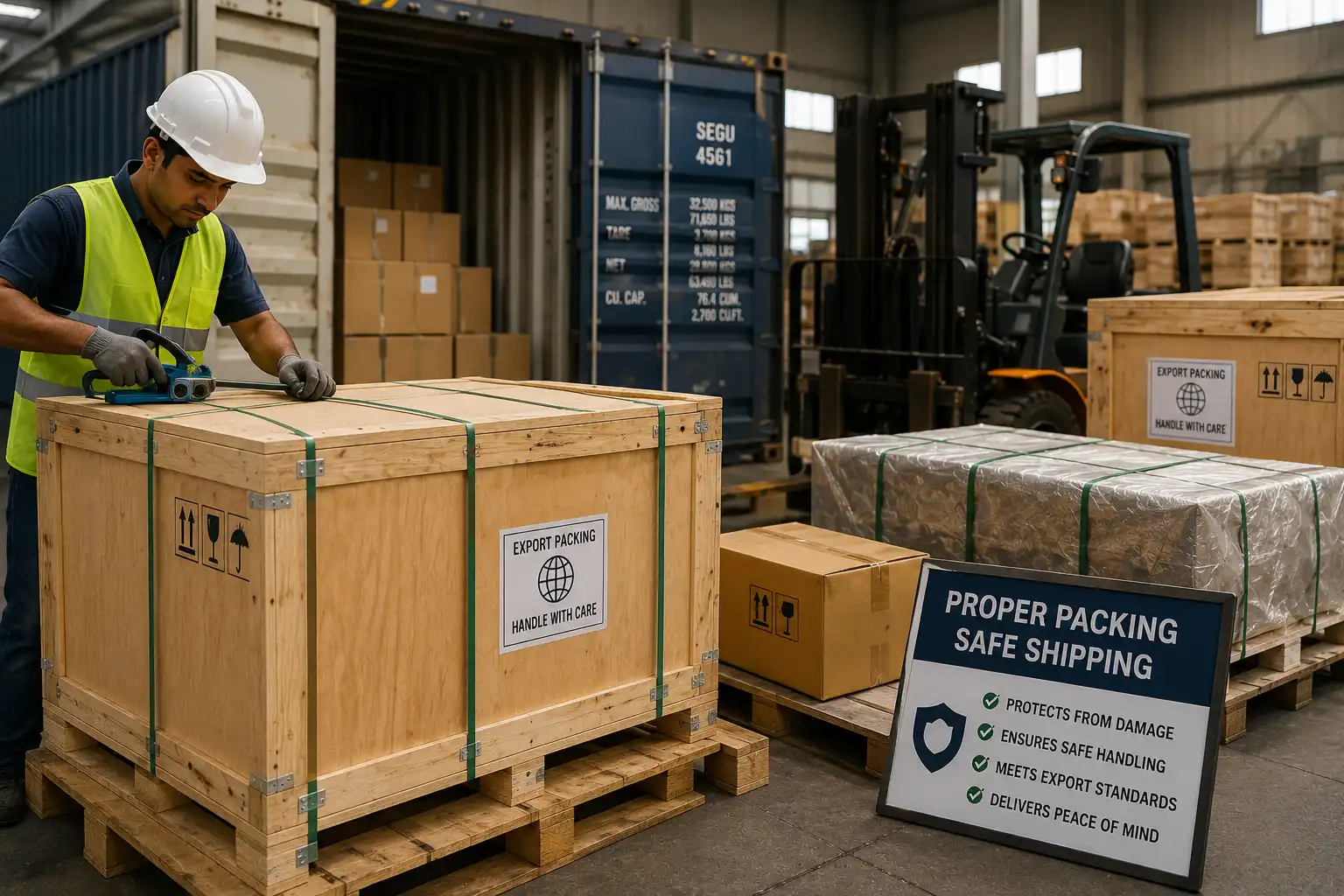
Export Packing Standards Explained: How Proper Packaging Prevents Cargo Damage
Quick Answer: Export packing standards are the technical, regulatory and destination-specific requirements used to prepare goods for international transport. The correct packing depends on the cargo, transport mode, handling conditions and destination. Effective export packaging protects against impact, vibration, compression, moisture, corrosion and cargo movement while also meeting requirements such as ISPM 15 for applicable wood packaging and dangerous-goods rules where relevant.
Key Takeaways
- There is no single export packing standard that applies to every shipment.
- Packaging should be designed around the cargo, route, transport mode and handling environment.
- Proper blocking, bracing and load securing are as important as the outer crate or box.
- Raw-wood pallets, crates and dunnage used internationally may need to comply with ISPM 15.
- Dangerous goods require packaging, marking and labelling that meet the applicable IMDG or IATA requirements.
International cargo can pass through factories, trucks, warehouses, ports, container yards, ships and destination terminals before reaching the consignee. During that journey, even robust industrial equipment may face repeated handling, vibration, humidity and movement.
This is why export packing standards should not be treated as an afterthought. The right packaging protects the product while helping the shipment move safely through the wider export logistics services process.
What Are Export Packing Standards?
Export packing standards are the specifications and practices used to prepare cargo for international transportation.
They are not one universal checklist. The correct requirements may come from several sources, including:
- the physical characteristics of the product
- buyer or engineering specifications
- carrier requirements
- destination-country rules
- dangerous-goods regulations
- phytosanitary requirements
- container packing and securing guidance
For containerised cargo, the IMO/ILO/UNECE CTU Code provides global guidance on safe packing and securing within cargo transport units. It addresses cargo loading, weight distribution, blocking, bracing and securing across intermodal transport chains. The CTU Code is a non-mandatory code of practice, but it is an important industry reference for safe container packing.
Why Proper Export Packaging Prevents Cargo Damage
Good packaging needs to protect against the hazards the cargo will actually face.
Impact and Vibration
Industrial cargo can experience vibration throughout road and sea transport. It may also encounter impact during forklift handling, container loading or terminal operations.
Cushioning, secure mounting and properly designed crates help prevent the product from moving inside its packaging.
Cargo Shifting
A heavy machine can be securely packed inside a wooden crate and still cause problems if the complete package moves inside the container.
The CTU Code recommends using appropriate blocking, lashing and other securing methods to prevent cargo from sliding or tipping. Void spaces should also be managed where necessary.
Packaging and container securing therefore need to be planned together.
Moisture and Corrosion
Sea freight can expose cargo to changing temperatures and humidity. Condensation inside a container can be particularly relevant for machinery, metal components and sensitive equipment.
Depending on the cargo and route, protection may include:
- moisture-barrier materials
- desiccants
- corrosion-protection materials
- suitable wrapping
- sealed inner packaging
The correct method should reflect the product’s sensitivity and expected transit conditions.
Which Export Packing Materials Are Commonly Used?
The packaging method should be matched to the commodity rather than selected simply by price.
| Packing Type | Typical Application |
| Wooden crates and boxes | Machinery, components and industrial equipment |
| Pallets | Cartons, drums and unitised cargo |
| Steel or HDPE drums | Chemicals and liquid or solid industrial products |
| Fibre drums | Suitable dry or solid products |
| UN-approved packaging | Regulated dangerous goods |
| Cushioning and blocking | Fragile or movement-sensitive equipment |
| Barrier wrapping | Moisture-sensitive or corrosion-sensitive cargo |
| Dunnage and lashing | Cargo securing inside containers |
Businesses using export packing services should provide accurate cargo dimensions, weight, centre of gravity and handling requirements before packaging is designed.
ISPM 15 Requirements for Wooden Export Packaging
Wood packaging needs particular attention in international trade.
ISPM 15 is the International Standard for Phytosanitary Measures covering wood packaging material made from raw wood. It is designed to reduce the risk of transporting pests internationally.
It applies to materials such as:
- solid-wood pallets
- crates
- boxes
- dunnage
- other applicable raw-wood packaging
Compliant wood must undergo an approved treatment and carry the recognised ISPM 15 mark. Processed wood products manufactured in ways that make them free from pest risk, such as plywood, are excluded from the standard.
For Indian exporters shipping machinery or industrial components on wooden packaging, destination-country requirements should be confirmed before dispatch.
Dangerous Goods Need Special Export Packing Standards
Hazardous cargo cannot be packed using ordinary commercial packaging simply because the package appears physically strong.
Dangerous goods may require UN-approved packaging specifically tested for the type and level of hazard involved.
Depending on the product, requirements may cover:
- approved inner and outer packaging
- UN packaging codes
- maximum permitted quantities
- absorbent or cushioning materials
- marks and hazard labels
- orientation requirements
- documentation
For sea freight, the IMDG Code 2024 Edition incorporating Amendment 42-24 became mandatory on 1 January 2026.
For air freight, IATA’s 67th Edition Dangerous Goods Regulations apply during 2026 and contain requirements for classification, packing instructions, packaging specifications, marking, labelling and documentation.
This is an area where specialised export packing services are particularly important.
How Export Packing Fits Into Indian Export Logistics
For an exporter moving cargo from an industrial location in Maharashtra, Gujarat, Tamil Nadu or another manufacturing region, packaging affects more than the ocean voyage.
The shipment may travel by truck to gateways such as Nhava Sheva, Mundra, Hazira or Chennai before being handled at terminals and loaded onto a vessel.
The packing design should therefore account for:
- factory handling,
- inland road movement,
- warehouse or CFS handling,
- port operations,
- ocean transport,
- destination handling and final delivery.
Good export logistics services consider the entire route instead of designing packaging only for the final sea leg.
Industry Insight: What We Usually Check Before Packing Export Cargo
When businesses approach us for export packing, we often see the discussion begin with a simple question: “How much will the wooden box cost?”
In our experience, dimensions alone are not enough to determine the correct solution.
We generally want to understand the cargo weight, centre of gravity, fragility, lifting points, destination, transport mode and whether the product has moisture or corrosion sensitivity.
One common issue we notice is that cargo is packed securely inside a crate, but insufficient attention is given to how the crate will be secured inside the container.
We also see wooden packaging selected before checking whether ISPM 15 requirements apply at destination. Planning these details before packing helps avoid repacking and last-minute documentation issues.
Common Export Packing Mistakes to Avoid
Businesses should watch for several recurring problems:
- using domestic packaging for long international transit without reassessment
- selecting a crate based only on cargo dimensions
- failing to consider cargo weight and centre of gravity
- inadequate blocking or lashing
- leaving excessive void space inside packages or containers
- using untreated wood where ISPM 15 applies
- ignoring moisture and corrosion exposure
- using ordinary packaging for regulated dangerous goods
- failing to provide handling or lifting information
- choosing the packing method without considering destination unloading facilities
How to Choose the Right Export Packing Services Provider
For industrial and regulated shipments, a packing company should understand both packaging and logistics.
Useful capabilities include:
- cargo assessment
- suitable crate, pallet or drum selection
- ISPM 15 compliant wood packaging
- dangerous-goods packing
- UN-approved packaging supply
- marking and labelling
- palletisation
- container stuffing and securing coordination
- warehousing and customs support
- road, air and sea freight coordination
This connection between packing and transport helps ensure that the packaging design reflects the complete movement.
How FAK Worldwide Can Assist in Appropriate Export Packing Standards
FAK Worldwide can assist exporters with appropriate export packing based on cargo classification, destination requirements and the chosen mode of transport. We provide DG packing and logistics solutions for hazardous solid and liquid products, including UN-approved primary and secondary packaging. Its capabilities also include HDPE, steel and fibre drums, marking, labelling and palletisation in line with applicable IATA and IMDG guidelines.
For shipments requiring wooden packaging, FAK Worldwide offers in-house pine wood crates, boxes and pallets with ISPM-15 certification. Additional facilities such as drum filling, nitrogen purging, warehousing, customs clearance and international air and sea freight support help connect packing with the wider logistics process. This allows exporters to address packaging, handling and compliance requirements as part of one coordinated cargo movement.
Conclusion
Effective export packing standards begin with understanding the cargo and the complete transport journey. The right crate, pallet or drum must be combined with suitable moisture protection, securing, regulatory compliance and destination requirements.
For industrial, chemical or dangerous-goods exports, FAK Worldwide can review the shipment specifications and coordinate appropriate packing with the wider international logistics movement.
FAQs
Q1. What are export packing standards?
A. Export packing standards are the technical, safety, regulatory and destination-specific requirements used to prepare cargo for international transportation. They vary according to the product, transport mode, packaging material and destination.
Q2. Why is proper export packaging important for international shipments?
A. Proper packaging helps protect cargo from impact, vibration, moisture, corrosion, compression and movement during handling and transport. It can also be necessary for regulatory and destination-country compliance.
Q3. What materials are commonly used for export packing?
A. Common materials include wooden crates, boxes, pallets, drums, cushioning materials, barrier wrapping, dunnage and securing equipment. Dangerous goods may require specific UN-approved packaging.
Q4. How can poor packaging affect international cargo?
A. Poor packaging can allow cargo to move, become wet, corrode, break or damage surrounding goods. It may also cause handling difficulties, shipment rejection or repacking when regulatory requirements are not met.
Q5. How do export packing services help reduce shipping risks?
A. Professional export packing services assess the cargo, route, handling conditions and regulatory requirements before selecting packaging. They can also coordinate blocking, palletisation, DG packaging, marking and documentation where required.