
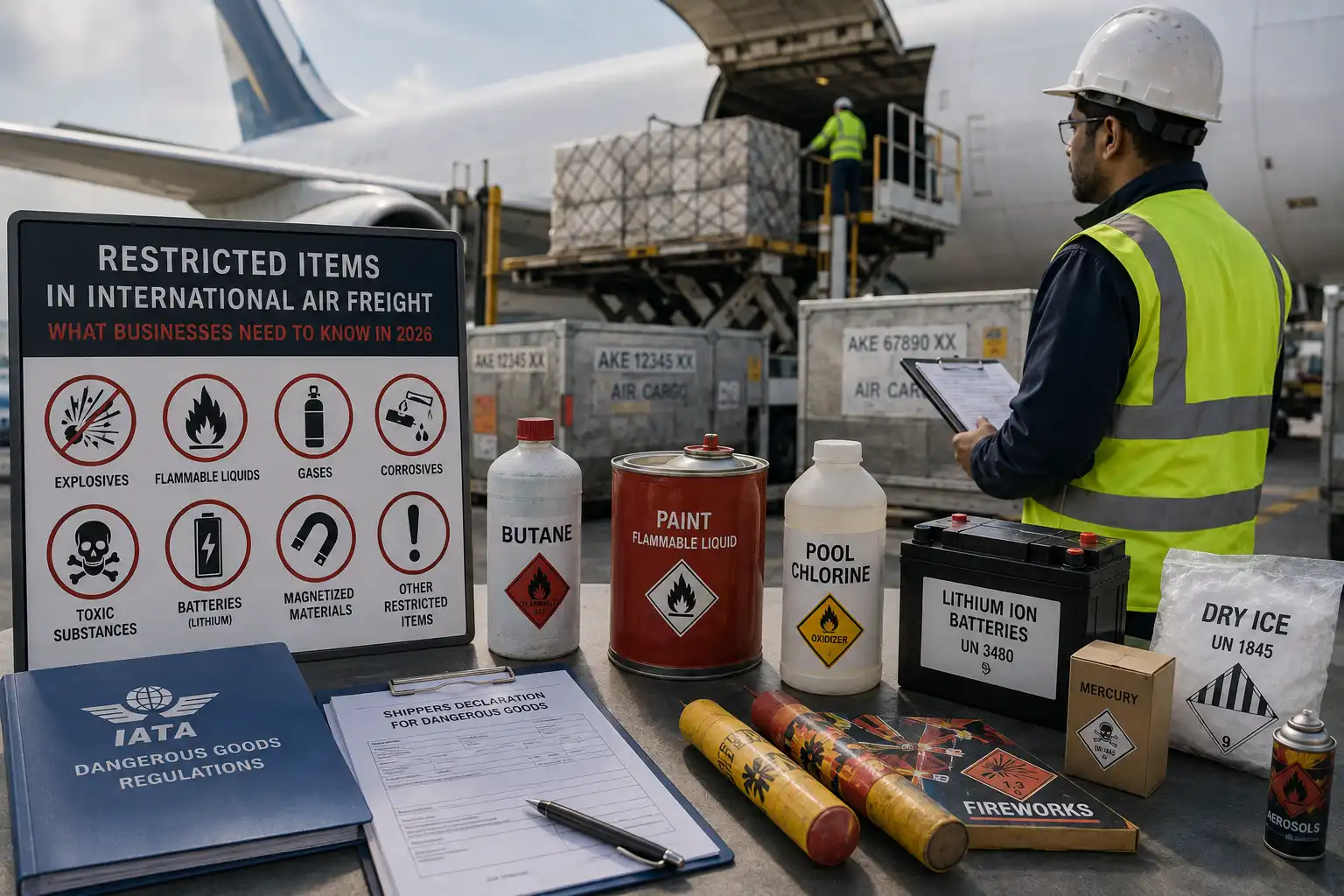
Restricted Items in International Air Freight: What Businesses Need to Know in 2026
Quick Answer: Restricted items in air freight include goods that create fire, explosion, pressure, toxicity, corrosive, radiation or other aviation risks. Many are not completely prohibited, but can travel only when correctly classified, packed, labelled, documented and accepted by the airline. Some dangerous goods are forbidden under normal circumstances or require specific State approval or exemption. Carrier restrictions can also be stricter than the general regulations.
Key Takeaways
- Restricted cargo and prohibited cargo are not the same thing.
- Dangerous goods may travel by air when the applicable regulatory conditions are satisfied.
- The 2026 IATA Dangerous Goods Regulations is the 67th Edition, effective from 1 January to 31 December 2026.
- India introduced the Aircraft (Carriage of Dangerous Goods) Rules, 2026, replacing the earlier 2003 framework.
- Airlines can impose operator-specific restrictions beyond the baseline rules.
Air freight is often chosen when businesses need speed, but not every product can simply be packed into a carton and booked on the next flight.
Aerosols, batteries, industrial chemicals, gases, certain pharmaceuticals and other products may fall under dangerous-goods regulations. Other items may be accepted only on cargo aircraft, within quantity limits or after specific approvals.
Understanding restricted items in air freight before booking helps exporters avoid rejected cargo, repacking, documentation changes and missed uplift.
What Are Restricted Items in Air Freight?
A restricted item is cargo that cannot be transported as ordinary general freight because its properties, quantity, packaging or regulatory status require special controls.
Some restricted goods are classified as dangerous goods, or DG. Others may face limitations because of airline policy, security requirements, destination-country rules or commodity-specific controls.
Air transport regulations distinguish between:
- Dangerous goods permitted under specified conditions
- Dangerous goods permitted only with additional approval
- Goods forbidden under normal circumstances
- Items prohibited from air transport entirely under the applicable conditions
ICAO states that dangerous goods can be transported safely by air when all requirements in its Technical Instructions are fulfilled. Goods identified as forbidden in normal circumstances may only move where the rules provide for State approval or an exemption. The current ICAO Technical Instructions are the 2025–2026 Edition, valid until 31 December 2026.
Common Restricted Items in International Air Freight
The exact classification must be determined for the individual product, but common categories include:
| Cargo Category | Why Air Transport May Be Restricted |
| Lithium and sodium-ion batteries | Fire and thermal-runaway risk |
| Flammable liquids | Ignition and vapour hazards |
| Aerosols | Flammable contents and pressurised containers |
| Compressed gases | Pressure and leakage hazards |
| Corrosive chemicals | Risk to aircraft, cargo and personnel |
| Toxic substances | Exposure hazard |
| Oxidising substances | Can intensify combustion |
| Organic peroxides | Thermal instability or reactivity |
| Infectious substances | Biological hazard |
| Radioactive materials | Radiation risk and specialised controls |
| Dry ice | Carbon dioxide gas accumulation |
| Magnetised material | Potential interference concerns when above permitted limits |
Whether a particular shipment is acceptable depends on factors such as UN number, hazard class, packing group where applicable, quantity, packing instruction and whether it is travelling on a passenger aircraft or cargo aircraft.
Lithium Batteries Need Particular Attention in 2026
Battery shipments are one of the most closely controlled areas of modern air cargo.
The 2026 IATA regulations include updated battery provisions, including requirements affecting lithium-ion, lithium-metal and sodium-ion batteries. IATA’s 2026 battery guidance is based on the ICAO 2025–2026 Technical Instructions and the 67th Edition of the IATA Dangerous Goods Regulations.
Businesses should identify:
- battery chemistry
- watt-hour rating or lithium content
- whether batteries are shipped alone, packed with equipment or contained in equipment
- applicable UN number
- test-status requirements
- state-of-charge requirements where applicable
- permitted quantity
- package and label requirements
A product containing a battery is not automatically general cargo simply because the battery is installed inside equipment.
Can Dangerous Goods Be Shipped by Air?
Yes, many dangerous goods can be shipped through professional air freight services, provided every applicable condition is met.
A compliant shipment may require:
Correct Classification
The shipper must determine the correct UN number, Proper Shipping Name, hazard class and packing group where applicable.
The current Safety Data Sheet can assist with chemical-product information, but the shipper remains responsible for correct transport classification.
Approved Packaging
Dangerous goods must follow the applicable packing instruction.
Depending on the commodity, this may specify:
- permitted inner packaging
- outer packaging type
- maximum quantity
- absorbent or cushioning requirements
- pressure resistance
- closure method
Marks and Labels
Required information can include:
- UN number
- Proper Shipping Name where applicable
- hazard labels
- handling labels
- package-orientation arrows
- battery marks or other specific markings
Airline Acceptance
Even when the IATA DGR permits a shipment, an individual airline may impose stricter operator variations. IATA specifically maintains operator variations within the DGR framework.
This means routing should be confirmed before cargo is packed around an assumed carrier.
Why Do Airlines Restrict Certain Cargo?
Aircraft present a different risk environment from trucks or ships.
Cargo is transported in an enclosed aircraft where pressure, altitude, temperature, fire detection, firefighting capability and access during flight are very different from surface transport.
A damaged battery, leaking chemical or pressurised cylinder therefore requires controls designed specifically for aviation.
Restrictions are intended to prevent hazards such as:
- fire
- uncontrolled chemical reactions
- toxic exposure
- leakage
- pressure-related failure
- incompatible substances interacting
- damage to aircraft systems or structure
The goal is not simply to restrict commerce. It is to make permitted dangerous-goods movements compatible with aviation safety.
What Documents Are Required for Restricted Air Cargo?
Documentation varies by product, origin, destination and airline.
A restricted or DG shipment may require:
- Shipper’s Declaration for Dangerous Goods, where required
- commercial invoice
- packing list
- air waybill information
- current Safety Data Sheet for classification or airline review where requested
- permits, approvals or exemptions for specifically controlled goods
- battery test documentation where applicable
- other commodity or destination-specific certificates
Documentation must match the physical package. A correct declaration cannot compensate for incorrect packaging or labelling.
Air Freight Compliance for Indian Exporters in 2026
Indian shippers should now account for the Aircraft (Carriage of Dangerous Goods) Rules, 2026, published under the Bharatiya Vayuyan Adhiniyam, 2024. The 2026 rules supersede the Aircraft (Carriage of Dangerous Goods) Rules, 2003 and apply to relevant operators, shippers and agents involved in air transport to, from, within or over India.
For exporters shipping through major air-cargo gateways such as Mumbai and Delhi, compliance therefore needs to cover both international dangerous-goods requirements and applicable Indian aviation rules.
Businesses should verify the latest requirements before each shipment because carrier acceptance policies, State variations and regulatory addenda can change.
Industry Insight: What We See Before a Restricted Cargo Booking
When businesses approach us for international freight forwarding, one of the most common questions we hear is, “Can this product go by air?”
In our experience, the answer usually cannot be given from the commercial product name alone.
We first need to understand the composition, SDS where relevant, UN classification, quantity, packaging and destination.
One recurring issue we notice is that businesses book the flight first and investigate the DG requirements afterwards. That can create problems if the selected airline does not accept the commodity or if the package needs to be rebuilt.
We also see shipments described simply as “electronics” without considering the lithium batteries inside them. Correct identification early in the process usually makes routing and packing decisions much clearer.
Common Air Freight Compliance Mistakes
Businesses should avoid:
- declaring DG cargo as general cargo
- relying on an outdated SDS
- using the wrong UN number or Proper Shipping Name
- assuming sea-freight packaging automatically works for air freight
- ignoring airline operator variations
- exceeding package quantity limits
- using incorrect battery classifications
- applying incomplete marks or labels
- booking before confirming carrier acceptance
- assuming every restricted item is completely prohibited
How to Choose a Freight Forwarder for Restricted Air Cargo
A provider handling restricted cargo should understand both operational freight forwarding and dangerous-goods requirements.
Useful capabilities include:
- DG document review
- UN-approved packing coordination
- marking and labelling
- airline acceptance checks
- routing selection
- customs support
- door-to-door air freight
- temperature-controlled cargo where required
- multimodal alternatives when air carriage is not permitted
The forwarder should ask technical questions before issuing a final routing recommendation.
Why FAK Cargo
FAK Worldwide provides international air freight services through dedicated air-freight teams in Mumbai and Delhi. Its published capabilities include worldwide door-to-door air freight, Next Flight Out routing, customs support, temperature-controlled handling and DGR-certified professionals supporting UN-approved dangerous-goods packing and transport.
FAK Packers also provides hazardous-solid and liquid packing, UN-approved packaging, marking, labelling and palletisation for air and sea shipments.
These services allow restricted cargo requirements to be considered alongside the wider international freight forwarding plan.
Conclusion
Understanding restricted items in air freight starts with recognising that “restricted” does not always mean “prohibited”. Many products can move safely by air, but only when classification, packing, documentation, airline acceptance and regulatory requirements align.
If your business needs to move batteries, chemicals or other controlled products internationally, FAK Cargo can review the cargo details and help coordinate compliant air freight services and suitable routing before shipment.
FAQs
Q1. What items are restricted in international air freight?
A. Restricted items can include lithium batteries, flammable liquids, aerosols, gases, corrosives, toxic chemicals, oxidisers, radioactive materials and other dangerous goods. Acceptance depends on classification, quantity, packaging, aircraft type, route and airline rules.
Q2. Can dangerous goods be shipped by air?
A. Yes. Many dangerous goods may travel by air when correctly classified, packed, marked, labelled, documented and accepted under the applicable regulations. Some goods are forbidden under normal circumstances or require additional approval.
Q3. Why do airlines restrict certain cargo?
A. Airlines restrict cargo because certain substances can create fire, pressure, toxicity, corrosion or other risks to the aircraft and occupants. Aviation regulations control these hazards through packaging, quantity, handling and acceptance requirements.
Q4. What documents are required for restricted air freight shipments?
A. Requirements vary, but they may include a Shipper’s Declaration for Dangerous Goods, air waybill information, invoice, packing list, SDS and product-specific permits or supporting documents.
Q5. How can businesses ensure compliance with air freight regulations?
A. Classify the cargo correctly, use the current 2026 regulatory requirements, follow the applicable packing instruction, prepare accurate labels and documents, check airline variations and confirm carrier acceptance before dispatch.

Leave a Reply