
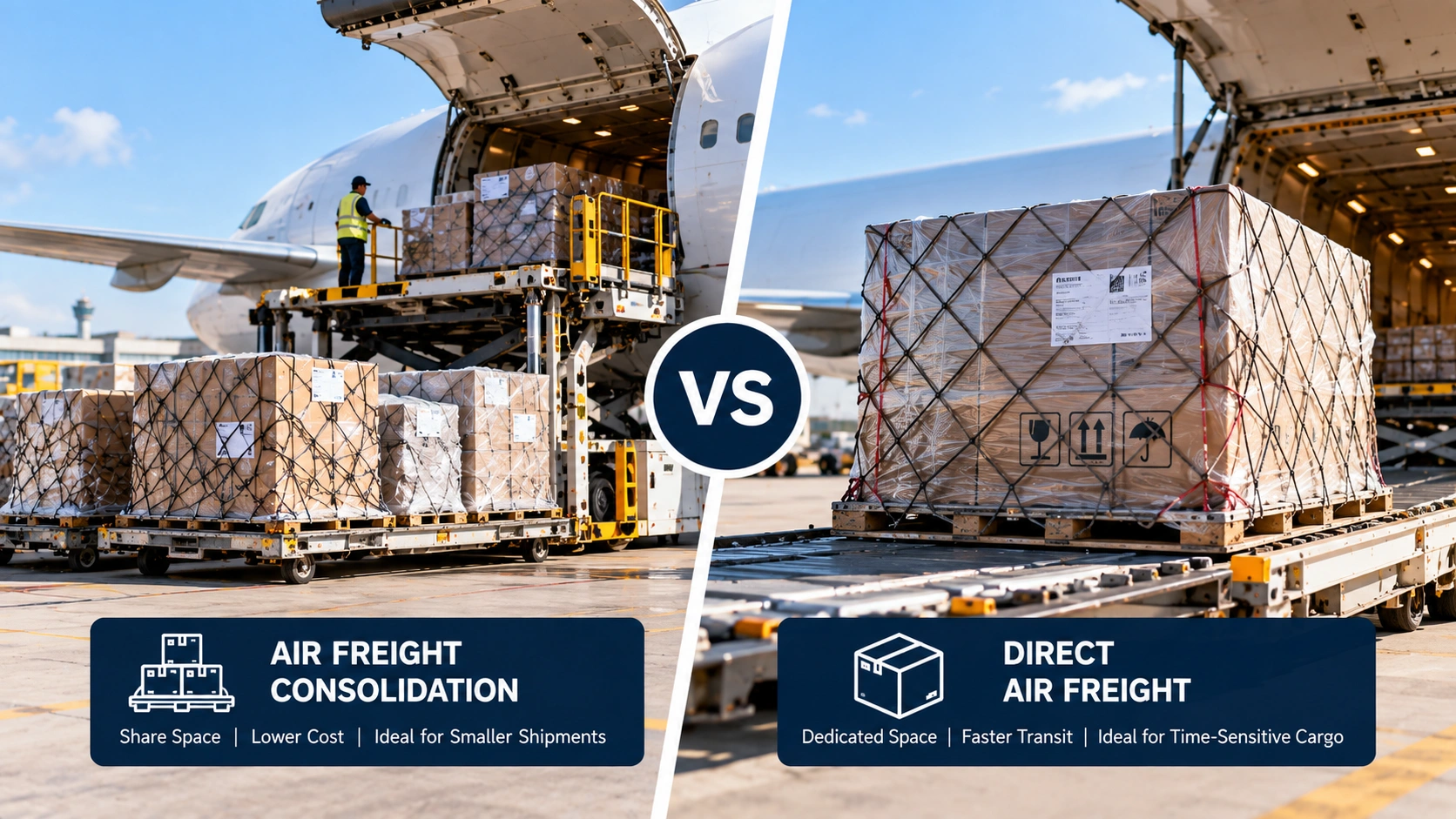
Air Freight Consolidation vs Direct Air Freight: Which Should Your Business Choose?
Quick Answer: Air freight consolidation is generally suitable for smaller shipments where sharing cargo space can help manage transportation costs, while direct air freight is often preferred when speed, dedicated handling, or shipment control is the priority. The right option depends on cargo volume, urgency, destination, handling requirements, shipment frequency, and total logistics cost. Businesses should compare the complete movement rather than choosing solely on the quoted freight rate.
Key Takeaways
- Air freight consolidation combines compatible shipments from multiple shippers into a consolidated movement.
- Direct air freight provides a more dedicated transportation arrangement and can be suitable for urgent or high-priority cargo.
- Consolidation can make air transportation more practical for smaller shipments.
- Direct freight may be preferable when delivery timelines and shipment control are critical.
- Cargo characteristics, destination, schedule, and total logistics cost should guide the decision.
Introduction
Air freight is often selected when businesses need faster international cargo movement than conventional sea freight can provide. However, choosing air transportation is only the first decision. Exporters and businesses also need to determine how their shipment should move.
Two common approaches are air freight consolidation and direct air freight. Both can support international shipments, but they serve different operational requirements.
For businesses using air freight services, the better option depends on more than shipment size. Cargo urgency, destination, handling requirements, documentation, flight schedules, and overall logistics costs can all influence the decision.
What Is Air Freight Consolidation?
Air freight consolidation involves combining compatible shipments from multiple shippers into a consolidated cargo movement. Instead of each shipper arranging an individual movement for a smaller consignment, cargo can be grouped to improve the utilisation of available air freight capacity.
The consolidated cargo is then managed through the required forwarding and handling processes before being separated for delivery at the destination.
When Is Air Freight Consolidation Suitable?
Air freight consolidation can be considered when:
- The shipment is relatively small.
- The cargo does not require a dedicated movement.
- Cost efficiency is important.
- The shipment can work with the available consolidation schedule.
- Delivery requirements allow some flexibility in routing or handling.
For example, an exporter with several cartons of commercial goods may not need to arrange a dedicated air freight movement. Consolidation can provide access to air transportation without requiring the business to utilise an entire shipment arrangement independently.
What Is Direct Air Freight?
Direct air freight refers to arranging transportation for a shipment without combining it with other shippers’ cargo as part of a consolidation programme.
This approach can provide greater control over the movement and may be more appropriate for cargo where timing, handling, or routing requirements are particularly important.
When Is Direct Air Freight Suitable?
Direct air freight may be considered when:
- Cargo is time-sensitive.
- The shipment requires greater control.
- The cargo volume justifies the arrangement.
- The destination has suitable direct flight connectivity.
- The shipment has specific handling requirements.
- Delays or additional handling could significantly affect operations.
For example, a business waiting for a critical replacement component may prioritise speed and predictability over the potential savings offered through consolidation.
Air Freight Consolidation vs Direct Air Freight: What Is the Difference?
| Factor | Air Freight Consolidation | Direct Air Freight |
| Cargo arrangement | Combined with other shipments | More dedicated shipment arrangement |
| Typical suitability | Smaller or less urgent consignments | Urgent or priority shipments |
| Cost approach | Can improve cost efficiency for smaller cargo | Can involve higher transportation cost |
| Scheduling | Based on consolidation availability | Greater flexibility depending on routing |
| Handling | Additional consolidation/deconsolidation processes may apply | More direct cargo movement |
| Control | Shared movement | Greater control over shipment planning |
| Best suited for | Cost-conscious shipments with flexible timelines | Time-sensitive or specialised requirements |
The table provides a general comparison, but actual suitability depends on the shipment and available routing.
Which Is More Cost-Effective?
The answer depends on the shipment.
For smaller consignments, air freight consolidation can be a practical way to manage transportation costs because cargo space is shared. Direct air freight may become more appropriate when the value of faster or more controlled transportation outweighs the additional cost.
Businesses should consider the complete cost, including:
- Origin handling
- Pickup and delivery
- Freight charges
- Consolidation or deconsolidation
- Documentation
- Customs-related requirements
- Storage
- Destination handling
- Potential delay-related costs
A lower initial freight quote does not necessarily mean a lower total logistics cost.
Which Option Is Faster?
Direct air freight may provide greater scheduling flexibility, but actual transit time depends on factors such as flight availability, routing, connections, airport handling, customs clearance, and destination delivery.
Consolidated shipments may operate according to scheduled consolidation cycles. This can make them suitable for businesses that need air transportation but have some flexibility around exact shipment timing.
For urgent cargo, businesses should compare the complete door-to-door transit requirement, rather than looking only at flight time.
How Does Cargo Type Affect the Choice?
Cargo characteristics can significantly influence the appropriate shipping arrangement.
High-value, fragile, temperature-sensitive, oversized, or regulated goods may require additional planning and specialised handling. Documentation and applicable regulatory requirements must also be considered before selecting the shipping method.
For chemical or dangerous goods, the shipment should be assessed for applicable air transport requirements, packaging, documentation, and handling procedures before booking.
This is where experienced international freight forwarding services can help coordinate the different stages of the movement.
What Should Indian Exporters Consider?
Indian exporters should consider their origin location, airport connectivity, destination, cargo profile, customs requirements, and required delivery timeline.
Major international air cargo gateways such as Mumbai, Delhi, Bengaluru, Hyderabad, and Chennai offer different connectivity and handling options. The appropriate gateway depends on the shipment’s origin, destination, airline availability, and cargo requirements.
Exporters should also consider whether consolidation schedules align with their production, warehouse, and customer delivery timelines.
Industry Insight
From a logistics planning perspective, we do not treat consolidation and direct air freight as a simple choice between cheap and expensive transportation.
We first look at the shipment requirement. Cargo volume, urgency, destination, handling needs, and available flight options all influence the decision. For a smaller shipment with a reasonable delivery window, consolidation can make sense. For cargo where timing or handling control is more important, a more direct arrangement may be preferable.
The objective is to select the transportation model that fits the complete supply-chain requirement, rather than optimising only one part of the shipment.
Common Mistakes When Choosing Air Freight
Businesses should avoid:
- Selecting the cheapest freight option without comparing total costs.
- Assuming consolidation is always slower.
- Assuming direct freight is always the fastest option.
- Ignoring airport and flight connectivity.
- Not accounting for consolidation schedules.
- Overlooking cargo-specific handling requirements.
- Failing to plan customs and documentation requirements.
- Comparing freight rates without considering door-to-door costs.
How Should Your Business Choose?
Before booking air cargo, evaluate:
- Shipment size: Is the cargo large enough to justify a more dedicated arrangement?
- Urgency: How quickly must it reach the consignee?
- Destination: What flight and routing options are available?
- Cargo type: Are there special handling or regulatory requirements?
- Schedule: Can the shipment work with a consolidation cycle?
- Total cost: What are the origin, freight, handling, customs, and delivery costs?
- Risk: How much control and predictability does the shipment require?
A freight forwarding partner can evaluate these factors and recommend a suitable transportation arrangement.
Why FAK Cargo?
FAK Cargo provides air freight services and international freight forwarding support for businesses managing domestic and international cargo movements.
Its broader logistics capabilities include freight forwarding, multimodal transportation, export packing, port agency, ISO tank logistics, and DG and chemical cargo handling, allowing shipment requirements to be considered as part of the wider supply chain.
Key Takeaway
There is no universal winner between air freight consolidation and direct air freight. Consolidation can be suitable for smaller shipments where cost efficiency and schedule flexibility matter, while direct arrangements can be more appropriate when timing, control, or specialised requirements take priority.
The best choice is the one that balances cost, transit requirements, cargo handling, reliability, and operational needs. Businesses planning an international shipment can assess these factors before selecting the appropriate air freight solution.
FAQs
Q1. What is air freight consolidation?
A. Air freight consolidation combines compatible shipments from multiple shippers into a consolidated cargo movement, allowing smaller consignments to share transportation capacity.
Q2. Is air freight consolidation cheaper than direct air freight?
A. It can be more cost-effective for smaller shipments, but the total cost depends on freight rates, handling, consolidation, documentation, and delivery requirements.
Q3. Which is faster, consolidated or direct air freight?
A. Direct arrangements may offer greater scheduling flexibility, but actual transit time depends on flight availability, routing, handling, customs clearance, and delivery.
Q4. When should a business choose direct air freight?
A. Direct air freight may be suitable for urgent, high-priority, specialised, or time-sensitive cargo where greater control over the shipment is important.
Q5. Can a freight forwarder help choose between the two?
A. Yes. A freight forwarder can assess cargo volume, urgency, destination, routing, handling requirements, and total logistics costs to determine a suitable option.
Related posts
Pharmaceutical Cold Chain Logistics: How to Protect Temperature-Sensitive Air Cargo
Learn how pharmaceutical cold chain logistics protects temperature-sensitive air
Restricted Items in International Air Freight: What Businesses Need to Know in 2026
Quick Answer: Restricted items in air freight include goods that create fire, ex