
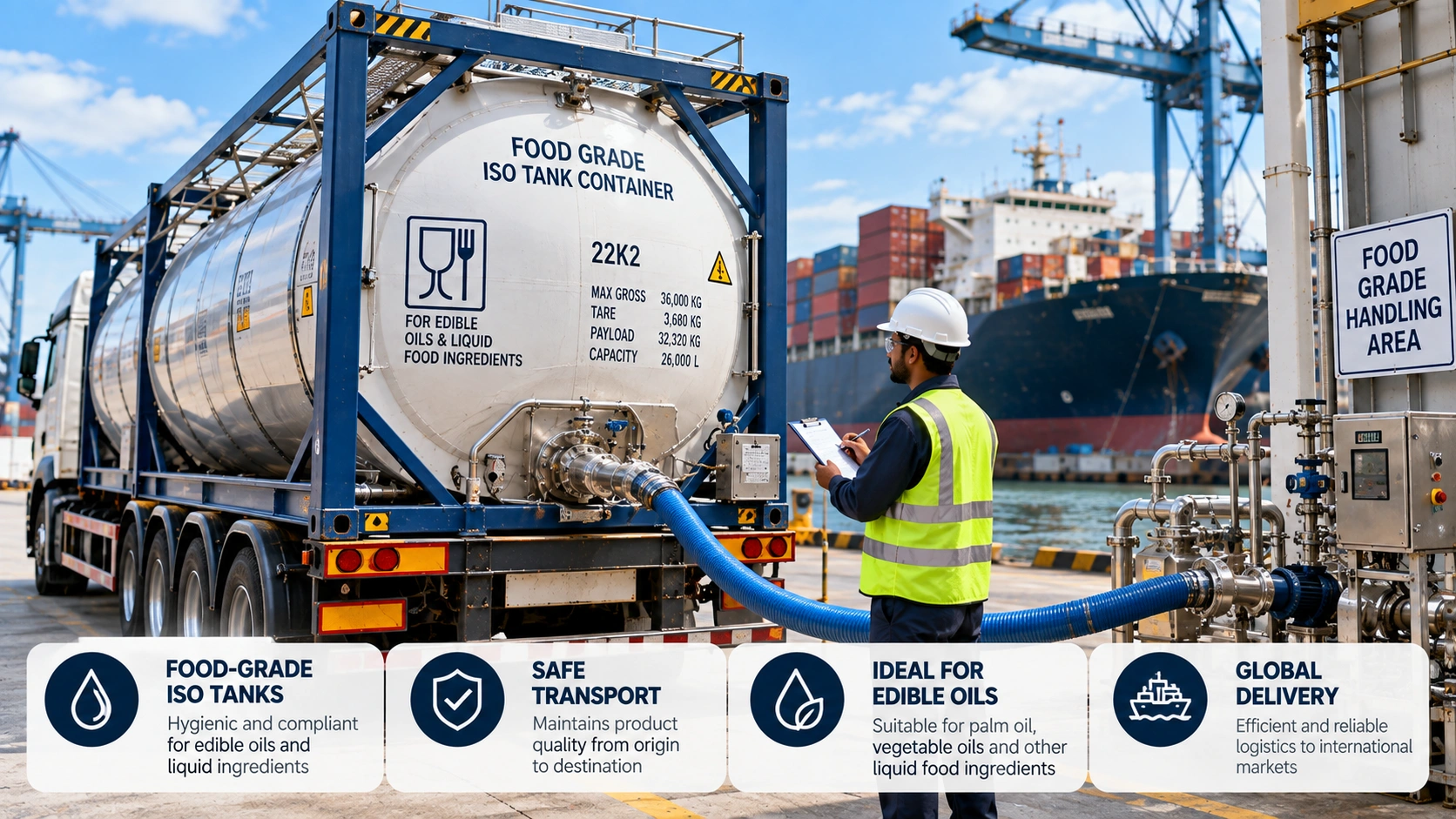
Food-Grade ISO Tank Logistics: How to Ship Edible Oils and Liquid Ingredients Safely
Quick Answer: A food-grade ISO tank is designed for transporting bulk liquid food products such as edible oils, syrups, liquid ingredients, and other suitable food-grade liquids while maintaining hygienic handling standards. Safe transportation depends on using the right tank specification, proper cleaning and inspection, compatible handling equipment, secure loading, temperature control where required, and appropriate documentation.
For exporters and manufacturers, working with an experienced logistics partner helps coordinate tank preparation, transportation, port handling, and other shipment requirements as one process.
Key Takeaways
- Food-grade ISO tanks are suitable for certain bulk liquid food products and can reduce the need for repeated intermediate handling.
- Tank cleanliness, product compatibility, and loading procedures are critical for protecting food quality.
- Temperature requirements must be considered for products that become viscous or solidify under certain conditions.
- Exporters need to coordinate documentation, port processes, container handling, and destination requirements.
- A logistics provider with experience in ISO tank logistics can help manage the shipment from origin to destination.
Why Are Food-Grade ISO Tanks Used for Edible Oils and Liquid Ingredients?
Transporting edible oils and liquid ingredients in drums, cans, flexitanks, or smaller containers can involve multiple handling points. Bulk transportation in a suitable ISO tank can provide a different operating model, particularly for larger commercial shipments.
A food-grade ISO tank provides a standardised container format that can be moved through established intermodal transport networks. Depending on the product and tank configuration, it can support movement by road, rail, and sea without transferring the liquid between different primary transport containers.
This can be particularly useful for manufacturers, ingredient suppliers, exporters, and importers handling recurring bulk liquid movements.
What Makes an ISO Tank Suitable for Food-Grade Cargo?
Not every ISO tank should be used for food products. The tank and its handling process need to be appropriate for the cargo being transported.
1. Product Compatibility
The tank’s construction, internal condition, fittings, seals, valves, and other components should be suitable for the specific product.
For example, an edible oil may have different handling requirements from a water-based liquid ingredient or a viscous syrup.
2. Cleaning and Hygiene
A tank used for food-grade cargo needs appropriate cleaning and preparation before loading. Residues from a previous cargo can create contamination risks or affect product quality.
Cleaning requirements should therefore be established based on the previous cargo, current product, tank operator’s procedures, and applicable customer requirements.
3. Temperature Requirements
Some liquid food products can become more viscous or difficult to pump when temperatures fall. In such cases, the shipper needs to assess whether heating or temperature management is required during loading, transportation, or discharge.
Temperature requirements should be determined by the characteristics of the actual product rather than applying a standard assumption to all liquid food cargo.
How Does Food-Grade ISO Tank Logistics Work?
A typical shipment involves several coordinated stages:
Product assessment → Tank selection → Cleaning and inspection → Loading → Inland transportation → Port handling → Ocean transportation → Destination handling → Discharge
The exact process varies depending on the product, origin, destination, transport mode, and tank operator.
Example: Bulk Edible Oil Export
Consider an Indian manufacturer exporting bulk edible oil to an overseas buyer.
Instead of packing the product into numerous smaller units, the exporter may use an appropriately specified food-grade ISO tank. Before loading, the tank is checked and prepared. The product is then loaded according to the agreed procedures, transported to the export gateway, handled as a containerised shipment, and moved to the destination.
At the receiving end, the buyer can discharge the product into suitable storage or processing infrastructure.
The important point is that the logistics plan needs to consider the entire movement, not just the ocean leg.
Food-Grade ISO Tank vs Other Bulk Liquid Transport Options
| Factor | Food-Grade ISO Tank | Drums/Smaller Containers | Flexitank |
| Typical use | Suitable bulk liquid movements | Smaller packaged quantities | Bulk liquid in compatible dry containers |
| Reusability | Reusable equipment | Packaging-based | Generally single-use liner |
| Handling | Standardised tank handling | More individual handling | Requires compatible container and setup |
| Temperature management | Possible depending on tank | Product-dependent | Product-dependent |
| Intermodal movement | Well suited | Possible but more handling | Primarily container-based |
| Best fit | Recurring or larger bulk liquid movements | Packaged shipments | Suitable compatible non-hazardous bulk liquids |
The right option depends on cargo characteristics, shipment size, handling infrastructure, destination requirements, and total logistics cost.
What Are the Business Benefits?
For suitable cargo, food-grade ISO tank logistics can help businesses structure bulk liquid movements more efficiently.
Potential operational advantages include:
- Reduced repeated handling: The product can remain within the transport tank through multiple stages.
- Standardised transportation: ISO tank dimensions support containerised logistics.
- Bulk movement: Businesses can evaluate bulk transportation instead of relying entirely on smaller packages.
- Operational efficiency: Fewer individual packages can simplify certain loading and unloading processes.
- Better shipment planning: Recurring exporters can establish consistent tank and transportation procedures.
However, the lowest packaging or freight cost does not automatically mean the lowest overall logistics cost. Tank availability, cleaning, positioning, inland movement, port charges, heating requirements, discharge infrastructure, and repositioning should all be considered.
India-Specific Considerations for Food-Grade ISO Tank Shipments
For Indian exporters, the logistics plan may involve inland transportation from the manufacturing or storage location to a suitable port, followed by ocean transportation to the destination market.
Major container gateways such as JNPT/Nhava Sheva, Mundra, and Chennai may feature in export logistics depending on the shipment’s origin, carrier options, destination, and routing.
Exporters should confirm:
- Product and tank compatibility
- Cleaning and inspection requirements
- Loading and discharge facilities
- Inland transportation arrangements
- Port and carrier requirements
- Export documentation
- Destination-country requirements
- Any applicable food-safety or product-specific requirements
The exact requirements should always be confirmed for the specific product and trade lane rather than assumed from another shipment.
Industry Insight
In ISO tank logistics, the tank itself is only one part of the shipment. The real challenge is coordinating the product, equipment, inland movement, port handling, documentation, and discharge requirements without creating avoidable delays.
For food-grade cargo, we would start with the product rather than simply asking which tank is available. Understanding the liquid’s characteristics, handling conditions, required cleanliness, loading method, and destination requirements helps determine the appropriate logistics plan.
This approach is particularly important when a business is moving from smaller packaged shipments to bulk liquid transportation services.
Common Mistakes to Avoid
- Selecting a tank based only on availability: Equipment should be appropriate for the product and handling requirements.
- Ignoring previous cargo: Tank cleanliness and preparation need proper attention.
- Underestimating temperature requirements: Some products require specific temperature management for efficient pumping and discharge.
- Planning only the ocean leg: Inland transportation and port handling can significantly affect the shipment.
- Not checking destination requirements: Importer, carrier, terminal, and destination requirements may differ.
- Treating all food-grade liquids the same: Edible oils, syrups, and other liquid ingredients can have different handling characteristics.
How to Choose and Implement Food-Grade ISO Tank Logistics
Before confirming a shipment, businesses should review:
- Product: What exactly is being transported?
- Volume: Is bulk tank transportation commercially suitable?
- Tank: Is the equipment appropriate for the product?
- Cleanliness: What preparation and inspection are required?
- Temperature: Does the product require controlled conditions?
- Loading: Is suitable infrastructure available at origin?
- Transport: Can inland and ocean legs be coordinated?
- Discharge: Can the destination facility receive the product efficiently?
- Documentation: Are all shipment and product documents in place?
- Destination: Have importer and destination-country requirements been confirmed?
Why FAK Cargo?
FAK Cargo works across logistics and supply-chain requirements including ISO tank logistics, freight forwarding, multimodal transportation, export packing, port agency, and specialised cargo movements.
For suitable food-grade bulk liquid shipments, these capabilities can help coordinate the different stages of the movement rather than treating tank transportation as an isolated service.
Key Takeaway
A food-grade ISO tank can be an effective option for transporting suitable edible oils and liquid ingredients in bulk, but successful execution depends on more than selecting a tank. Product compatibility, cleanliness, temperature requirements, inland movement, port handling, documentation, and destination discharge all need to be planned together.
If you are evaluating bulk liquid transportation services for an upcoming shipment, discuss the product, volume, origin, destination, and handling requirements with a logistics specialist before finalising the transport plan.
FAQs
Q1. What is a food-grade ISO tank?
A. A food-grade ISO tank is an ISO tank configured and prepared for transporting suitable food-grade liquid products while meeting applicable hygiene and handling requirements.
Q2. Can edible oil be transported in an ISO tank?
A. Yes, suitable edible oils can be transported in appropriately specified food-grade ISO tanks, subject to product compatibility and handling requirements.
Q3. What liquids can be shipped in food-grade ISO tanks?
A. Suitable products can include certain edible oils, syrups, liquid food ingredients, and other compatible bulk food liquids. The tank must be appropriate for the specific product.
Q4. Does food-grade ISO tank transportation require temperature control?
A. Not always. The requirement depends on the product’s physical characteristics and the temperatures needed for loading, transportation, and discharge.
Q5. How do I select ISO tank logistics for my shipment?
A. Assess the product, volume, tank compatibility, cleaning requirements, temperature conditions, loading and discharge facilities, transport route, documentation, and destination requirements before selecting the logistics solution.
Related posts
How to Choose the Right ISO Tank for Different Chemical Products
Quick Answer: Choosing the correct ISO tank for chemicals starts with the chemic
How ISO Tanks are Transported from Factory to Indian Ports
Moving bulk liquid cargo safely from a manufacturing facility to an internationa
What Is DG Cargo? A 2026 Guide to Dangerous Goods Transportation
Quick Answer: DG cargo means goods classified as dangerous for transport because