
What Is DG Cargo? A 2026 Guide to Dangerous Goods Transportation
Quick Answer: DG cargo means goods classified as dangerous for transport because their physical, chemical or biological properties can present risks to people, property or the environment. Examples include flammable liquids, gases, corrosive chemicals, batteries and toxic substances. Safe dangerous goods transportation requires correct classification, approved packaging, marking and labelling, documentation, trained personnel and compliance with rules applicable to road, sea or air transport.
Key Takeaways
- Dangerous goods are classified into nine hazard classes under the UN framework.
- A product’s UN number, Proper Shipping Name, hazard class and packing group, where applicable, determine many transport requirements.
- Packaging, labels, placards, documentation and segregation must match the specific cargo and mode of transport.
- The IMDG Code Amendment 42-24 is mandatory for packaged dangerous goods transported by sea from 1 January 2026.
- Businesses should identify DG requirements before booking transport, not after cargo reaches the warehouse or port.
Businesses regularly move products that seem ordinary in commercial use but are regulated during transport. Paints, solvents, industrial chemicals, compressed gases, lithium batteries and cleaning products can all fall within dangerous-goods rules depending on their composition and properties.
For manufacturers, exporters and procurement teams, understanding DG cargo is therefore not limited to knowing whether a product is “hazardous”. The exact transport classification determines how it must be packed, documented, marked, handled, segregated and carried.
What Is DG Cargo and How Is It Classified?
Dangerous goods are substances or articles that present one or more transport hazards recognised under international dangerous-goods regulations.
The UN system groups dangerous goods into nine classes.
| DG Class | General Category | Common Examples |
| Class 1 | Explosives | Certain explosives and pyrotechnic articles |
| Class 2 | Gases | Compressed, liquefied or dissolved gases |
| Class 3 | Flammable liquids | Solvents, fuels, some paints |
| Class 4 | Flammable solids and related hazards | Certain reactive or self-heating substances |
| Class 5 | Oxidisers and organic peroxides | Oxidising chemicals, certain peroxides |
| Class 6 | Toxic and infectious substances | Toxic chemicals, certain infectious materials |
| Class 7 | Radioactive material | Regulated radioactive substances |
| Class 8 | Corrosive substances | Certain acids and alkalis |
| Class 9 | Miscellaneous dangerous goods | Various regulated substances and articles, including specified batteries |
The class alone is not enough to prepare a shipment.
A DG classification may also include:
- UN number: A four-digit identification number assigned to dangerous goods.
- Proper Shipping Name: The regulatory transport name for the substance or article.
- Subsidiary hazard: An additional risk presented by the cargo.
- Packing group: Where applicable, an indication of relative danger, generally Packing Group I, II or III.
- Marine pollutant status: Relevant to certain maritime shipments.
- Special provisions: Product-specific requirements or exceptions.
Correct classification is the foundation of compliant dangerous goods transportation.
Which Products Can Be Classified as Dangerous Goods?
DG cargo extends beyond chemicals that visibly appear dangerous.
Depending on composition, concentration, quantity and transport regulation, controlled products may include:
- industrial solvents
- paints and coatings
- acids and alkalis
- compressed gas cylinders
- aerosols
- pesticides and chemical intermediates
- lithium-ion and lithium-metal batteries
- certain adhesives and resins
- oxidising substances
- organic peroxides
- toxic chemicals
- certain environmentally hazardous substances
Businesses should not classify cargo based only on a commercial product name.
The Safety Data Sheet, particularly the transport information normally found in Section 14, is an important starting point. Classification should then be checked against the current regulations applicable to the intended mode and route.
How Is DG Cargo Transported Safely?
Safe DG logistics depends on several controls working together.
Correct Packaging
The packaging must be authorised for the specific dangerous good and transport conditions.
Depending on the product, this may involve drums, jerricans, combination packaging, intermediate bulk containers, pressure receptacles, portable tanks or other approved systems.
Packaging selection may depend on the hazard class, packing group, quantity and applicable packing instruction.
Accurate Marks, Labels and Placards
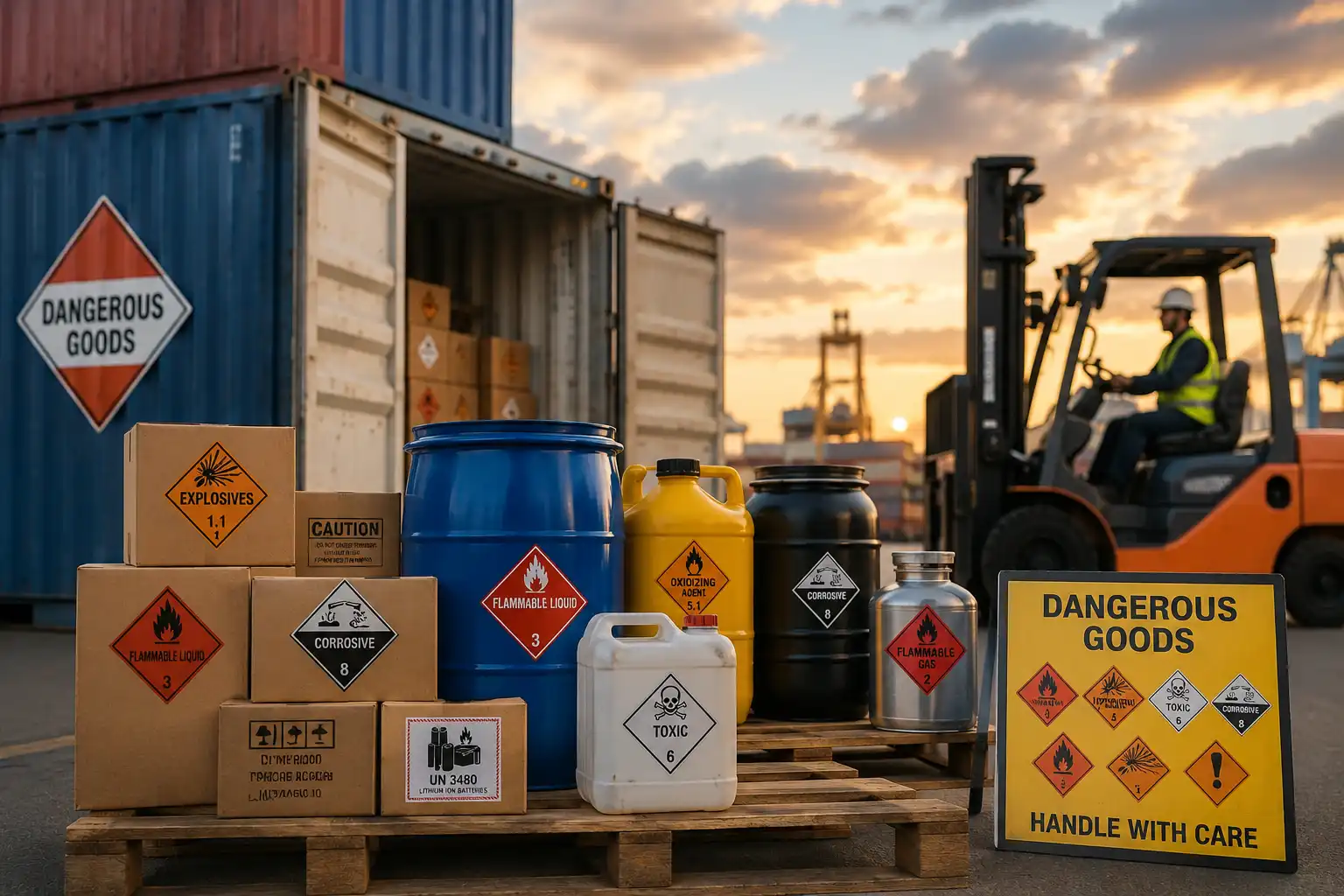
Packages containing dangerous goods generally require prescribed hazard labels and markings.
Depending on the shipment, these may include:
- UN number
- Proper Shipping Name where required
- hazard and subsidiary-risk labels
- orientation arrows
- environmentally hazardous substance marks
- specific battery marks
- overpack markings
Containers and transport units may also require placards and other identification.
Incorrect or missing labels can prevent cargo acceptance even if the physical packaging itself is suitable.
Proper Documentation
DG documentation communicates the nature of the hazard to carriers, ports, terminals, airlines and emergency responders.
The exact documents differ by mode and shipment, but accurate classification details must remain consistent across the transport chain.
Segregation and Stowage
Some dangerous goods must not be packed, loaded or stowed together because they can react dangerously if leakage or damage occurs.
For maritime shipments, the IMDG Code provides detailed requirements covering classification, packing, tank provisions, consignment procedures and transport operations. The 2024 Edition incorporating Amendment 42-24 became mandatory on 1 January 2026.
Which DG Cargo Regulations Apply in 2026?
The applicable framework depends heavily on transport mode.
DG Cargo by Sea
International maritime movements of packaged dangerous goods are governed by the International Maritime Dangerous Goods Code.
IMDG Amendment 42-24 is the mandatory edition from 1 January 2026.
Dangerous Goods by Air
Air transport follows the ICAO Technical Instructions for the Safe Transport of Dangerous Goods by Air. The 2025–2026 edition remains applicable through 31 December 2026.
The 67th edition of the IATA Dangerous Goods Regulations is effective from 1 January to 31 December 2026 and is the operational reference widely used by airlines, freight forwarders and shippers.
Air transport can impose different or more restrictive quantity, packaging and acceptance requirements than sea freight.
Dangerous Goods Transportation in India
Indian businesses also need to consider the domestic leg between factories, warehouses, ICDs, airports and seaports such as Nhava Sheva.
Under India’s Central Motor Vehicles Rules, consignors must provide the transporter with adequate and accurate information about dangerous or hazardous goods. Transporters have responsibilities relating to vehicle suitability, safety equipment and written information for drivers. The rules also provide for route planning and appropriately qualified drivers for covered dangerous-goods movements.
This means an export movement should be planned as one connected logistics chain.
A shipment travelling from an industrial plant in Gujarat to a port, for example, may need compliant road transport before it reaches the maritime leg governed by the IMDG Code.
Industry Insight: What We Often See With First-Time DG Shippers
When businesses approach us about DG cargo, one of the first questions we often hear is, “Can this product go as normal cargo?”
In our experience, the commercial description rarely gives enough information to answer that safely. We normally need the product details and applicable SDS before the transport requirements become clear.
One common issue we notice is DG classification being considered too late. The freight booking may already have been requested before packaging, labels or carrier acceptance requirements have been checked.
We also see businesses assume that a shipment accepted by sea can automatically move by air using the same packaging and quantities. That is not necessarily the case because modal requirements differ.
The most practical approach is to establish classification and transport mode first, then build packaging, documentation and routing around those requirements.
Common DG Cargo Mistakes Businesses Should Avoid
Recurring problems include:
- booking freight before confirming DG classification
- relying on an outdated SDS
- using commercial names instead of the correct Proper Shipping Name
- choosing packaging without checking the applicable instruction
- missing subsidiary-hazard labels
- incorrect or inconsistent documentation
- overlooking carrier-specific restrictions
- failing to consider segregation requirements
- treating the inland road journey separately from the international shipment
These issues can result in rejection, repacking, re-documentation or operational delays.
How to Choose a Dangerous Goods Logistics Partner
A capable provider of DG cargo logistics services should understand both freight forwarding and dangerous-goods compliance.
Useful capabilities include:
- classification-document review
- DG packing coordination
- marking and labelling support
- sea and air freight handling
- hazardous road-transport coordination
- ISO tank and bulk-liquid logistics
- port and terminal coordination
- multimodal transport planning
- carrier acceptance requirements
The logistics provider should ask detailed questions about the cargo rather than providing a freight quote based only on weight and destination.
Why FAK Worldwide for DG Logistics is a Perfect Solution for Your Business
FAK Worldwide provides freight forwarding, multimodal transportation, ISO tank logistics and chemical supply-chain services for industrial customers. The service includes hazardous chemical and bulk-liquid handling as well as export packing for DG solid and liquid products.
FAK Worldwide is also registered with DG Shipping in India as a Multimodal Transport Operator, allowing its dangerous-goods capabilities to sit within a broader road, sea, air and multimodal logistics offering.
For businesses requiring chemical logistics services alongside conventional DG cargo logistics services, this can help connect equipment, documentation and freight planning within one transport workflow.
Conclusion
DG cargo requires more than careful physical handling. Safe and compliant transport starts with accurate classification and continues through packaging, labelling, documentation, carrier acceptance, inland transport and international freight requirements.
If your business is planning a hazardous chemical, industrial or regulated shipment, speak with FAK Worldwide about the cargo classification, route and transport mode so the appropriate dangerous goods transportation process can be planned before dispatch.
FAQs
Q1. What is DG cargo?
A.DG cargo is cargo classified as dangerous for transport because it can present risks such as fire, explosion, toxicity, corrosion, pressure, radiation or other hazards. It must be transported according to the regulations applicable to its classification and transport mode.
Q2. Which products are classified as dangerous goods?
A.Dangerous goods can include explosives, gases, flammable liquids and solids, oxidisers, organic peroxides, toxic substances, infectious substances, radioactive materials, corrosives and miscellaneous regulated articles. Classification depends on the specific product and applicable regulations.
Q3. What regulations apply to DG cargo transportation?
A. The applicable rules depend on transport mode and jurisdiction. International sea freight uses the IMDG Code, while air cargo is governed by ICAO Technical Instructions with IATA DGR widely used operationally. Indian hazardous road transport is also subject to relevant Central Motor Vehicles Rules.
Q4. How is DG cargo transported safely?
A. Safe transport requires correct classification, approved packaging, accurate marking and labelling, compliant documentation, appropriate segregation, trained personnel and suitable vehicles or transport units.
Q5. Why should businesses use specialised DG cargo logistics services?
A. Specialised providers understand carrier acceptance, packaging, documentation, multimodal requirements and hazardous-cargo handling. This is valuable because DG rules differ by product, transport mode, route and carrier.
Related posts
Food-Grade ISO Tank Logistics: How to Ship Edible Oils and Liquid Ingredients Safely
Learn how food-grade ISO tank logistics supports safe bulk transport of edible o
How ISO Tanks are Transported from Factory to Indian Ports
Moving bulk liquid cargo safely from a manufacturing facility to an internationa
How to Choose the Right ISO Tank for Different Chemical Products
Quick Answer: Choosing the correct ISO tank for chemicals starts with the chemic