
How to Choose the Right ISO Tank for Different Chemical Products
Quick Answer: Choosing the correct ISO tank for chemicals starts with the chemical’s transport classification and physical properties. Check the UN number, Proper Shipping Name, hazard class, packing group where applicable, chemical compatibility, vapour pressure, loading temperature, density and discharge requirements. Then match these factors with the permitted portable-tank instruction, tank material, lining, valves, seals and valid inspection status.
Key Takeaway
- There is no universal ISO tank suitable for every chemical.
- Product classification and the applicable portable-tank instruction should be checked before equipment is allocated.
- Shell material, lining, gaskets, valves and seals must all be chemically compatible.
- Temperature, pressure, density and unloading requirements can change the tank specification.
- For sea shipments in 2026, IMDG Code Amendment 42-24 is the mandatory current edition.
Bulk chemical transport can look straightforward from a distance. Load the liquid into an ISO tank, move it by road to port, ship it overseas and deliver it to the consignee.
The difficult part happens before loading.
Selecting the wrong tank can create compatibility, contamination, operational or regulatory problems. Effective ISO tank logistics therefore begins with understanding the chemical and the complete transport journey, rather than assigning whichever tank happens to be available.
How Do You Choose the Right ISO Tank for Chemicals?
The correct tank is determined by the specific product and applicable dangerous-goods regulations.
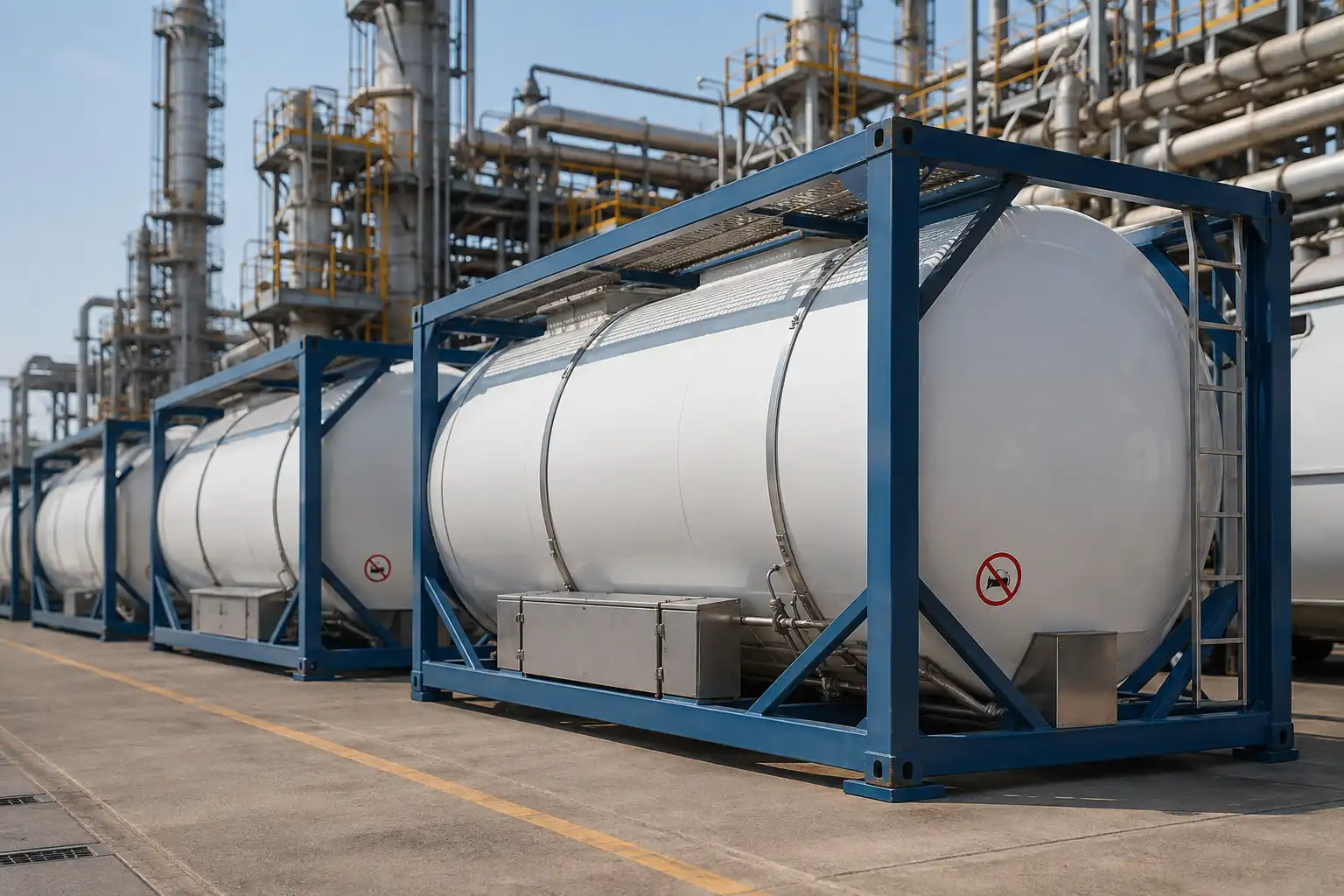
An ISO tank container is a portable tank mounted within a standard intermodal frame so that bulk liquids and certain gases can move by road, rail and sea without transferring the product between transport modes.
However, tanks differ in pressure ratings, openings, relief devices, linings, valves, insulation and other service equipment.
A practical selection process begins with five questions:
- What exactly is the chemical?
- How is it classified for transport?
- Is it compatible with the tank and service equipment?
- Does it require special pressure or temperature control?
- Can the same configuration be loaded, transported and discharged safely across the complete route?
Start With the SDS, UN Number and Dangerous Goods Classification
For hazardous chemicals, the Safety Data Sheet, or SDS, is an essential starting document.
The logistics team should establish details such as:
- UN number
- Proper Shipping Name
- hazard class and subsidiary hazard
- packing group, where assigned
- flash point
- density
- vapour pressure
- corrosivity
- viscosity
- transport temperature
- marine-pollutant status where relevant
The UN Model Regulations provide the international framework for dangerous-goods classification and portable-tank requirements. The latest 24th revised edition was published in 2025 and includes updated provisions affecting dangerous-goods transport and portable tanks.
For maritime transport, the Dangerous Goods List in the applicable IMDG Code must then be checked for the individual substance.
Understand What T11, T20 and T50 Actually Mean
Terms such as T11, T20 and T50 are frequently used in chemical logistics services, but they should not be treated simply as commercial tank categories.
They are portable tank instructions linked to regulatory requirements.
T11 and Liquid Chemicals
T11 is commonly encountered for certain liquid dangerous goods. It specifies requirements covering areas such as test pressure, shell thickness, openings and pressure-relief arrangements.
It is not a universal tank for all liquid chemicals.
The UN number and Dangerous Goods List entry must determine whether T11 is permitted for the specific substance.
T20 and More Demanding Chemical Requirements
Some substances are assigned more stringent portable-tank instructions, including T20.
A logistics team should not move a chemical into a T20 tank merely because it appears to be a “stronger” tank. The assigned instruction, special provisions and actual product compatibility still need to be verified.
T50 for Specific Gases
T50 applies to specified non-refrigerated liquefied gases and chemicals under pressure. Its requirements include product-specific maximum allowable working pressures, openings, relief arrangements and filling ratios.
FAK Worldwide currently ships with options of T11, T20, T50, lined and special-valve tanks among its ISO tank capabilities.
Chemical Compatibility Goes Beyond the Stainless-Steel Shell
A tank may satisfy the required portable-tank instruction and still be unsuitable for the product.
Compatibility needs to cover every part that comes into contact with the chemical.
This can include:
- stainless-steel shell
- internal lining, if fitted
- valve materials
- gaskets
- seals
- hoses and connections
- sampling equipment
Highly corrosive or material-sensitive chemicals may require lined tanks or specialist service equipment.
Concentration and temperature can also matter. A material that performs adequately with one concentration of a chemical may not necessarily be suitable under different operating conditions.
This is why an ISO tank for chemicals should be allocated using documented compatibility information rather than previous experience with a broadly similar product.
Temperature, Viscosity and Pressure Can Change Tank Selection
Not every chemical behaves the same way during transport.
A viscous liquid may become difficult to discharge after cooling. Another product may need insulation or heating equipment. A volatile product may require closer attention to vapour pressure and pressure-relief arrangements.
Before tank allocation, confirm:
- loading temperature
- maximum permitted product temperature
- expected ambient conditions
- insulation requirements
- steam or other permitted heating arrangements
- discharge temperature
- destination heating capability
Operational planning matters as much as equipment specification. A heated tank provides little benefit if the consignee cannot support the planned discharge method.
Previous Cargo and Cleaning History Should Be Checked
Product purity and compatibility do not end when the previous shipment is discharged.
For sensitive chemical movements, shippers may need to review:
- previous cargo
- cleaning certificate
- cleanliness standard
- odour or residue risks
- dedicated-product requirements
- pre-loading inspection results
A regulatory-compliant tank with an unacceptable previous cargo may still be commercially unsuitable.
Good ISO tank logistics therefore combines safety compliance with product-quality requirements.
Check Tank Inspection Validity Before Loading
Portable tanks require periodic inspection and testing.
UN portable-tank provisions specify a five-year periodic inspection and an intermediate 2.5-year inspection. These checks include examinations of the tank and fittings, while required tests can include leakproofness and checks of service equipment.
Before loading, verify that the tank’s certification remains valid for the planned movement.
Tank condition should also be checked for damaged fittings, leakage, corrosion or anything else that could affect safe operation.
Filling Level Is About More Than Tank Capacity
A nominal tank volume does not mean every chemical can be loaded to that volume.
The allowable quantity can be limited by:
- chemical density
- permitted filling ratio
- gross vehicle or container mass
- thermal expansion
- regulatory filling provisions
Dense products may reach the permitted weight before the tank reaches its volumetric capacity.
This calculation should happen before equipment positioning, especially where inland road payload restrictions and port movements are involved.
ISO Tank Compliance for Chemical Logistics in India
For Indian chemical manufacturers and exporters, tank selection forms part of a wider multimodal compliance process.
Dangerous goods exported by sea through gateways such as Nhava Sheva, Hazira, Mundra or Chennai must follow the applicable IMDG requirements. The 2024 Edition incorporating Amendment 42-24 became mandatory on 1 January 2026.
Indian road transport also has specific requirements for dangerous goods. The Central Motor Vehicles Rules address matters including hazard labelling, safety equipment, accurate information from the consignor, trained drivers and responsibilities of transporters. The rules also require route planning for relevant hazardous-goods movements.
The factory-to-port and port-to-consignee movements should therefore be considered alongside the ocean leg rather than planned separately.
Industry Insight: What We Check Before Recommending a Tank
When businesses approach us about chemical movements, we often receive the question, “Can you provide a T11 tank for this product?”
In our experience, the better first question is, “What is the exact product specification?”
We generally look at the SDS, UN classification, concentration, density, loading temperature, discharge requirements and destination before considering equipment.
One common challenge we observe is focusing only on the tank code while overlooking valves, gaskets, previous cargo or heating requirements.
We also see situations where equipment is technically suitable for transport but does not match the consignee’s unloading facility. Good planning considers what happens at both ends of the journey.
Common ISO Tank Selection Mistakes to Avoid
Avoid these recurring problems:
- Selecting a tank before confirming the UN classification.
- Treating T11 as a universal chemical tank.
- Checking shell compatibility but ignoring seals and valves.
- Overlooking product temperature and viscosity.
- Failing to review previous cargo and cleaning history.
- Ignoring the tank’s 2.5-year or five-year inspection status.
- Loading by nominal litres without checking density and filling limits.
- Confirming shipping compliance but overlooking Indian inland DG requirements.
How to Choose an ISO Tank Logistics Partner
A capable logistics provider should ask detailed technical questions before offering equipment.
Look for support covering tank selection, DG documentation, depot coordination, inland hazardous transport, cleaning requirements, port handling and international multimodal forwarding.
For complex chemicals, effective chemical logistics services should connect the product specification, equipment and route into one operational plan.
Why FAK Worldwide is a Perfect Choice for Your Shipping Requirements
FAK Worldwide provides ISO tank and chemical supply-chain services for hazardous and non-hazardous bulk liquids. Its stated capabilities include T11, T20, T50, lined and special-valve tanks, domestic ISO tank transport and door-to-door international movements.
FAK Worldwide also offers IMDG-trained personnel and operations at Indian gateways including Nhava Sheva, Hazira, Mundra, Chennai and Delhi ICDs.
Conclusion
Choosing the correct ISO tank for chemicals is a technical and regulatory decision, not simply an equipment-booking exercise. Start with the product classification, then verify compatibility, tank instructions, pressure, temperature, filling requirements, cleanliness, inspection validity and the complete multimodal route.
If you are planning a bulk chemical movement from India, FAK Worldwide can review your product and route requirements and help coordinate the appropriate ISO tank logistics solution.
FAQs
Q1. How do I choose the right ISO tank for chemical transportation?
A. Start with the SDS, UN number, Proper Shipping Name and applicable portable-tank instruction. Then verify chemical compatibility, pressure, temperature, density, valves, seals, lining, filling requirements and inspection validity.
Q2. What factors should be considered when selecting an ISO tank?
A. Key factors include hazard classification, chemical compatibility, corrosivity, vapour pressure, density, viscosity, loading temperature, discharge method, previous cargo, cleanliness and tank certification.
Q3. Are different ISO tanks required for different chemical products?
A. Yes. Different chemicals can have different portable-tank instructions and may require different pressure ratings, linings, openings, valves or service equipment. Selection must be made for the individual substance.
Q4. What safety standards do ISO tanks need to meet?
A. Portable tanks must meet applicable international design, inspection and dangerous-goods requirements. For maritime shipments in 2026, IMDG Code Amendment 42-24 is mandatory. Portable tanks also undergo prescribed periodic inspections and testing.
Q5. Why is choosing the correct ISO tank important for chemical logistics?
A. Correct tank selection supports chemical compatibility, regulatory compliance, product integrity and safer loading, transport and discharge. The wrong equipment can create operational, contamination or safety problems.
Related posts
How ISO Tanks are Transported from Factory to Indian Ports
Moving bulk liquid cargo safely from a manufacturing facility to an internationa
Food-Grade ISO Tank Logistics: How to Ship Edible Oils and Liquid Ingredients Safely
Learn how food-grade ISO tank logistics supports safe bulk transport of edible o
Road vs Rail for ISO Tank Movement in India: Which is Better?
Transporting liquid chemicals, food-grade products, petrochemicals, and hazardou