
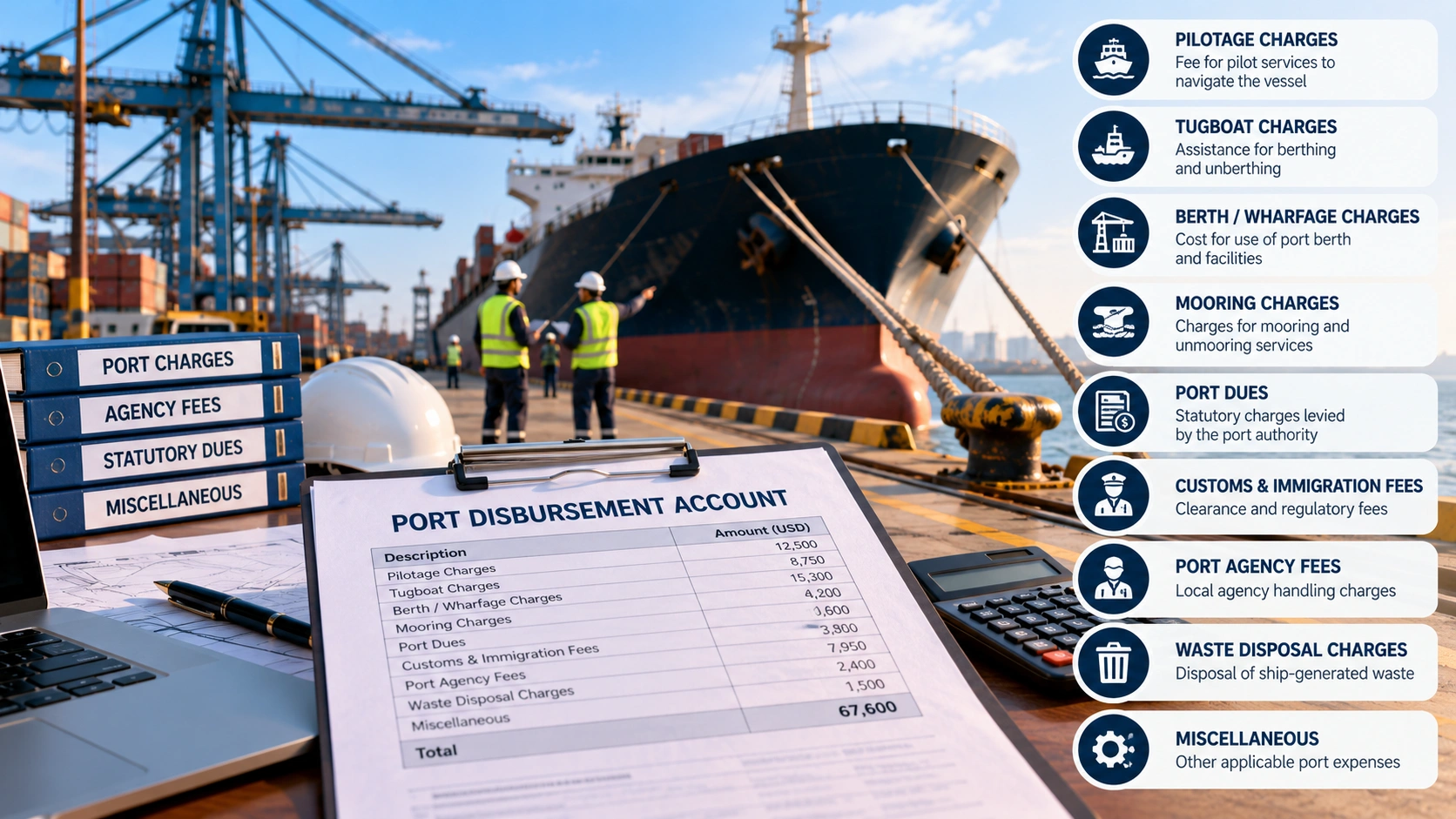
Port Disbursement Account Explained: What Shipowners Should Check Before a Port Call
Quick Answer: A port disbursement account (PDA) is a cost estimate prepared for a vessel’s port call, covering the expected expenses for services, authorities, terminals, husbandry requirements, and other port-related activities. Shipowners or operators typically review the PDA before the vessel arrives to understand the anticipated cost and ensure funds are available for the port call.
A careful PDA review should check the scope of services, port dues, agency fees, vessel-related services, cargo or terminal charges, taxes, estimated quantities, and any assumptions that could result in additional costs.
Key Takeaways
- A port disbursement account provides an estimate of expected expenses for a vessel’s port call.
- Shipowners should review each cost line rather than looking only at the total estimated amount.
- Port dues, pilotage, towage, berth-related costs, agency fees, husbandry expenses, and other services may form part of the account.
- Clear communication between the shipowner, agent, vessel, terminal, and service providers helps reduce unexpected charges.
- An experienced port agent can coordinate multiple port-call requirements and provide clearer cost visibility.
What Is a Port Disbursement Account?
A port disbursement account is an estimated statement of expenses associated with a vessel’s visit to a port.
The account is generally prepared before the vessel’s arrival using the information available at that stage. It helps the shipowner, operator, or manager understand the expected financial requirements for the port call.
Depending on the vessel, port, cargo operation, and services required, a PDA may include items such as:
- Port dues and statutory charges
- Pilotage
- Tug or towage services
- Berthing-related expenses
- Agency fees
- Launch or boat services
- Crew-related requirements
- Fresh water or provisions where requested
- Waste-related services
- Cargo or terminal-related charges where applicable
- Communications and documentation
- Taxes and other applicable charges
The final account can differ from the estimate because actual services, quantities, timings, and port conditions may change.
What Should Shipowners Check in a PDA?
1. Port and Vessel Details
Start by confirming the basic information used to prepare the estimate.
Check:
- Vessel name and type
- Port of call
- Expected arrival and departure
- Estimated port stay
- Cargo operation
- Berth or terminal information where available
- Agency scope
An incorrect vessel detail or port-call assumption can affect several cost calculations.
2. Port and Statutory Charges
Port-related dues should be checked against the applicable port requirements and the vessel’s characteristics.
Depending on the port and vessel, charges can be influenced by factors such as vessel size, gross tonnage, berth usage, or services required.
Shipowners should ask for clarification where a charge is unclear rather than accepting an unexplained lump sum.
3. Vessel Handling Services
The PDA should reflect the vessel handling requirements expected during the port call.
This can include services associated with:
- Pilotage
- Tugs
- Mooring
- Launch services
- Berthing
- Shifting
- Documentation
- Other vessel-support activities
The exact requirements vary according to the port, vessel, and operation.
4. Agency and Husbandry Costs
If the port call requires crew support, documentation assistance, supplies, transport, or other husbandry services, these should be identified clearly.
This is where the scope of port agency services becomes important. The shipowner should understand which services are included within the agency fee and which are charged separately.
PDA Estimate vs Final Disbursement Account
A PDA should not be treated as a guaranteed final invoice.
| PDA Stage | What It Represents | What to Check |
| Pre-arrival estimate | Expected port-call costs | Assumptions and estimated quantities |
| Port call | Actual services performed | Changes, additional services, timings |
| Final account | Actual expenses incurred | Supporting invoices and adjustments |
For example, a vessel may initially be expected to require a particular number of tug movements. If the actual operation changes, the final cost may differ from the original estimate.
This is why comparing the PDA against the final account can help identify the reason for significant variations.
How Can a PDA Help With Port Call Planning?
A properly prepared PDA is not only a finance document. It can also help shipowners plan the operational side of a port call.
Before arrival, the owner or operator can use the estimate to assess:
- Expected port-call expenditure
- Required funds
- Services planned for the vessel
- Potential additional requirements
- Information that still needs confirmation
It also provides a common reference point for communication between the shipowner, port agent, vessel, terminal, and service providers.
Practical Example: Reviewing a Vessel’s Port Call
Suppose a vessel is scheduled to call at an Indian port for cargo operations.
Before arrival, the agent prepares the PDA based on the vessel’s particulars, expected port stay, cargo operation, and services requested by the vessel.
The shipowner reviews the estimate and notices that certain vessel-handling costs are based on assumptions about the operation. The agent can then clarify what has been included, which items are provisional, and which charges may change based on actual services.
If the vessel subsequently requires an additional service, that change should be reflected in the final accounting with the relevant supporting information.
The benefit is greater transparency between the estimate and the actual port call.
What Is the Business and Operational Impact?
Poorly reviewed port expenses can create financial uncertainty and make it difficult to reconcile the final account.
A structured PDA review can help businesses:
- Improve port-call cost visibility
- Identify unclear charges before arrival
- Allocate funds more accurately
- Reduce avoidable billing disputes
- Coordinate vessel services more efficiently
- Reconcile estimated and actual expenditure
For shipowners and operators managing multiple port calls, consistency in how PDAs are reviewed can also make financial control easier.
India-Specific Considerations
Indian port calls can involve multiple parties, including port authorities, terminals, pilots, tug operators, customs or other authorities, service providers, and agents, depending on the vessel and operation.
The applicable charges and procedures can vary between ports and terminals. A PDA should therefore be prepared using the specific requirements of the intended port call rather than copying an estimate from another location.
For vessels calling at Indian ports, shipowners should confirm:
- Applicable port and terminal charges
- Vessel particulars used for calculations
- Pilotage and towage requirements
- Berthing or shifting requirements
- Cargo operation details
- Agency scope
- Crew and husbandry requirements
- Applicable taxes and statutory charges
- Any port-specific requirements
The exact costs should always be verified against the relevant port, terminal, service provider, and vessel requirements.
Industry Insight
When reviewing a PDA, we would not focus only on whether the final number looks reasonable. We would look at how that number has been built.
The assumptions behind quantities, vessel movements, services, and estimated port stay can be just as important as the individual rates. Clear line-item descriptions also make it easier to understand why the final account changes after the vessel completes its port call.
For port agency operations, good cost control starts before the vessel arrives. The more clearly the expected scope is defined, the easier it is to manage changes during the call and reconcile the final expenses afterwards.
Common Mistakes to Avoid
Reviewing Only the Total Amount
A reasonable-looking total can still contain unclear or unnecessary line items.
Not Checking Assumptions
Estimated quantities, port stay, vessel movements, and service requirements can affect the final account.
Confusing Agency Fees With Third-Party Expenses
Shipowners should understand which charges are part of the agency scope and which are external costs.
Ignoring Additional Services
Services requested during the port call can increase the final disbursement.
Failing to Reconcile the Final Account
Differences between the PDA and final account should have a clear operational or financial explanation.
How to Review a PDA Before a Port Call
Use this checklist before approving the estimated disbursement:
- Vessel: Are the vessel particulars correct?
- Port: Is the correct port and terminal being used?
- Operations: Is the expected cargo operation clearly defined?
- Services: Are pilotage, towage, mooring, and other vessel services included where required?
- Agency: Is the scope of port agency services clear?
- Quantities: Are estimated quantities and movements reasonable?
- Taxes: Are applicable taxes and statutory charges identified?
- Third parties: Are external service-provider costs clearly identified?
- Contingency: Are potential variable costs explained?
- Final reconciliation: Is there a process for comparing the PDA with the final account?
Why FAK Cargo?
FAK Cargo provides port agency services and supports vessel-related logistics coordination, including relevant vessel handling services and port-call requirements.
Its broader logistics capabilities across freight forwarding, cargo handling, and multimodal transportation can support coordination where vessel operations form part of a wider supply-chain movement.
Key Takeaway
A port disbursement account is more useful when treated as a port-call planning document rather than simply a cost estimate. Shipowners should review the assumptions, services, rates, quantities, agency scope, and potential variable costs before approving it.
If you have an upcoming vessel call and need support coordinating port agency or vessel-handling requirements, discussing the expected scope with the port agent early can help improve cost and operational visibility.
FAQs
Q1. What is a port disbursement account?
A. A port disbursement account is an estimate of the expected expenses associated with a vessel’s port call.
Q2. Who prepares a port disbursement account?
A. It is typically prepared by the appointed port agent using information about the vessel, port, planned operations, and required services.
Q3. Is a PDA the final port bill?
A. No. A PDA is an estimate. The final disbursement account reflects the actual expenses incurred during the port call.
Q4. What does a PDA usually include?
A. It may include port dues, pilotage, towage, agency fees, vessel services, husbandry expenses, taxes, and other applicable port-call costs.
Q5. Why are port agency services important for a vessel call?
A. A port agent can coordinate required port-call services, documentation, communications, and other operational requirements between the vessel, shipowner, port, terminal, and service providers.
Related reading: Port Congestion Forecast 2026: What Shippers Should Prepare For
Related posts

How Poor Packaging Decisions Cause Claims, Rejections, and Transit Losses
In 2026, exporters have less room for avoidable mistakes. India’s total export

The Hidden Logistics Cost of Internal Coordination Failure
In 2026, exporters cannot afford to lose money on avoidable internal mistakes. I
Port Cut-Off Times Explained: How Missing One Hour Can Delay Your Shipment by a Week
Delays in global logistics are hardly initiated by a crisis. They begin much sim