
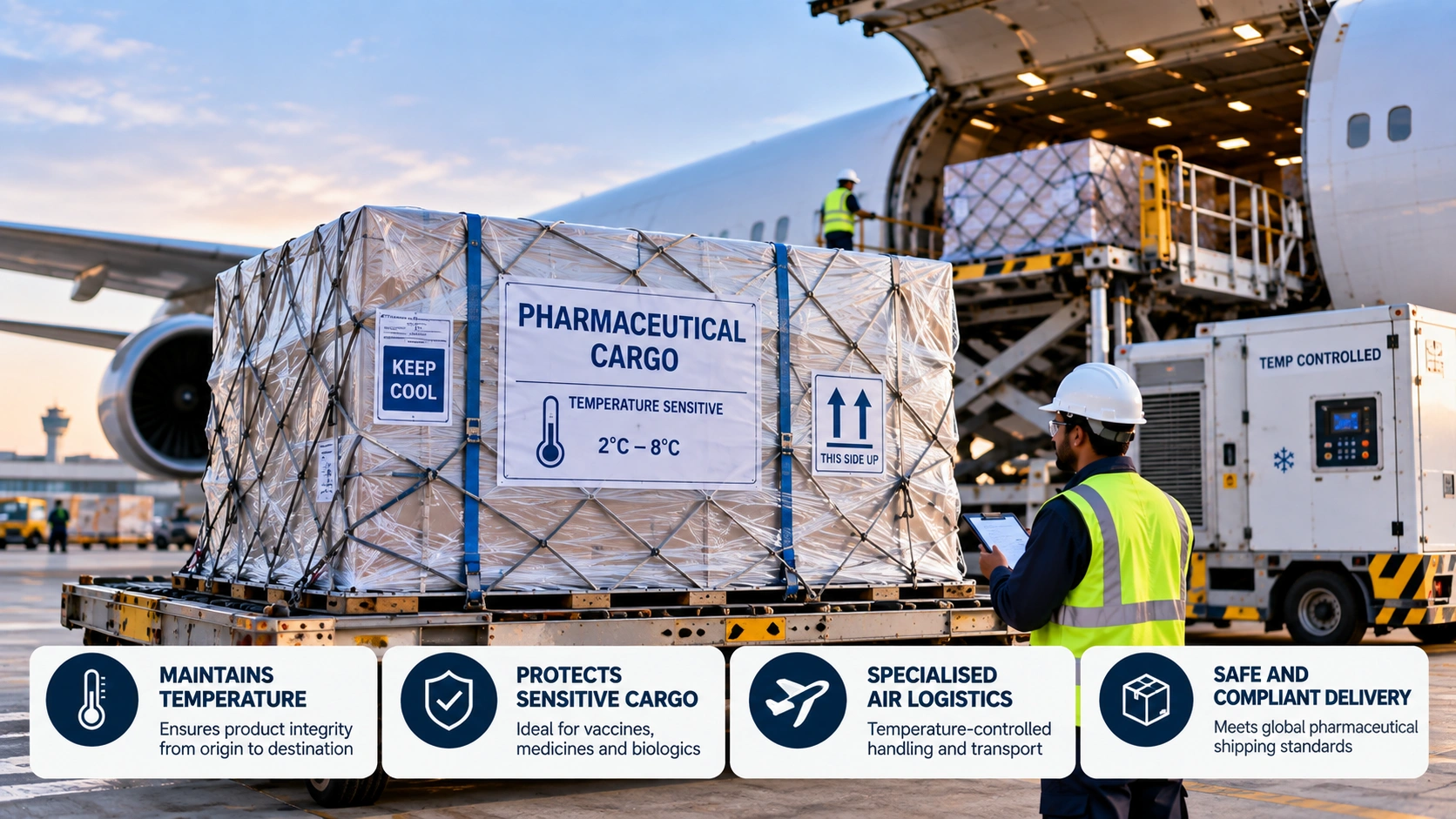
Pharmaceutical Cold Chain Logistics: How to Protect Temperature-Sensitive Air Cargo
Quick Answer: Pharmaceutical cold chain logistics protects temperature-sensitive medicines and healthcare products by maintaining the required temperature conditions from pickup and packing through airport handling, air transportation, and final delivery. Effective cold chain planning combines validated packaging, appropriate storage, temperature monitoring, controlled handling, suitable air freight services, and contingency planning for delays or temperature excursions.
For exporters, the objective is not simply to keep cargo cold. It is to maintain the product’s specified conditions throughout the entire transportation chain.
Key Takeaways
- Temperature-sensitive pharmaceuticals require continuous planning from origin to destination.
- Packaging should be selected according to the product’s required temperature range, transit duration, and route conditions.
- Temperature monitoring helps identify whether cargo remained within the specified conditions during transit.
- Airport transfers, customs clearance, storage, and delays can create cold chain risks even when the flight itself is short.
- Proper export packing services and coordinated air freight handling can reduce avoidable temperature-related risks.
Why Is Pharmaceutical Cold Chain Logistics Important?
Many pharmaceutical products are sensitive to temperature changes. Exposure outside the manufacturer’s specified conditions can affect product quality and may result in shipment rejection or additional investigation.
Unlike conventional cargo, pharmaceutical shipments therefore require logistics planning around the product’s temperature requirements.
The cold chain can involve:
Manufacturer → Temperature-controlled storage → Pickup → Export packing → Airport → Ground handling → Aircraft → Destination airport → Customs → Delivery → Controlled storage
Every transition creates an opportunity for temperature exposure.
This means cold chain performance depends on the complete logistics process rather than transportation alone.
How Is Temperature Maintained During Pharmaceutical Air Cargo?
1. Start with the Product’s Temperature Requirements
The first step is understanding the manufacturer’s specified storage and transportation conditions.
Different pharmaceutical products may have different requirements. The logistics plan should therefore be based on the actual product, rather than assuming that every pharmaceutical shipment requires the same temperature range.
Factors to assess include:
- Required temperature range
- Maximum acceptable exposure time
- Shipment quantity and volume
- Packaging configuration
- Expected transit duration
- Origin and destination conditions
- Handling and storage requirements
2. Select Appropriate Packaging
Packaging acts as the first line of protection against external temperature conditions.
Depending on the shipment, this may involve qualified passive temperature-controlled packaging, insulated containers, refrigerants, or other suitable solutions.
The packaging choice should consider the expected journey rather than only the flight duration.
For example, a shipment travelling from a pharmaceutical facility in India to an overseas destination may spend significant time in pickup, airport processing, customs, transfers, and final delivery.
3. Monitor Temperature Throughout the Journey
Temperature monitoring provides visibility into the conditions experienced by the shipment.
Appropriate data loggers or monitoring devices can help identify temperature excursions and support post-shipment review.
Monitoring should be planned around the shipment’s requirements, including where the device is positioned and how the recorded information will be reviewed.
What Are the Main Risks in Pharmaceutical Air Freight?
The aircraft journey is only one part of the cold chain.
| Cold Chain Stage | Potential Risk | Planning Consideration |
| Pickup | Exposure during loading | Minimise uncontrolled waiting |
| Packaging | Incorrect thermal protection | Match packaging to product and route |
| Airport transfer | Weather or handling delays | Plan controlled movement |
| Ground handling | Extended exposure | Confirm applicable handling procedures |
| Flight | Transit delays | Consider route and contingency requirements |
| Customs | Shipment waiting time | Prepare documentation in advance |
| Final delivery | Uncontrolled storage | Coordinate receiving facility |
This is why pharmaceutical air freight services require greater coordination than conventional air cargo.
How Does Export Packing Protect Pharmaceutical Cargo?
Export packing services for pharmaceutical shipments need to account for both physical protection and temperature management.
The packaging plan should consider:
- Product sensitivity
- Packaging configuration
- Expected transit time
- Temperature range
- Handling conditions
- Protection against physical damage
- Labelling and identification requirements
- Shipment orientation where applicable
For temperature-sensitive cargo, simply adding insulation is not enough. The complete packaging configuration needs to be appropriate for the intended transportation conditions.
What Happens During an Actual Pharmaceutical Shipment?
Consider an exporter shipping temperature-sensitive pharmaceutical products from India to an overseas buyer.
The logistics team first confirms the product’s transportation requirements and expected route. Appropriate temperature-controlled packaging is prepared, and the cargo is collected according to the agreed handling plan.
The shipment then moves to the airport, where coordination between the forwarder, ground handlers, airline, and other parties becomes important.
At destination, customs clearance and final delivery must be managed without unnecessary exposure.
The example highlights an important point: cold chain planning needs to cover the gaps between transportation stages, not only the flight.
What Are the Business Implications of Poor Cold Chain Planning?
A temperature excursion can have consequences beyond the immediate transportation cost.
Depending on the product and applicable procedures, businesses may need to investigate the shipment, review temperature records, assess product suitability, or manage replacement and delivery delays.
Effective pharmaceutical cold chain logistics can therefore support:
- Better shipment visibility
- More predictable handling
- Reduced avoidable delays
- Improved coordination between logistics partners
- Better temperature documentation
- More structured contingency planning
The goal is to prevent problems where possible rather than relying on corrective action after a shipment has been exposed.
India-Specific Considerations for Pharmaceutical Air Cargo
India has a significant pharmaceutical manufacturing and export ecosystem, making reliable temperature-sensitive logistics important for exporters moving healthcare products internationally.
For shipments originating from pharmaceutical manufacturing or distribution locations, the plan may involve road transportation to an international airport, airport handling, air transportation, destination customs clearance, and controlled final delivery.
Indian exporters should consider:
- Origin-to-airport transit time
- Airport handling arrangements
- Seasonal temperatures
- Packaging requirements for the expected route
- Customs documentation
- Airline and ground-handler procedures
- Destination-country requirements
- Availability of appropriate storage during transit
The exact requirements should be confirmed for the product, shipment, airline, airport, and destination rather than applying one standard process to every pharmaceutical cargo movement.
Industry Insight
When planning pharmaceutical shipments, we look at the cold chain as a series of connected handovers rather than a single temperature-controlled journey.
A shipment can have appropriate packaging and still face risk if there is an unexpected delay during pickup, airport processing, customs, or final delivery.
That is why route planning, packaging, handling instructions, monitoring, and contingency arrangements need to be considered together. For exporters, this approach provides a more practical way to identify where temperature exposure can occur before the cargo actually moves.
Common Mistakes to Avoid
Using Generic Packaging
Pharmaceutical packaging should be selected according to the product and transportation conditions.
Planning Only for Flight Time
Airport waiting, customs, transfers, and final delivery can add significant time to the journey.
Ignoring Seasonal Conditions
External temperatures can affect cargo during road transportation and airport handling.
Failing to Monitor Temperature
Without suitable monitoring, it can be difficult to establish the temperature conditions experienced during transit.
Leaving Contingency Planning Until the Shipment Moves
Potential delays, alternate handling arrangements, and communication procedures should be considered before dispatch.
How to Implement Pharmaceutical Cold Chain Logistics
Before shipping temperature-sensitive pharmaceutical cargo, confirm:
- Product: What temperature range and handling conditions apply?
- Packaging: Is the thermal packaging suitable for the complete journey?
- Route: How long will the shipment realistically remain in transit?
- Monitoring: How will temperature conditions be recorded?
- Airport: What handling and storage arrangements are available?
- Documentation: Are required shipment documents ready?
- Contingency: What happens if there is a delay?
- Destination: Can the receiving facility accept and store the cargo appropriately?
Why FAK Cargo?
FAK Cargo supports freight forwarding and specialised logistics requirements, including air freight services, export packing services, multimodal transportation, and coordinated cargo handling.
For temperature-sensitive pharmaceutical shipments, these capabilities can be integrated into a broader transportation plan covering the movement from origin through the relevant logistics stages.
Key Takeaway
Successful pharmaceutical cold chain logistics is about maintaining product-specific conditions across the entire journey, not simply keeping cargo cold during the flight. Packaging, monitoring, airport handling, documentation, route planning, and contingency arrangements all contribute to protecting temperature-sensitive cargo.
If you are planning an international pharmaceutical shipment, reviewing the product requirements and complete transportation route with a logistics partner before dispatch can help identify potential cold chain risks early.
FAQs
Q1. What is pharmaceutical cold chain logistics?
A. It is the coordinated transportation and handling of temperature-sensitive pharmaceutical products while maintaining their required temperature conditions throughout the supply chain.
Q2. What packaging is used for pharmaceutical air cargo?
A. Depending on the product and route, shipments may use qualified insulated or temperature-controlled packaging systems with suitable thermal protection and monitoring.
Q3. Why is air freight used for pharmaceuticals?
A. Air freight can support time-sensitive international pharmaceutical movements because it can provide faster transportation over long distances. The appropriate service depends on the product and shipment requirements.
Q4. How is pharmaceutical cargo temperature monitored?
A. Suitable temperature-monitoring devices or data loggers can record conditions during transportation, allowing the shipment history to be reviewed.
Q5. What should exporters consider before shipping pharmaceutical cargo?
A. Exporters should assess product temperature requirements, packaging, route duration, airport handling, monitoring, documentation, destination requirements, and contingency arrangements before dispatch.
Related posts
Restricted Items in International Air Freight: What Businesses Need to Know in 2026
Quick Answer: Restricted items in air freight include goods that create fire, ex
Air Freight Consolidation vs Direct Air Freight: Which Should Your Business Choose?
Compare air freight consolidation vs direct air freight based on cost, speed, ca

Leave a Reply