
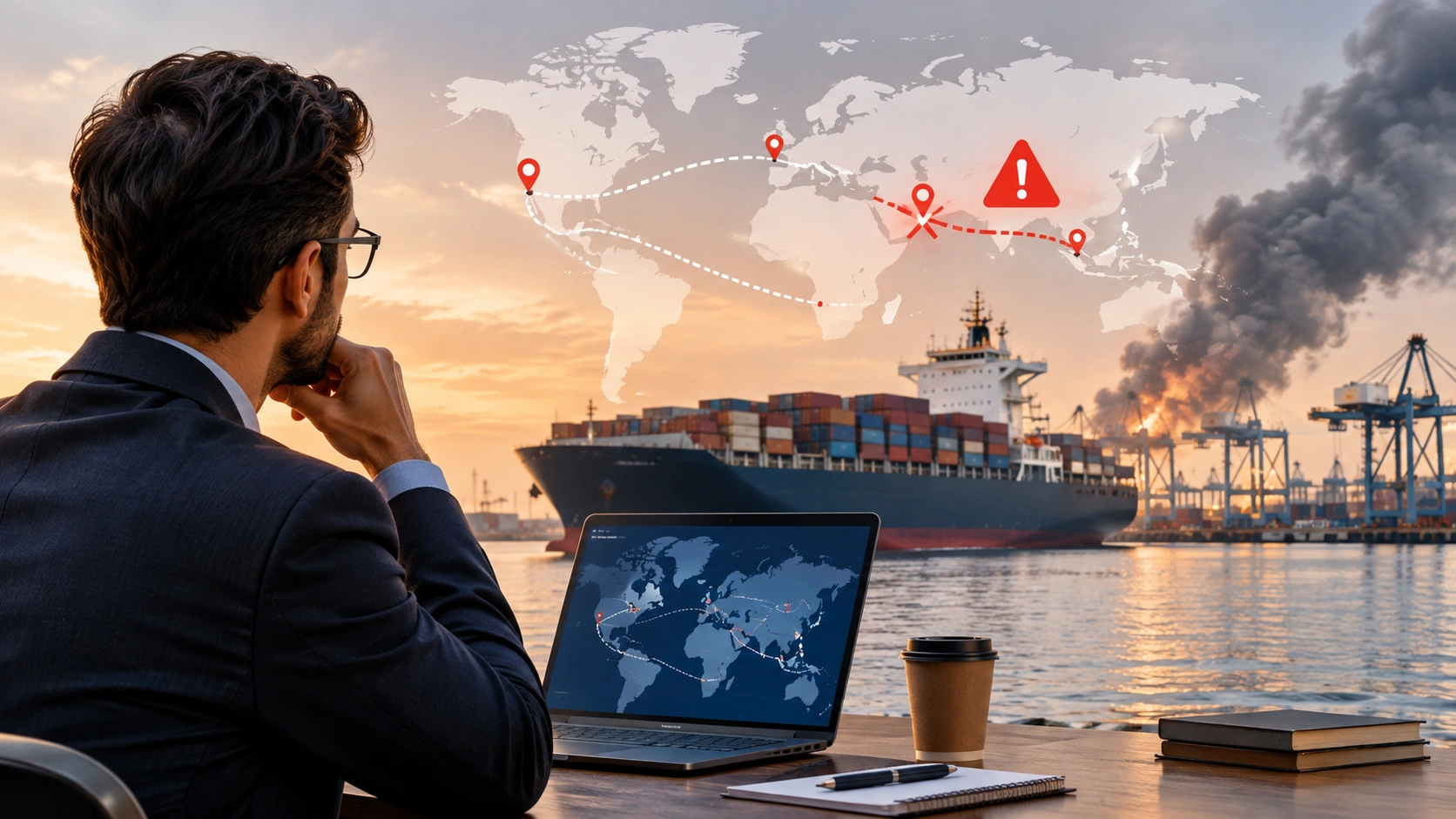
What Should Businesses Do If a War Disrupts Their Shipping Route?
Quick Answer
When a war disrupts shipping routes, businesses should assess the affected shipment, contact their freight forwarder, compare alternate shipping routes due to war, and evaluate the cost, transit time, cargo safety, and documentation requirements of each option. They should also communicate revised timelines to customers, review insurance coverage, and prepare contingency plans to minimise supply-chain disruption.
Key Takeaways
- Assess how the conflict affects your vessel, port, transit corridor, and delivery schedule before making decisions.
- Compare alternative routes and transport modes based on total landed cost, transit time, and cargo requirements.
- Check insurance terms, carrier notices, contractual obligations, and any applicable trade restrictions.
- Coordinate with suppliers, freight forwarders, customs teams, and customers to maintain shipment visibility.
- Build contingency plans for recurring exports instead of relying on a single route or carrier.
Introduction
International shipping depends on interconnected ports, maritime corridors, inland transport networks, and transshipment hubs. When a war disrupts shipping routes, businesses can face vessel diversions, port restrictions, longer transit times, higher freight costs, and uncertainty over delivery commitments.
For exporters, these disruptions can affect production schedules, inventory planning, customer relationships, and cash flow. Importers may also experience shortages of raw materials, delayed components, or increased procurement costs.
The immediate priority is not simply to find another route. Businesses must identify the safest and most commercially viable way to move their cargo while meeting contractual, regulatory, and operational requirements.
What Happens When a War Disrupts Shipping Routes?
The impact depends on the conflict’s location, the cargo’s origin and destination, carrier decisions, and the availability of alternative transport options.
Common consequences include:
- Vessel diversions: Ships may avoid an affected maritime corridor and take a longer route.
- Transit delays: Longer voyages, port congestion, and missed transshipment connections can extend delivery schedules.
- Higher freight costs: Changes in fuel consumption, vessel availability, surcharges, and insurance arrangements can increase shipping expenses.
- Capacity constraints: When several carriers avoid the same corridor, demand for alternative routes may rise.
- Documentation changes: A revised routing or port call may require updated shipping instructions or other documentation, depending on the shipment and applicable requirements.
A disruption does not automatically mean every shipment is affected. Businesses should obtain shipment-specific information before changing their logistics plans.
What Should Businesses Do Immediately After a Shipping Route Is Disrupted?
1. Confirm the shipment’s current status
Contact your freight forwarder or carrier to establish whether the shipment has departed, is waiting at a port, is already at sea, or is scheduled for a future sailing.
Request confirmation of:
- Current vessel or cargo status, where available.
- Any revised port calls or transit arrangements.
- The latest estimated arrival date.
- Whether the booking remains valid.
- Any additional charges or decisions required from your business.
This helps distinguish an actual disruption from a potential risk.
2. Identify which orders are most urgent
Not every shipment needs the same response. Prioritise cargo according to its commercial and operational importance.
For example, a manufacturer waiting for essential production components may need to explore faster alternatives, while a shipment of non-urgent inventory could remain on a delayed sea route if the revised cost is manageable.
Consider customer deadlines, stock availability, production schedules, contractual penalties, and the financial impact of a late delivery.
3. Compare alternate shipping routes due to war
Ask your freight forwarder to assess feasible alternatives based on the shipment’s origin, destination, cargo type, and current carrier options.
Possible alternatives may include a different maritime corridor, a different transshipment hub, or a combination of sea and air transport. Road or rail connections may also be relevant for certain origin-destination pairs.
However, an alternative route is not necessarily available, faster, or cheaper. Its feasibility depends on carrier acceptance, port capacity, border access, cargo restrictions, and the transport infrastructure involved.
Which Shipping Alternative Should Businesses Choose?
The best option balances urgency, cost, reliability, and cargo requirements.
| Option | Potential advantage | What to evaluate |
| Continue on the existing route | Avoids unnecessary booking changes if the route remains operational | Revised arrival date, carrier advisories, and risk exposure |
| Reroute by sea | May preserve the economics of ocean freight | Longer sailing time, additional charges, and port capacity |
| Change the transshipment hub | May provide access to different carrier connections | Connection availability, handling costs, and transfer delays |
| Use air freight | Can be suitable for urgent, high-value, or time-sensitive goods | Higher transport cost, cargo acceptance, and airport capacity |
| Use a multimodal solution | May provide flexibility across different transport networks | Transfer points, inland movement, documentation, and total transit time |
Businesses should compare the total landed cost, not only the freight quotation. This includes additional handling, storage, inland transportation, insurance, customs-related costs, and the financial impact of delays.
How Can Indian Exporters Reduce the Impact of War-Related Disruptions?
Indian exporters should assess the shipment’s complete transport chain rather than looking only at the departure port.
For example, an exporter shipping goods from an inland manufacturing facility may need to consider factory-to-port transportation, container availability, port cut-offs, vessel schedules, transshipment connections, and the destination-side delivery arrangement.
If a maritime corridor becomes unreliable, changing the vessel route may also affect inland collection schedules, delivery commitments, and working-capital planning.
Businesses should take the following steps:
- Review export documentation: Ensure shipping instructions, commercial invoices, packing lists, and other required documents remain accurate when arrangements change.
- Check customs and trade requirements: Confirm applicable export controls, sanctions, destination restrictions, and other requirements with qualified compliance professionals.
- Review port and carrier updates: Obtain information from the relevant carrier, port, freight forwarder, and other responsible parties.
- Coordinate with overseas buyers: Communicate revised estimates and agree on realistic delivery expectations.
- Review contractual responsibilities: Check the sales contract and transport agreement for provisions covering delays, additional charges, liability, and notification obligations.
The most suitable Indian port or routing arrangement depends on the shipment’s actual origin, destination, cargo, and available services. Businesses should not assume that a different port will automatically provide a faster or more economical solution.
How Can Businesses Control the Financial Impact?
When war disrupts shipping routes, the additional cost may extend beyond the freight bill. Delayed inventory can affect production, customer fulfilment, storage requirements, and cash flow.
Businesses can control this exposure by making decisions based on the overall commercial impact.
Compare the cost of delay with the cost of rerouting
Suppose an Indian exporter has a shipment of components travelling by sea. A route diversion may delay delivery beyond the buyer’s required date.
The exporter could compare two options: continue with the revised sailing schedule or move the most urgent portion of the shipment by air, subject to feasibility and cargo acceptance.
Sending the entire consignment by air may be unnecessarily expensive. Moving only the critical portion, while keeping the balance on the sea route, could be a more practical option if the cargo can be divided and the buyer agrees.
Confirm insurance and additional charges
Before accepting a revised arrangement, review the cargo insurance policy and obtain clarification from the insurer or broker about the applicable coverage, exclusions, notification requirements, and any war-related provisions.
Do not assume that standard cargo insurance automatically covers every loss arising from war or related events.
Also request a clear breakdown of proposed additional charges, including rerouting, storage, handling, and other applicable costs.
What Common Mistakes Should Businesses Avoid?
When a disruption occurs, rushed decisions can create further complications. Avoid these common mistakes:
- Changing routes without checking feasibility: An alternative may lack confirmed vessel space, suitable connections, or cargo acceptance.
- Choosing the cheapest quotation alone: A lower freight rate may come with longer transit times or higher onward costs.
- Ignoring contractual obligations: Delays can affect delivery terms, buyer commitments, and liability arrangements.
- Assuming insurance coverage: Policy wording and exclusions must be checked before relying on cover.
- Communicating too late: Buyers and suppliers need timely updates to adjust inventory and production plans.
- Depending on one route indefinitely: Repeated disruptions can expose businesses to concentrated supply-chain risk.
Industry Insight: How Should Businesses Approach Route Disruptions?
From a logistics coordination perspective, the most useful response is to treat a route disruption as a decision-making exercise rather than simply a freight-booking problem.
We recommend evaluating three factors together: the cargo’s urgency, the total cost of each feasible alternative, and the reliability of the revised delivery plan. A route that saves a few days may not justify a substantial increase in cost for non-urgent inventory. Conversely, a delayed shipment of essential production materials may create costs far greater than the price of a faster alternative.
Clear communication is equally important. Businesses should establish who will approve rerouting, who will absorb additional costs, and who will inform the overseas buyer. This reduces delays caused by internal uncertainty while the shipment itself is already facing disruption.
How Can Businesses Prepare for Future Shipping Disruptions?
Use this checklist to strengthen your logistics contingency plan:
- Map your main shipping routes, ports, and transshipment dependencies.
- Identify critical products and shipments that cannot tolerate extended delays.
- Discuss feasible alternative routes with your freight forwarder before an emergency.
- Compare sea, air, and multimodal options for priority cargo.
- Review cargo insurance, contracts, and responsibilities for additional costs.
- Maintain realistic inventory buffers for critical inputs where commercially justified.
- Establish a communication process for suppliers, customers, and internal teams.
- Monitor carrier advisories and reassess plans when conditions change.
The goal is not to eliminate every possible disruption. It is to make informed decisions quickly when circumstances change.
How Can FAK Cargo Help Businesses Manage Shipping Disruptions?
FAK Cargo supports businesses with freight forwarding, multimodal transportation, 3PL logistics, export packing, and related logistics coordination. These services can help businesses assess transport requirements, coordinate shipment arrangements, and evaluate suitable options when normal shipping plans are affected.
The appropriate solution depends on the cargo, destination, available capacity, and prevailing operating conditions. Businesses should share their shipment details and delivery priorities so that feasible arrangements and associated costs can be assessed.
Key Takeaway
When a war disrupts shipping routes, businesses should confirm the shipment’s status, compare feasible alternatives, assess the full financial impact, and communicate revised timelines early. A well-prepared contingency plan can help protect customer commitments and reduce avoidable supply-chain disruption.
Need help assessing your export shipment or evaluating alternative transport arrangements? Contact FAK Cargo to discuss your cargo requirements, delivery timelines, and available logistics options.
Frequently Asked Questions
Q1. What should exporters do when a war disrupts shipping routes?
A. Exporters should confirm their shipment status, obtain revised transit estimates, assess alternative routes, review additional charges and insurance terms, and inform overseas buyers of potential delays.
Q2. What are the alternate shipping routes due to war?
A. Alternatives may include a different maritime corridor, another transshipment hub, air freight, or a multimodal arrangement. The suitable option depends on the origin, destination, cargo type, capacity, and prevailing restrictions.
Q3. Does rerouting a shipment always increase costs?
A. Not necessarily, but it can introduce additional freight, fuel-related surcharges, handling, storage, or inland transport costs. Businesses should request an itemised comparison before approving changes.
Q4. Does cargo insurance cover war-related shipping disruptions?
A. Coverage depends on the policy wording, exclusions, and specific circumstances. Businesses should consult their insurer or broker rather than assume that standard cargo insurance covers war-related losses.
Q5. How can a freight forwarder help during a shipping disruption?
A. A freight forwarder can help confirm shipment status, coordinate with carriers, assess feasible transport alternatives, communicate revised schedules, and clarify the operational and cost implications of proposed changes.
Related posts
Port Cut-Off Times Explained: How Missing One Hour Can Delay Your Shipment by a Week
Delays in global logistics are hardly initiated by a crisis. They begin much sim

How to Reduce Logistics Coordination When Multiple Vendors Handle One Shipment
Coordinating multiple logistics vendors? Discover practical ways to prevent comm
Port Disbursement Account Explained: What Shipowners Should Check Before a Port Call
Learn how to review a port disbursement account before a vessel call, including

Leave a Reply