
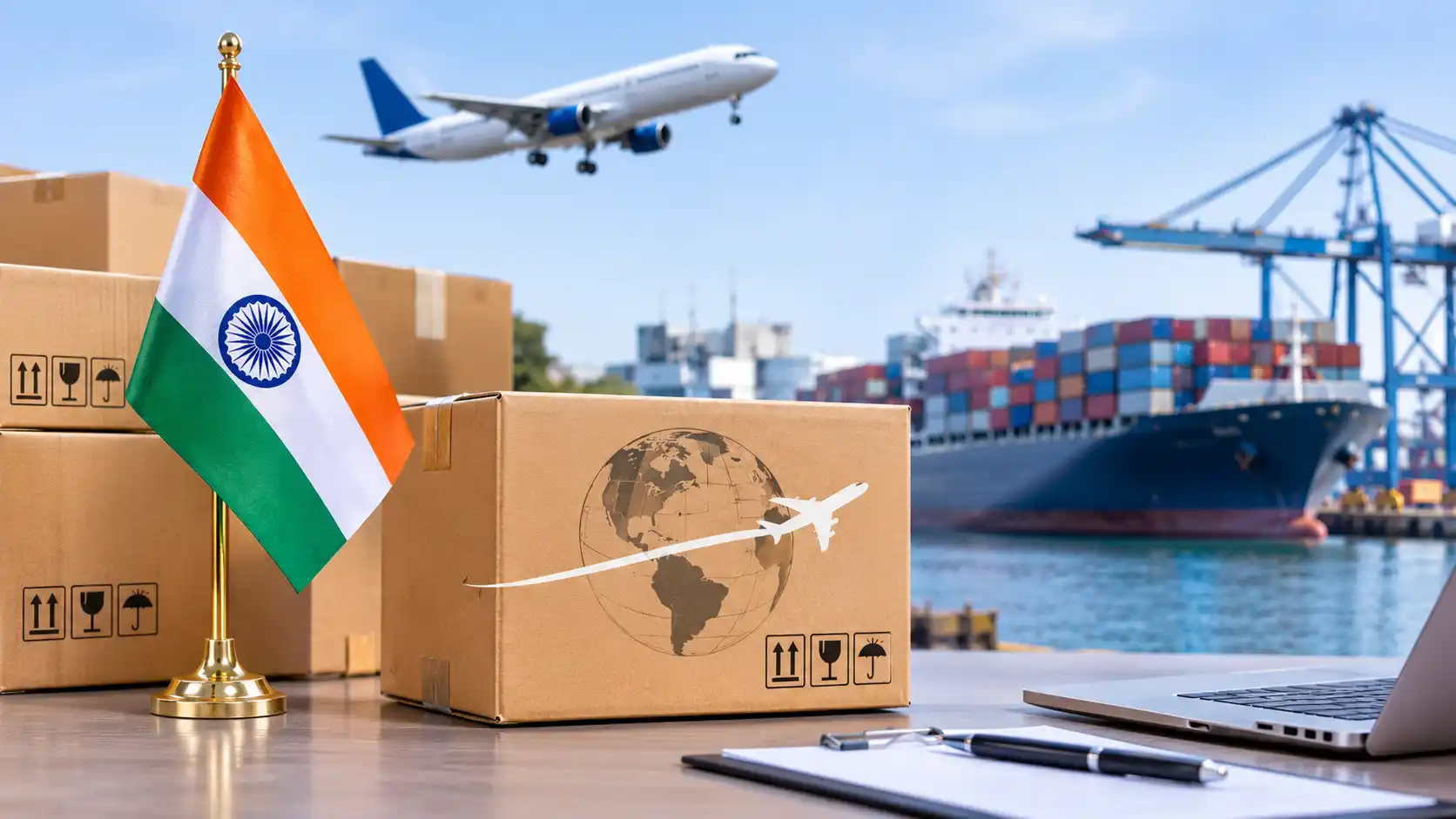
India Removes the ₹10 Lakh Courier Export Limit: What Changes for Indian Exporters?
Quick Answer
The Government of India has removed the earlier ₹10 lakh per-consignment value limit on commercial exports through courier services, effective 1 April 2026. The change was introduced through DGFT Notification No. 67/2025-26, dated 27 March 2026, amending Paragraph 9.05 of the Foreign Trade Policy (FTP) 2023.
Under the revised provision, exporters can send commercial consignments of any value through registered courier services or Foreign Post Offices without being restricted by the earlier ₹10 lakh ceiling. The reform applies to both e-commerce and non-e-commerce commercial exports.
However, removing the value cap does not remove customs procedures, product restrictions, documentation requirements or other applicable export regulations. Exporters must continue to comply with the relevant customs and Foreign Trade Policy provisions.
Key Takeaways
- India removed the ₹10 lakh per-consignment value limit for commercial courier exports from 1 April 2026.
- DGFT Notification No. 67/2025-26 amended Paragraph 9.05 of FTP 2023.
- The reform covers both e-commerce and non-e-commerce commercial exports through courier mode.
- Exporters must continue to follow applicable IEC, customs documentation and product-specific compliance requirements.
- Businesses can evaluate courier services and conventional air freight based on shipment size, cost, handling requirements and delivery timelines.
How India’s Courier Export Reforms Are Changing Cross-Border Shipping
Courier services have become an important part of India’s international trade ecosystem, particularly for e-commerce businesses, small manufacturers, artisans and MSMEs.
However, the earlier ₹10 lakh value limit per commercial courier export consignment restricted businesses shipping higher-value products through this channel. Exporters often had to consider alternative transportation arrangements when shipment values exceeded the prescribed ceiling.
To address this limitation, the government introduced reforms under the Union Budget 2026-27, removing the courier export value cap.
The change offers greater flexibility to Indian businesses planning international shipments. Understanding the revised courier export limit in India and its operational implications can help exporters choose more suitable transportation arrangements.
What Is the New Courier Export Rule in India?
The Directorate General of Foreign Trade (DGFT) issued Notification No. 67/2025-26 on 27 March 2026, amending Paragraph 9.05 of the Foreign Trade Policy 2023.
Previously, commercial exports through courier services were subject to a maximum consignment value of ₹10 lakh.
The revised provision removes this restriction and states that there shall be no prescribed per-consignment value limit for exports through courier services.
The amendment came into effect on 1 April 2026.
The Central Board of Indirect Taxes and Customs (CBIC) also issued Circular No. 17/2026-Customs on 31 March 2026, clarifying that the removal applies to both e-commerce and non-e-commerce commercial exports through courier mode.
This means an Indian manufacturer shipping a commercial consignment valued at ₹15 lakh can now consider registered courier services without being restricted by the previous value ceiling.
However, the shipment must still comply with applicable customs procedures and export policy requirements.
Who Benefits from the Removal of the ₹10 Lakh Courier Export Limit?
The reform creates opportunities for several categories of Indian exporters.
1. E-Commerce Exporters
Businesses selling products through international marketplaces can use courier networks for higher-value commercial orders without the previous consignment-value restriction.
2. MSMEs and Small Manufacturers
Small and medium-sized manufacturers can explore international markets with greater flexibility in choosing their shipment methods.
3. Artisans and Handicraft Businesses
Businesses exporting handcrafted products, home décor, textiles and other specialised goods can evaluate courier transportation for higher-value orders.
4. Non-E-Commerce Commercial Exporters
The amendment is not limited to online sellers. Businesses exporting commercial goods through registered courier services can also benefit.
5. Growing Export Businesses
Companies expanding their international customer base can evaluate courier services for shipments that previously exceeded the prescribed value limit.
How Have Courier Export Rules in India Changed in 2026?
The most significant change is the removal of the consignment-value ceiling. However, the 2026 reforms also address other operational challenges associated with courier trade.
| Area | Earlier position | Revised position |
| Commercial courier export value | Maximum ₹10 lakh per consignment | No prescribed per-consignment value limit |
| E-commerce exports | Subject to the value cap | Value cap removed |
| Non-e-commerce commercial exports | Subject to the value cap | Value cap removed |
| Return of unclaimed imported courier shipments | Earlier disposal-related procedures | Simplified Return to Origin framework for eligible shipments |
| Re-import of returned or rejected goods | Existing procedures with verification challenges | Simplified risk-based approach |
The return-related changes are separate from the export value-cap removal. They are particularly relevant to e-commerce businesses handling international returns and rejected shipments.
Under the revised Return to Origin (RTO) framework, eligible imported courier goods that remain uncleared or unclaimed for more than 15 days may be considered for return to origin, subject to prescribed conditions and customs permission.
The customs reforms also introduce a risk-based approach to the re-import of returned and rejected goods.
These measures aim to improve operational efficiency across courier-based international trade.
Courier Exports vs Conventional Air Freight: What Should Businesses Choose?
Removing the value cap does not mean courier services are automatically the best option for every export shipment.
Businesses should evaluate courier transportation against conventional air freight based on shipment characteristics.
| Factor | Courier services | Conventional air freight |
| Shipment suitability | Parcels and eligible commercial consignments | General, commercial and larger cargo shipments |
| Handling | Integrated courier network | Airport cargo handling and freight forwarding |
| Documentation | Courier-specific customs declarations | Standard air cargo export documentation |
| Delivery arrangement | Often includes integrated delivery services | Delivery arrangements depend on the freight contract |
| Cargo requirements | Subject to courier acceptance and applicable restrictions | Subject to airline, airport and regulatory acceptance |
| Cost considerations | Depends on chargeable weight, dimensions and service level | Depends on freight rates, chargeable weight, handling and associated charges |
For smaller, time-sensitive shipments, courier services may offer operational convenience.
For larger consignments, specialised cargo or shipments requiring customised handling, conventional air freight may be more suitable.
The right choice depends on the shipment’s commercial value, dimensions, weight, destination, delivery expectations and cargo classification.
What Does the Change Mean for Indian Exporters?
The removal of the courier export value cap can influence how businesses plan their international supply chains.
Greater flexibility in shipment planning
Exporters are no longer required to consider the earlier ₹10 lakh ceiling when evaluating eligible commercial courier shipments.
More transportation options
Businesses can compare courier services with international air freight services in India based on cost, transit time and handling requirements.
Better opportunities for cross-border e-commerce
Higher-value orders can be evaluated for courier fulfilment, subject to the courier operator’s acceptance and applicable regulations.
Potential reduction in operational complexity
Businesses may avoid changing transportation arrangements solely because a consignment exceeds the previous value limit.
Improved returns management
The accompanying customs reforms provide a more structured framework for eligible returned and rejected courier shipments.
Practical Example: How Can a Manufacturer Benefit?
Consider an Indian manufacturer exporting premium handicraft products to customers in the United States.
Previously, a commercial courier consignment valued at ₹12 lakh would have exceeded the ₹10 lakh limit. The manufacturer would have needed to consider an alternative export arrangement.
Under the revised framework, the manufacturer can evaluate registered courier services for the same shipment without being restricted by the former value ceiling.
The final transportation decision would still depend on package dimensions, chargeable weight, courier acceptance, destination requirements, customs procedures and overall shipping costs.
This gives the manufacturer greater flexibility when planning international deliveries.
Why Are International Air Freight Services in India Still Important?
Although the courier value restriction has been removed, conventional air freight continues to play an important role in international logistics.
Courier and air freight services have different operating models and may suit different cargo requirements.
International air freight services in India can support businesses transporting:
- Larger commercial consignments requiring specialised freight arrangements.
- Industrial products with specific handling requirements.
- Time-sensitive shipments requiring suitable airline connections.
- Specialised cargo subject to additional packaging and regulatory procedures.
- Shipments requiring coordinated freight forwarding and customs support.
For chemical and dangerous goods shipments, applicable classification, packaging, documentation and carrier acceptance requirements must be verified before dispatch.
Businesses should compare total logistics costs rather than selecting a transportation mode based only on shipment value.
Industry Insight: Why Transportation Planning Still Matters
From our perspective at FAK Cargo, removing the courier export value limit provides greater flexibility, but it does not eliminate the need for proper freight planning.
The choice between courier and conventional air freight should be based on cargo characteristics, destination, delivery expectations and handling requirements.
For exporters, understanding chargeable weight, packaging standards, customs documentation and destination-country regulations is essential before confirming an international shipment.
A well-planned transportation arrangement can help avoid unnecessary handling, documentation discrepancies and delivery delays.
Common Mistakes Exporters Should Avoid
- Assuming all goods can be exported through courier: Restricted and prohibited products remain subject to applicable export policies.
- Confusing value eligibility with regulatory clearance: Removing the ₹10 lakh cap does not mean customs requirements have been removed.
- Ignoring courier acceptance conditions: Courier operators may have their own restrictions based on cargo type, dimensions and handling requirements.
- Overlooking chargeable weight: Shipping costs may depend on actual or volumetric weight, whichever is applicable under the service arrangement.
- Using unsuitable packaging: International shipments require packaging appropriate for handling, stacking and transportation conditions.
- Ignoring return procedures: Exporters should understand how returned or rejected shipments will be handled.
How Should Exporters Prepare for the Revised Courier Export Rules?
Before dispatching a commercial courier shipment, businesses should follow these steps:
- Verify product eligibility: Check the applicable ITC (HS) export policy and identify any restrictions or licensing requirements.
- Confirm exporter documentation: Ensure applicable IEC, GST and other registration requirements are fulfilled.
- Select a registered courier: Confirm that the service provider can handle the shipment type, destination and declared value.
- Prepare accurate documentation: Arrange commercial invoices, packing lists, shipping details and applicable customs declarations.
- Evaluate transportation costs: Compare courier and conventional air freight based on chargeable weight, handling and delivery requirements.
- Check destination regulations: Verify import duties, product standards, labelling and other requirements in the destination market.
- Plan shipment tracking and returns: Establish procedures for delivery exceptions, rejected shipments and international returns.
How Can FAK Cargo Support Your International Shipments?
FAK Cargo provides logistics and supply-chain solutions covering freight forwarding, third-party logistics (3PL), export packing, port agency, multimodal transportation and specialised cargo handling.
For exporters evaluating courier and conventional freight options, understanding cargo requirements and transportation arrangements is essential.
FAK Cargo supports businesses in coordinating export packing, freight movement and logistics requirements for international shipments.
Conclusion
The removal of India’s ₹10 lakh courier export limit is an important development for MSMEs, e-commerce businesses, artisans and established exporters.
Effective 1 April 2026, commercial consignments can be exported through registered courier services without the previous per-consignment value ceiling.
However, exporters must continue to follow applicable customs procedures, product regulations and documentation requirements.
The opportunity now lies in selecting the right transportation arrangement for each shipment. Businesses planning international expansion can evaluate courier and conventional freight options based on cost, cargo requirements and delivery expectations.
For assistance with freight forwarding, export packing and international cargo movement, connect with FAK Cargo to discuss suitable logistics solutions.
Frequently Asked Questions
Q1. Has India removed the ₹10 lakh courier export limit?
A. Yes. The government removed the ₹10 lakh per-consignment value limit for commercial courier exports with effect from 1 April 2026.
Q2. Which notification removed the courier export limit in India?
A. DGFT Notification No. 67/2025-26, dated 27 March 2026, amended Paragraph 9.05 of the Foreign Trade Policy 2023 to remove the value ceiling.
Q3. Does the new courier export rule apply to non-e-commerce businesses?
A. Yes. CBIC Circular No. 17/2026-Customs clarifies that the removal applies to both e-commerce and non-e-commerce commercial exports through courier mode.
Q4. Can Indian exporters send consignments worth more than ₹10 lakh through courier?
A. Yes. There is no prescribed per-consignment value ceiling under the revised provision. Shipments must still comply with applicable customs regulations, export policies and courier acceptance requirements.
Q5. Is conventional air freight still required for high-value exports?
A. Not solely because of shipment value. Exporters can evaluate courier services or conventional air freight based on cargo characteristics, transportation costs, handling requirements and delivery expectations.
Related Reading: Choosing How to Ship High-Value Exports
Related posts
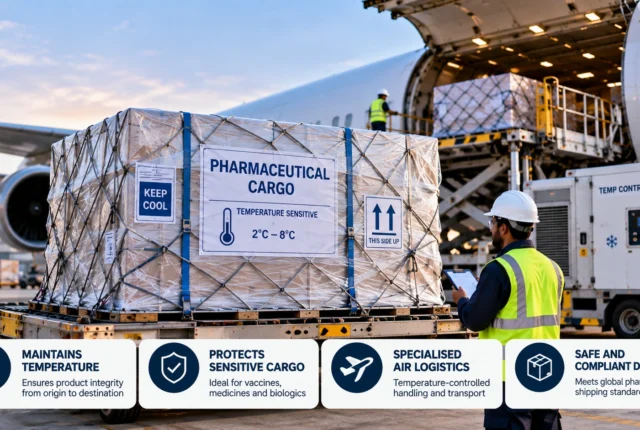
Pharmaceutical Cold Chain Logistics: How to Protect Temperature-Sensitive Air Cargo
Learn how pharmaceutical cold chain logistics protects temperature-sensitive air
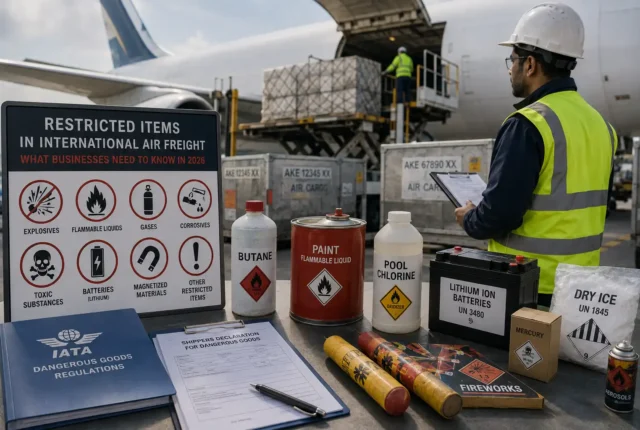
Restricted Items in International Air Freight: What Businesses Need to Know in 2026
Quick Answer: Restricted items in air freight include goods that create fire, ex

India’s Air Cargo Transshipment Expansion in 2026: What Exporters Need to Know
Explore India's 2026 air cargo transshipment expansion, new routes, screening ch

Leave a Reply