
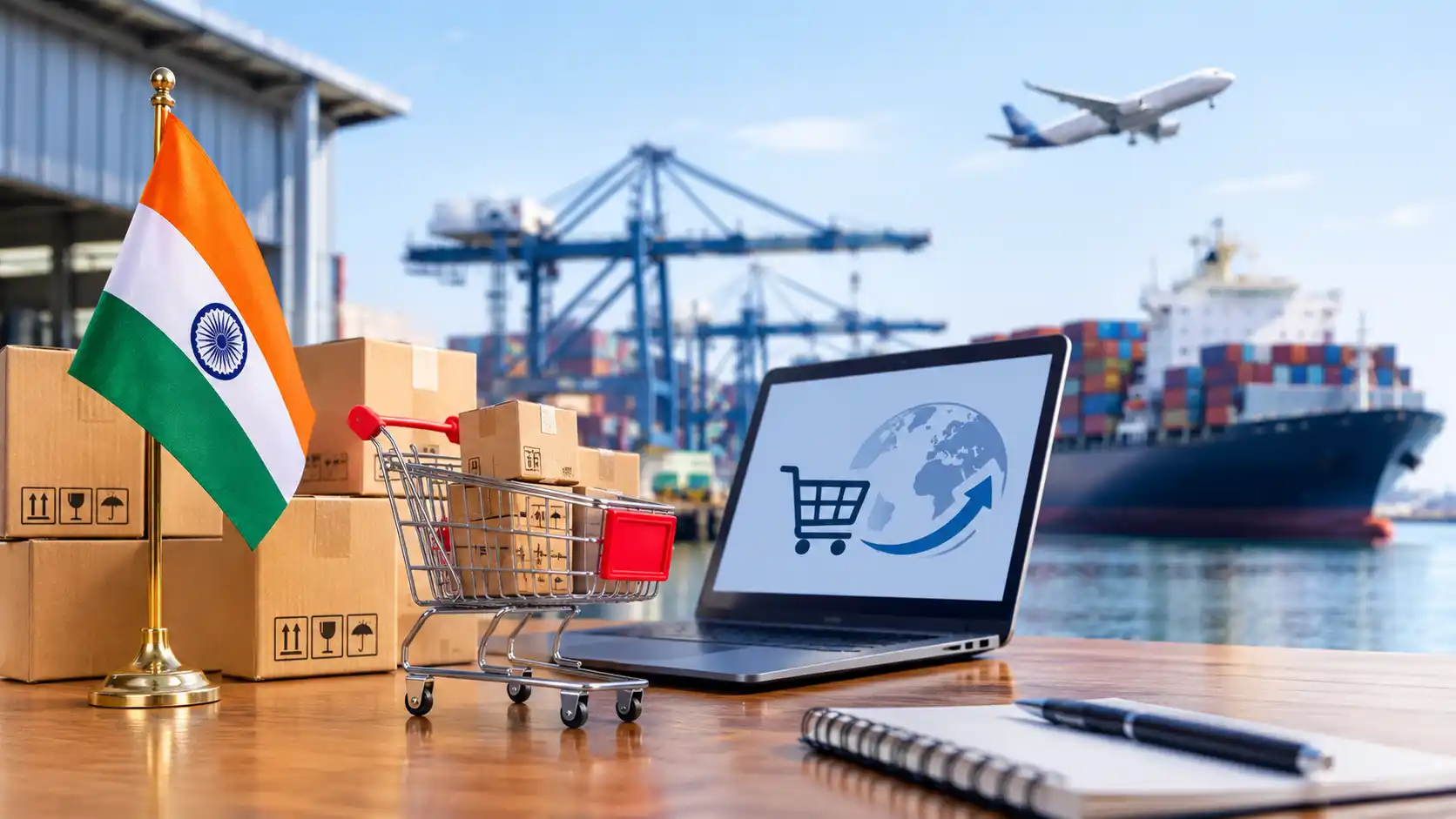
India’s Inventory-Based E-Commerce Export Policy: A Guide for Indian Manufacturers
Quick Answer
India’s inventory-based e-commerce export policy creates a structured route for Indian manufacturers, artisans and MSMEs to sell products to international customers through an export-only inventory model.
Operationalised by the Directorate General of Foreign Trade (DGFT) on 5 August 2026, the framework allows eligible e-commerce entities to hold export inventory through a registered Exporter-on-Record (EOR). The EOR procures goods from Indian sellers against confirmed overseas orders and manages export documentation, customs formalities, international fulfilment and destination-country compliance.
For manufacturers, this creates an opportunity to access international e-commerce markets without independently managing every stage of the export process. However, product eligibility, inventory traceability, packaging, documentation and logistics planning remain essential.
Key Takeaways
- The framework permits inventory-based e-commerce operations exclusively for exports of goods manufactured or produced in India.
- Registered Exporters-on-Record manage export inventory and undertake exports in their own name.
- Indian manufacturers can supply products against confirmed overseas orders through eligible Sellers-on-Record arrangements.
- Inventory segregation, digital records, seller payments and export-benefit distribution are governed by specific requirements.
- Efficient freight forwarding, export packaging and customs coordination remain important for successful implementation.
A New Approach to Cross-Border E-Commerce for Indian Businesses
International e-commerce has created new opportunities for Indian manufacturers to reach customers beyond domestic markets. However, exporting individual orders involves several operational responsibilities, including documentation, customs clearance, packaging, transportation and international returns.
For smaller manufacturers and MSMEs, managing these activities independently can be challenging.
The inventory-based e-commerce export policy introduces a framework designed to make cross-border e-commerce operations more accessible. It allows eligible entities to operate an export-only inventory model through registered Exporters-on-Record, creating a more structured connection between Indian suppliers and overseas buyers.
Understanding the framework is important for manufacturers considering international expansion through digital sales channels.
What Is India’s Inventory-Based E-Commerce Export Policy?
The policy was introduced through DPIIT Press Note No. 3 (2026 Series), dated 23 July 2026, and operationalised through DGFT Notification No. 27/2026-27 and Public Notice No. 25/2026-27, both dated 5 August 2026.
It creates an exception to the existing restrictions on inventory-based e-commerce under the FDI policy, specifically for exports of domestically manufactured or produced goods.
Under this framework, eligible e-commerce entities can undertake export-only inventory operations through a registered EOR.
Three participants are central to this arrangement:
- Seller-on-Record (SOR): An Indian GST-registered entity supplying domestically produced goods against confirmed export orders.
- Exporter-on-Record (EOR): A DGFT-registered entity that procures products from SORs and exports them in its own name.
- Overseas buyer: The international customer purchasing products through the e-commerce channel.
The framework is not a general relaxation permitting unrestricted inventory-based domestic e-commerce. Its scope is specifically limited to eligible exports.
How Do Inventory-Based Exports Work?
The process connects an overseas customer, an Indian manufacturer and a registered EOR. Instead of the manufacturer independently handling the entire export transaction, the EOR manages the export-facing operations.
Step-by-step process
- Overseas order placement: An international customer places an order through an eligible e-commerce platform.
- Order-linked procurement: The EOR procures the required products from an Indian SOR against the confirmed overseas order.
- Inventory registration: Products are identified as export inventory, segregated and recorded in a digital repository.
- Product verification: Quality, packaging, labelling and destination-country requirements are checked.
- Export documentation: The EOR coordinates applicable documentation, customs procedures and regulatory compliance.
- International transportation: Goods are dispatched using an appropriate freight arrangement.
- Seller payment: The EOR pays the SOR within seven days of acceptance or deemed acceptance of the goods.
- Delivery and returns: The EOR coordinates fulfilment, shipment visibility and applicable reverse-logistics arrangements.
This is how inventory based exports work in practice: the manufacturer supplies against confirmed demand, while the EOR takes responsibility for the export transaction.
What Are the Main Compliance Requirements?
Manufacturers should understand the framework’s operational safeguards before entering into an agreement with an EOR.
| Compliance area | Key requirement |
| Product eligibility | Goods must be manufactured or produced in India and meet applicable origin requirements |
| EOR registration | Valid IEC, GSTIN and DGFT registration are required |
| Order procurement | Inventory must be procured against confirmed overseas orders |
| Inventory management | Export stock must be separately identified, segregated and digitally traceable |
| Seller payment | Payment within seven days of acceptance or deemed acceptance |
| Export benefits | Seller-attributable rebates and refunds must be distributed transparently |
| Administrative charges | EOR charges against export rebates and refunds are capped at 10% of the gross amount |
| Benefit distribution | Seller-attributable benefits must be disbursed within 30 days of receipt |
| Record retention | Relevant records must be maintained for five years |
The EOR must also provide sellers with visibility into overseas sale prices, order status and shipment tracking.
Where an e-commerce entity undertakes these operations under the applicable FDI provisions, the EOR must be a separate legal entity incorporated for this purpose.
The EOR is responsible for destination-country compliance, including applicable product testing, certification, labelling and packaging requirements. Annual compliance certification by an independent professional is also part of the framework.
These requirements make documentation and inventory management particularly important for manufacturers participating in the model.
How Is This Model Different from Conventional Exporting?
The main difference is the way inventory ownership, procurement and export responsibilities are organised.
| Factor | Conventional exporting | Inventory-based e-commerce exports |
| Export arrangement | Manufacturer or appointed exporter manages the transaction | Registered EOR manages the export transaction |
| Procurement | Based on the exporter’s commercial arrangement | Against confirmed overseas orders |
| Inventory | Managed under the exporter’s normal stock arrangements | Separately identified export inventory |
| Documentation | Managed by the exporter or appointed service providers | EOR coordinates export documentation |
| International fulfilment | Arranged independently | Managed through the EOR’s fulfilment network |
| Seller payment | Based on agreed commercial terms and applicable regulations | Subject to the prescribed payment timeline |
The new model can be useful for manufacturers who want to participate in international e-commerce without establishing an independent export operations team.
What Does the Policy Mean for Indian Manufacturers?
The framework creates opportunities, but manufacturers must also consider the operational requirements of fulfilling international orders.
1. Access to international markets
Manufacturers can work with eligible EORs to reach overseas customers through e-commerce channels without independently managing every export responsibility.
2. Better demand-linked production planning
Since procurement is linked to confirmed overseas orders, manufacturers can coordinate production schedules and material requirements with actual demand.
3. Greater emphasis on export-ready packaging
Products may pass through multiple handling and transportation stages. Packaging must account for fragility, moisture, handling conditions, labelling and destination-market requirements.
4. Improved inventory visibility
Digital inventory records and shipment tracking can improve coordination between manufacturers, EORs and logistics partners.
5. More structured international returns
Returns can involve additional freight, customs procedures, storage and product-disposal decisions. These responsibilities should be defined before commercial operations begin.
Practical Example
Consider an Indian manufacturer producing handcrafted home décor products for customers in Europe.
An overseas customer places an order through an eligible e-commerce channel. The EOR procures the required products from the manufacturer, checks the specifications and arranges export packaging.
The shipment is then prepared for customs clearance and international transportation. A logistics partner coordinates the movement of the goods, while the EOR manages the export transaction and delivery-related responsibilities.
The manufacturer can concentrate on production while the EOR manages the export-facing activities.
Why Are Export Logistics Services in India Important?
A simplified export arrangement does not eliminate the physical movement and regulatory requirements involved in international trade.
Reliable export logistics services in India help coordinate the movement of goods from the manufacturing facility to the overseas destination.
Key requirements include:
- Freight forwarding: Selecting suitable air or sea freight arrangements based on cargo type, cost and delivery requirements.
- Export documentation: Coordinating commercial invoices, packing lists, shipping instructions and other applicable documents.
- Customs coordination: Supporting accurate cargo declarations and customs clearance.
- Export packing: Protecting products against handling damage, moisture and transportation-related risks.
- Multimodal transportation: Coordinating different transport modes where required.
- Reverse logistics: Planning the movement and handling of rejected or returned consignments.
For specialised cargo, including chemicals and industrial products, classification, handling procedures and applicable transport regulations require additional attention.
The choice of logistics arrangement should depend on product characteristics, shipment volume, destination, delivery commitments and compliance requirements.
Industry Insight: Why Export Execution Needs Early Planning
From our perspective at FAK Cargo, successful international shipments depend on coordination between procurement, packaging, documentation, transportation and delivery.
The inventory-based model introduces another layer of coordination because every shipment must remain traceable to the seller, export inventory and corresponding overseas order.
Manufacturers should evaluate logistics requirements before accepting international orders. Product dimensions, cargo classification, packaging standards, destination-country restrictions and freight costs should be considered during the order-planning stage.
A well-coordinated logistics process can help minimise documentation discrepancies, avoidable handling costs and shipment delays.
Common Mistakes Manufacturers Should Avoid
Businesses exploring this model should avoid the following:
- Treating export inventory as domestic stock: Export-designated inventory cannot be diverted into domestic sales.
- Ignoring origin requirements: Products must satisfy applicable Indian-origin criteria.
- Underestimating packaging requirements: Domestic packaging may not provide sufficient protection during international transportation.
- Overlooking destination regulations: Product testing, certification, labelling and safety requirements vary across markets.
- Ignoring reverse logistics: Return responsibilities, freight costs and disposal arrangements should be agreed upon beforehand.
- Maintaining incomplete records: Procurement invoices, inventory records and export documentation must remain properly linked.
How Should Manufacturers Prepare for Inventory-Based Exports?
Before participating in the framework, manufacturers should follow a structured approach:
- Check product eligibility: Confirm that products meet Indian-origin requirements and are not covered by applicable exclusions.
- Identify a registered EOR: Verify its IEC, GSTIN, DGFT registration and operational capabilities.
- Review commercial agreements: Establish product specifications, pricing, acceptance conditions and payment arrangements.
- Prepare export-ready products: Review packaging, labelling, quality checks and destination-market compliance.
- Plan transportation: Evaluate freight options, customs requirements, transit times and cargo insurance.
- Establish documentation controls: Ensure procurement, inventory and export records can be reconciled.
- Define return procedures: Agree on responsibilities for rejected products, international returns and disposal.
Manufacturers should also obtain professional advice on applicable DGFT, GST and FEMA requirements before implementing the model.
How Can FAK Cargo Support Export Logistics Requirements?
FAK Cargo provides logistics and supply-chain solutions covering freight forwarding, third-party logistics (3PL), export packing, port agency, multimodal transportation and specialised cargo handling.
For manufacturers exploring inventory-based e-commerce exports, these capabilities are relevant to coordinating the physical movement and handling of export consignments.
Whether dealing with general cargo, industrial products or specialised chemical shipments, selecting appropriate transportation, documentation and handling arrangements is essential for reliable international supply chains.
Conclusion
India’s inventory-based e-commerce export policy creates a structured opportunity for domestic manufacturers, artisans and MSMEs to access international customers through eligible export-only inventory operations.
However, successful implementation requires more than an overseas sales channel. Inventory traceability, product compliance, export documentation, freight coordination and reverse logistics all play an important role.
Manufacturers planning international expansion should evaluate their export readiness and logistics requirements early. For assistance with freight forwarding, export packing and international cargo movement, connect with FAK Cargo to discuss suitable logistics arrangements.
Frequently Asked Questions
Q1. What is the inventory-based e-commerce export policy in India?
A. It is a framework under India’s Foreign Trade Policy 2023 that permits eligible e-commerce entities to operate export-only inventory models through registered Exporters-on-Record.
Q2. Who can benefit from inventory-based exports?
A. Indian manufacturers, artisans and MSMEs supplying eligible domestically manufactured or produced goods can benefit by accessing international e-commerce markets through registered EORs.
Q3. What is an Exporter-on-Record (EOR)?
An EOR is a DGFT-registered entity holding a valid IEC and GSTIN that procures goods from Indian Sellers-on-Record and exports them in its own name.
Q4. Can inventory under this framework be sold in India?
A. No. Inventory designated under this framework is exclusively for exports and cannot be diverted into domestic sales.
Q5. Why are export logistics services important for inventory-based exports?
A. They support freight transportation, export packaging, customs coordination, shipment tracking, and reverse logistics, helping manufacturers move products efficiently to international markets.
Related Reading: Choosing the Right Export Partner
Related posts
The Export Readiness Gap: Why Production and Logistics Teams Still Plan in Silos
India’s exports are still moving at scale, but the margin for error is getting
Inside a Failed Shipment: What Really Goes Wrong in Chemical & Bulk Liquid Exports
The majority of the failed exported shipments do not crumble due to a single sen
Port Cut-Off Times Explained: How Missing One Hour Can Delay Your Shipment by a Week
Delays in global logistics are hardly initiated by a crisis. They begin much sim

Leave a Reply