
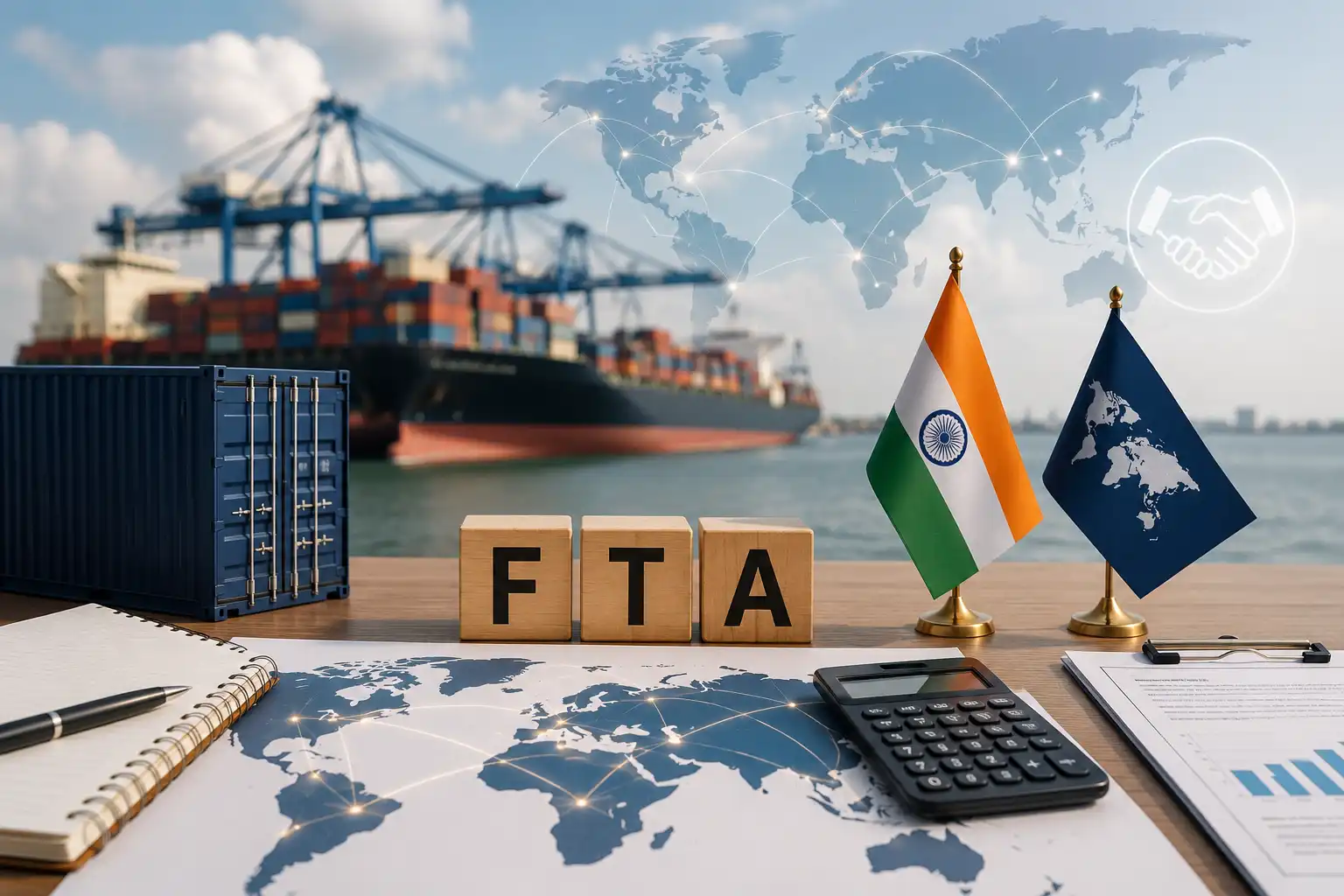
India Free Trade Agreements for Exporters: How FTAs Can Reduce Import Duties in 2026
As global trade becomes increasingly competitive, pricing plays a critical role in winning international business. Even when Indian manufacturers offer high-quality products, import duties in destination countries can make exports less competitive compared to suppliers from countries that benefit from preferential trade agreements.
This is where India Free Trade Agreements for Exporters become valuable. Free Trade Agreements (FTAs) allow eligible Indian goods to enter partner countries at reduced or zero customs duties, helping exporters improve pricing, expand into new markets, and strengthen long-term international relationships.
However, these benefits are available only when exporters understand the agreement, meet the applicable Rules of Origin, and maintain proper documentation.
Quick Answer
India has signed several bilateral and regional Free Trade Agreements that provide preferential tariff benefits for eligible exports. In 2026, exporters can reduce import duties in partner countries by ensuring their products qualify under the relevant FTA, comply with Rules of Origin requirements, and obtain the necessary Certificate of Origin. Leveraging these agreements effectively can improve export competitiveness and support long-term international growth.
What Is a Free Trade Agreement?
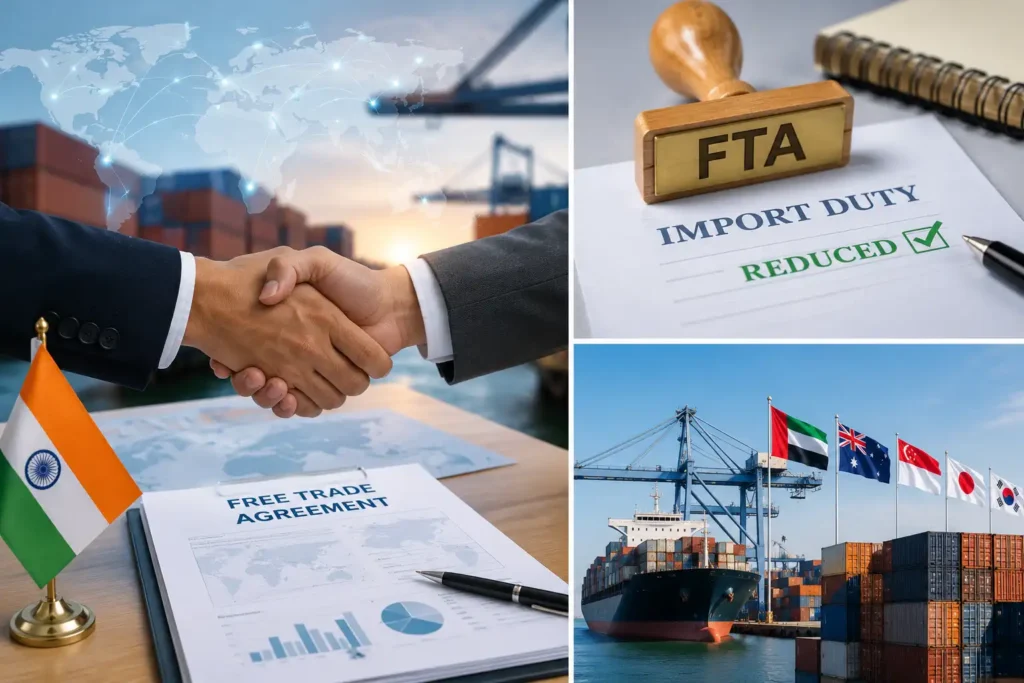
A Free Trade Agreement is a formal trade arrangement between two or more countries that reduces or eliminates customs duties and certain trade barriers on eligible goods and services.
Unlike standard international trade, where imports are subject to regular tariff rates, FTAs provide preferential duty treatment for qualifying products.
The objective is to:
- Promote international trade
- Increase market access
- Encourage investment
- Strengthen economic cooperation
- Improve competitiveness for exporters
For Indian exporters, FTAs can make products more attractive in overseas markets by lowering the landed cost for buyers.
Why FTAs Matter for Indian Exporters in 2026
India continues to expand its network of trade agreements as part of its broader export growth strategy.
With rising global competition and evolving supply chains, buyers increasingly compare suppliers based not only on product quality but also on the final import cost.
When customs duties are reduced under an FTA, buyers often gain a pricing advantage, making Indian products more competitive.
For exporters, this can result in:
- Better pricing opportunities
- Increased export volumes
- Improved market access
- Stronger customer relationships
- Higher competitiveness against suppliers from non-FTA countries
Major Free Trade Agreements Available to Indian Exporters
As of 2026, India participates in several important bilateral and regional trade agreements.
Some of the key agreements include:
India-UAE Comprehensive Economic Partnership Agreement (CEPA)
The India-UAE CEPA, effective since 2022, provides preferential tariff access for a wide range of Indian products exported to the United Arab Emirates.
It has significantly improved trade opportunities across sectors including engineering goods, gems and jewellery, food products, textiles, pharmaceuticals, and chemicals.
India-Australia Economic Cooperation and Trade Agreement (ECTA)
The India-Australia ECTA offers tariff concessions on many product categories and has strengthened bilateral trade across manufacturing, agriculture, and services.
Eligible exporters can benefit from reduced customs duties by complying with agreement requirements.
India-European Free Trade Association (EFTA) Trade and Economic Partnership Agreement
India signed the Trade and Economic Partnership Agreement (TEPA) with the EFTA countries (Iceland, Liechtenstein, Norway, and Switzerland). Following ratification and entry into force, the agreement is expected to improve market access while encouraging investment and economic cooperation. Exporters should verify the agreement’s operational status and product-specific tariff schedules before claiming benefits.
ASEAN-India Free Trade Agreement
This agreement enables preferential trade between India and ASEAN member countries across numerous product categories.
It remains an important trade framework for businesses exporting to Southeast Asia.
Other Regional and Bilateral Agreements
India also maintains preferential trade arrangements with several other countries and trading blocs.
Since tariff schedules vary by product and destination, exporters should always verify the applicable agreement before preparing quotations.
How Do Exporters Qualify for FTA Benefits?
Simply exporting goods to an FTA partner country does not automatically guarantee reduced duties.
Several conditions must be satisfied.
1. Rules of Origin
Every FTA contains Rules of Origin that determine whether a product qualifies as originating in India.
These rules may consider:
- Local value addition
- Manufacturing process
- Change in tariff classification
- Product-specific requirements
Failure to satisfy these conditions may result in denial of preferential tariff benefits.
2. Certificate of Origin
A Certificate of Origin (CoO) is generally required to claim preferential duty treatment under an FTA.
The certificate confirms that the exported goods satisfy the origin requirements specified in the agreement.
Without a valid Certificate of Origin, importers may not receive reduced tariff benefits.
3. Accurate Documentation
Exporters should maintain complete documentation, including:
- Commercial invoice
- Packing list
- Shipping documents
- Manufacturing records where required
- Certificate of Origin
- Product classification details
Accurate documentation supports compliance and facilitates customs clearance.
How FTAs Help Reduce Import Duties
Reduced customs duties directly lower the buyer’s import cost.
For example:
Without an FTA:
- Product value: ₹10,00,000
- Import duty: Standard tariff
With an applicable FTA:
- Product value remains unchanged
- Eligible preferential tariff may reduce or eliminate customs duty, subject to product coverage and compliance
Although the export price remains the same, the buyer’s overall landed cost may decrease, making the Indian supplier more competitive.
Common Mistakes Exporters Should Avoid
Many businesses fail to maximise FTA benefits because of avoidable errors.
Common mistakes include:
- Assuming every product qualifies automatically
- Incorrect product classification
- Incomplete origin documentation
- Failure to understand Rules of Origin
- Using outdated tariff schedules
- Missing Certificate of Origin requirements
Careful planning helps prevent customs delays and rejected preferential claims.
Why Supply Chain Planning Matters
Free Trade Agreements provide benefits only when supported by efficient logistics.
Strong operations and supply chain management enables exporters to:
- Meet shipment schedules
- Reduce transit delays
- Maintain documentation accuracy
- Improve inventory planning
- Coordinate manufacturing with export timelines
Combining trade agreement knowledge with efficient logistics strengthens overall export competitiveness.
How Freight Forwarders Support FTA Compliance
Experienced logistics providers help exporters navigate international shipping requirements while ensuring documentation aligns with destination regulations.
Professional Freight Forwarding service providers assist with:
- Export documentation
- Shipping coordination
- Customs processes
- Route planning
- Carrier selection
- Shipment tracking
- Logistics compliance support
While freight forwarders generally do not determine legal eligibility for FTA benefits, they help ensure shipping documentation is complete and aligned with operational requirements.
How FAK Cargo Supports Indian Exporters
International trade requires more than transportation. Successful exports depend on efficient logistics, accurate documentation, and timely coordination across the supply chain.
FAK Cargo provides reliable Freight Forwarding service solutions that support exporters throughout the shipment process. From transportation planning and documentation coordination to customs support and cargo movement, the team helps businesses streamline export operations while improving supply chain efficiency.
By combining logistics expertise with strong operations and supply chain management, FAK Cargo enables exporters to focus on business growth while maintaining reliable global shipments.
Conclusion
Understanding India Free Trade Agreements for Exporters is becoming increasingly important as businesses seek new international markets in 2026.
When used correctly, FTAs can reduce import duties, improve product competitiveness, and strengthen long-term export growth. However, these benefits depend on meeting Rules of Origin, maintaining proper documentation, and understanding the specific requirements of each agreement.
By combining sound trade knowledge with efficient logistics planning and experienced freight forwarding support, Indian exporters can maximise the opportunities created by India’s expanding network of international trade agreements.
Looking for a Reliable Logistics Partner for Your Global Shipments?
At FAK Cargo, we provide customised logistics solutions backed by industry expertise, reliable global networks, and a customer-first approach. From freight forwarding and multimodal transportation to export support and specialised cargo handling, our team works closely with businesses to ensure shipments move safely, efficiently, and on schedule.
Get in touch with FAK Cargo today to discuss your logistics requirements and discover solutions tailored to your business goals.
Frequently Asked Questions
Q1. What are India Free Trade Agreements for exporters?
A. These are trade agreements between India and partner countries that allow eligible products to receive reduced or zero customs duties, subject to agreement conditions.
Q2. Do all exported products qualify for FTA benefits?
A. No. Products must satisfy the Rules of Origin and other eligibility requirements specified under the applicable agreement.
Q3. What is the purpose of a Certificate of Origin?
A. A Certificate of Origin confirms that exported goods meet the origin requirements needed to claim preferential tariff benefits under an FTA.
Q4. How do FTAs help exporters?
A. FTAs can lower import duties in destination countries, making Indian products more competitive and reducing the buyer’s overall import cost.
Q5. How can a Freight Forwarding service support exporters using FTAs?
A. A freight forwarder helps coordinate documentation, transportation, customs processes, and shipment planning, supporting smoother international trade operations while ensuring logistics documentation is properly managed.
Related posts

What Exporters Get Wrong About “Guaranteed Transit Time”
One of the most confident phrases used in the logistics is guaranteed transit ti
How Small Purchase Order Changes Lead to Major Export Delays
In 2026, exporters have less room for avoidable mistakes. India’s total export

Optimizing Bulk Liquid Supply Chains: FAK Worldwide’s Data-Driven Approach
Transporting bulk liquids is among the most complex challenges in logistics. Fro