
Top Documentation Mistakes That Delay IGST Refunds for Exporters
For Indian exporters, timely tax refunds play an important role in maintaining healthy cash flow. Since exports are generally treated as zero-rated supplies under the Goods and Services Tax (GST) framework, eligible exporters may claim refunds in accordance with the applicable provisions of GST law.
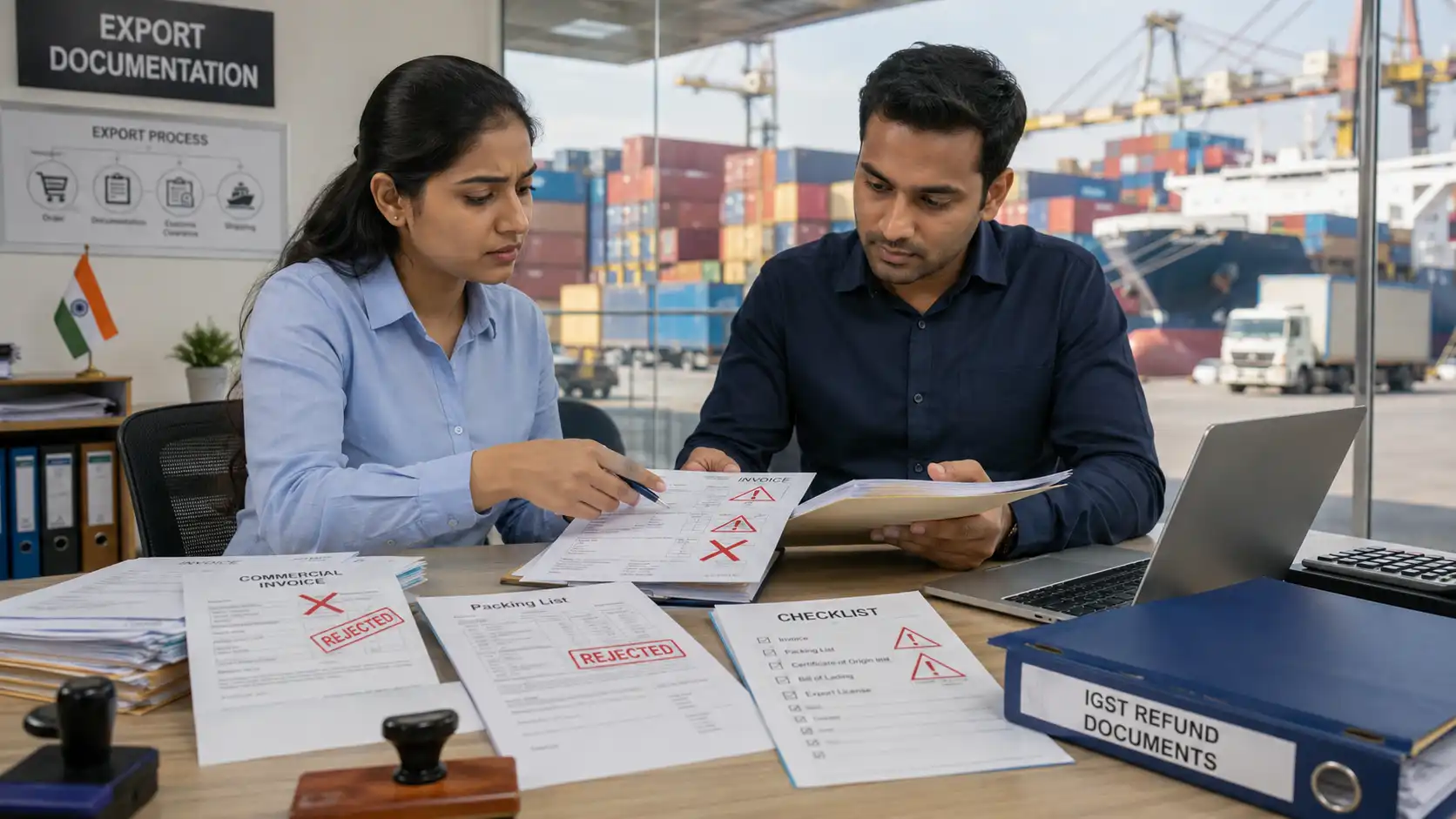
However, one of the most common reasons for delayed IGST Refund for Exporters is inaccurate or incomplete documentation. Even minor mismatches between shipping documents and GST filings can result in processing delays, additional verification, or refund holds.
Understanding the documentation requirements before goods are exported helps businesses minimise compliance issues and improve the overall refund process.
Quick Answer
Most delays in IGST Refund for Exporters occur because of incorrect GST filings, mismatched shipping bill details, invoice inconsistencies, missing export documentation, or errors in customs declarations. Maintaining accurate records, reconciling GST returns with shipping documents, and ensuring consistency across all export paperwork can significantly reduce refund delays. Refund processing remains subject to verification by the relevant authorities and applicable GST provisions.
Understanding IGST Refunds for Exporters

Under India’s GST framework, exports are generally regarded as zero-rated supplies under the Integrated Goods and Services Tax (IGST) Act, subject to the applicable legal provisions.
Eligible exporters may claim refunds through the prescribed mechanisms, depending on the nature of the export transaction and compliance with GST requirements.
Since refunds involve both GST and customs-related data, accuracy across multiple documents becomes essential.
Even small discrepancies may delay automated processing or require manual verification.
Why Documentation Accuracy Matters
Several government systems exchange export-related information electronically.
Data submitted through GST returns, shipping bills, customs filings, and invoices must align correctly.
When inconsistencies occur, refund processing may be delayed until the discrepancies are resolved.
Accurate documentation helps:
- Improve processing efficiency
- Reduce verification requests
- Minimise refund delays
- Strengthen compliance
- Maintain proper audit records
Common Documentation Mistakes That Delay IGST Refunds
1. Mismatch Between GST Returns and Shipping Bill Details
One of the most frequent causes of refund delays is inconsistency between GST returns and customs records.
Examples include:
- Incorrect invoice numbers
- Different invoice values
- Wrong taxable amount
- Incorrect GSTIN
- Data entry mistakes
Before filing returns, exporters should reconcile all shipment information with customs documentation.
2. Errors in Shipping Bills
The shipping bill acts as an important export document during refund processing.
Common mistakes include:
- Incorrect exporter details
- Wrong port information
- Product description errors
- Incorrect invoice references
- Missing shipping bill amendments where required
Since customs data forms part of refund verification, accurate shipping bills are essential.
3. Incorrect Invoice Details
Commercial invoices should remain consistent across all export documents.
Errors may include:
- Incorrect invoice date
- Wrong invoice value
- Product quantity mismatch
- Typographical mistakes
- Incorrect GST information
Small invoice discrepancies can trigger additional verification.
4. Incorrect HSN Classification
Using the wrong Harmonised System of Nomenclature (HSN) code may create inconsistencies between GST filings and customs declarations.
Incorrect product classification may also affect export reporting and compliance.
Businesses should verify HSN classifications before filing export documentation.
5. Incorrect GST Return Filing
Refund processing depends heavily on accurate GST return submission.
Common issues include:
- Incorrect reporting of export invoices
- Missing export supplies
- Data entry errors
- Late return filing
- Incomplete reconciliation
Regular internal reviews help identify errors before returns are submitted.
6. Errors in Bank Account Details
Refunds are generally credited to the registered bank account linked with the exporter.
Incorrect banking information can delay payment even after refund approval.
Exporters should periodically verify:
- Bank account number
- IFSC details
- Account status
- GST registration records
7. Missing Export Documentation
Incomplete records often delay verification.
Important documents generally include:
- Commercial invoice
- Packing list
- Shipping bill
- Bill of Lading or Airway Bill
- Export General Manifest (EGM), where applicable
- GST returns
- Payment-related documentation where required under applicable regulations
Maintaining organised records simplifies future verification.
8. Failure to Reconcile Data Before Filing
Many refund delays occur because businesses file documents without performing a final reconciliation.
Before submission, exporters should compare:
- GST returns
- Shipping bill data
- Invoice details
- Product descriptions
- Export values
- Tax information
Early reconciliation reduces correction requests later.
Best Practices to Reduce Refund Delays
Businesses can improve refund processing by adopting structured compliance procedures.
Recommended practices include:
Maintain Digital Documentation
Store all export documents in organised digital folders for easy retrieval.
Verify Data Before Submission
Conduct multiple reviews before filing GST returns and export documents.
Standardise Invoice Formats
Use consistent invoice templates across all export shipments.
Track Amendments Promptly
If corrections become necessary, complete amendments as early as possible.
Coordinate Between Departments
Finance, logistics, documentation, and customs teams should share updated shipment information.
The Role of Export Documentation in Compliance
Export documentation serves several important purposes beyond refund processing.
Proper records support:
- Customs clearance
- Foreign trade compliance
- GST compliance
- Shipment tracking
- Audit requirements
- Buyer documentation
- International trade records
Businesses involved in exporting services and goods benefit from maintaining accurate documentation systems throughout the export lifecycle.
Why Logistics Coordination Matters
Documentation accuracy depends not only on finance teams but also on efficient logistics coordination.
Shipment schedules, customs filings, transport documents, and invoice preparation must remain aligned.
Professional logistics partners help exporters by:
- Coordinating shipping documentation
- Supporting customs procedures
- Managing shipment timelines
- Reducing operational errors
- Improving document consistency
This integrated approach supports smoother export operations.
How FAK Cargo Supports Export Documentation
Successful exports depend on accurate documentation and efficient logistics coordination.
FAK Cargo supports businesses involved in exporting services in India by helping coordinate shipment documentation, customs processes, freight movement, and export logistics. With experience across international shipping operations, the team works closely with exporters to improve documentation accuracy and streamline cargo movement.
Although GST refund approvals are processed by the relevant government authorities, efficient logistics planning and properly coordinated shipping documentation help reduce avoidable operational delays during the export process.
Conclusion
Timely IGST Refund for Exporters depends largely on the accuracy of export documentation. Most refund delays result from mismatched information, incorrect filings, missing documents, or avoidable data entry errors.
By maintaining organised records, reconciling shipment information before filing, and coordinating closely with logistics and compliance teams, exporters can significantly improve the efficiency of the refund process.
As export regulations and digital compliance systems continue to evolve in 2026, investing in strong documentation practices remains one of the most effective ways to support smooth international trade operations and healthy business cash flow.
Looking for a Reliable Logistics Partner for Your Global Shipments?
At FAK Cargo, we provide customised logistics solutions backed by industry expertise, reliable global networks, and a customer-first approach. From freight forwarding and multimodal transportation to export support and specialised cargo handling, our team works closely with businesses to ensure shipments move safely, efficiently, and on schedule.
Get in touch with FAK Cargo today to discuss your logistics requirements and discover solutions tailored to your business goals.
Frequently Asked Questions
Q1. What is the most common reason for delays in IGST Refund for Exporters?
A. The most common reasons include mismatched GST returns, incorrect shipping bill details, invoice inconsistencies, and incomplete export documentation.
Q2. Does an incorrect shipping bill affect IGST refunds?
A. Yes. Errors in shipping bills can delay customs verification and the overall refund process.
Q3. Why is reconciliation important before filing GST returns?
A. Reconciling invoices, shipping bills, and GST returns helps identify inconsistencies before submission, reducing the likelihood of refund delays.
Q4. Can exporters involved in exporting services claim GST-related benefits?
A. The GST treatment of exporting services differs from goods exports and depends on the applicable legal provisions, fulfilment of export conditions, and the nature of the transaction. Businesses should evaluate eligibility under the relevant GST rules or seek professional tax advice.
Q5. How can logistics partners support export documentation?
A. Logistics providers help coordinate shipping documents, customs procedures, freight planning, and shipment timelines, improving documentation accuracy and reducing operational errors.
Related reading: Customs Pre-Clearance Strategies to Shorten Transit Time
Related posts
Original Bill of Lading vs Sea Waybill vs Telex Release: What Exporters Should Use
Compare Original Bill of Lading, Sea Waybill and Telex Release for exporters, in