
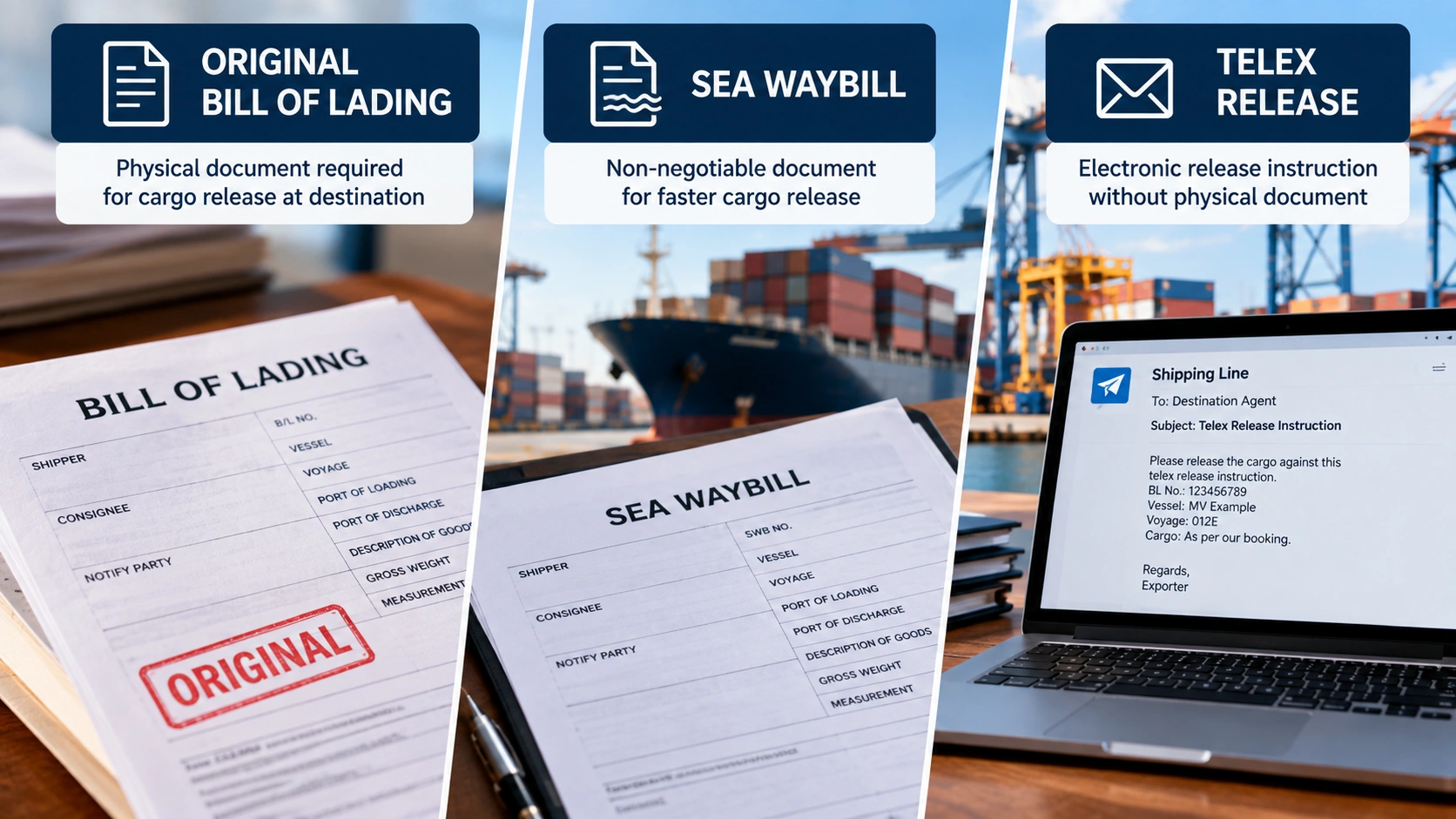
Original Bill of Lading vs Sea Waybill vs Telex Release: What Exporters Should Use
Quick Answer: The choice between an original Bill of Lading, Sea Waybill, and Telex Release depends on how cargo ownership, document control, payment arrangements, and cargo release need to be managed. An original Bill of Lading can provide stronger document control and may be required in transactions involving documentary credit or transfer of title. A Sea Waybill is generally simpler when there is no need for a negotiable document. A Telex Release allows cargo to be released at destination without presenting the original Bill of Lading after the required release process has been completed.
Key Takeaways
- An Original Bill of Lading can function as a document of title and provides control over cargo release.
- A Sea Waybill is generally non-negotiable and can simplify cargo release when document-of-title control is not required.
- A Telex Release is a release instruction that allows cargo to be released without presentation of the original Bill of Lading.
- Payment terms, buyer-seller relationship, cargo destination, and release requirements should influence the choice.
- Exporters should confirm the documentation and release process with their carrier or freight forwarding partner before shipment.
Introduction
Shipping documents are an important part of every international ocean shipment. Among the most commonly discussed options are the Bill of Lading, Sea Waybill, and Telex Release.
Although these terms are often used interchangeably in day-to-day conversations, they do not serve exactly the same purpose.
For exporters using sea freight services, choosing the appropriate document can affect cargo release, payment processes, document handling, and coordination with the consignee. Selecting the wrong arrangement can create unnecessary delays, particularly when the shipment is ready for delivery but the required documentation or release instruction is incomplete.
Understanding the differences before cargo is shipped can therefore make the export process easier to manage.
What Is an Original Bill of Lading?
A Bill of Lading, commonly abbreviated as B/L or BL, is a key document used in ocean transportation. Depending on its form and applicable terms, it can serve as evidence of the contract of carriage, a receipt for the cargo, and, in the case of a negotiable B/L, a document of title.
An Original Bill of Lading generally involves physical original documents being issued and controlled.
When Is an Original Bill of Lading Useful?
An original B/L may be appropriate when:
- Document control is important.
- The transaction involves documentary credit requirements.
- The buyer and seller require control over cargo through shipping documents.
- The B/L needs to be transferred or endorsed where applicable.
- The commercial transaction requires a negotiable document.
For example, if an exporter has payment terms where shipping documents must be presented before the buyer can obtain control of the cargo, an original B/L may form an important part of the transaction.
What Is a Sea Waybill?
A Sea Waybill is generally a non-negotiable transport document. Unlike a negotiable Bill of Lading, it does not normally function as a document of title.
Because the original document does not need to be surrendered for cargo release in the same way as an original B/L, the process can be simpler.
When Is a Sea Waybill Suitable?
A Sea Waybill may be considered when:
- The buyer and seller have an established commercial relationship.
- Cargo ownership does not need to be controlled through a negotiable document.
- Faster documentation is preferred.
- The shipment does not require an original B/L for payment or transfer purposes.
For example, a regular exporter shipping to a long-standing overseas customer may prefer a Sea Waybill when there is no commercial requirement for negotiable shipping documents.
What Is a Telex Release?
A Telex Release is not simply another type of Bill of Lading. It is a release instruction used by a carrier or shipping line to authorise cargo release at destination without requiring presentation of the original B/L, subject to the carrier’s applicable procedures.
Typically, the original B/L is surrendered or otherwise processed as required, and the carrier communicates the release instruction to the destination office or agent.
This can reduce the need to physically courier original documents to the destination after the required release conditions have been met.
Bill of Lading vs Sea Waybill vs Telex Release
| Factor | Original Bill of Lading | Sea Waybill | Telex Release |
| Document type | Transport document that may be negotiable | Non-negotiable transport document | Release instruction |
| Document of title | May function as one when negotiable | Generally no | Depends on underlying B/L |
| Original document surrender | Generally required where applicable | Generally not required in the same manner | Original B/L is handled according to carrier procedure |
| Cargo release | Controlled through applicable B/L process | Usually simpler | Released based on carrier’s release instruction |
| Document control | Higher | Lower | Release-focused |
| Suitable for | Transactions requiring document control | Straightforward shipments | Shipments where original B/L release can be handled before destination |
The exact legal and operational effect can depend on the B/L terms, carrier procedures, governing law, and commercial transaction.
Which Option Should Exporters Use?
There is no single document that is best for every shipment.
Choose an Original Bill of Lading When
An original B/L may be preferable when document control is important or when the commercial transaction, bank, buyer, or letter of credit requires it.
Choose a Sea Waybill When
A Sea Waybill can be practical when the transaction is straightforward, the consignee is known, and there is no requirement for a negotiable document of title.
Consider a Telex Release When
A Telex Release may be useful when an original B/L has been issued but the parties want cargo to be released at destination without physically presenting the original document, subject to the carrier’s release requirements.
What Business Factors Should Be Considered?
The documentation choice should be aligned with the complete transaction.
Exporters should consider:
- Payment terms
- Letter of credit requirements
- Buyer-seller relationship
- Cargo ownership and control
- Destination requirements
- Carrier procedures
- Bank documentation requirements
- Expected delivery timeline
For example, choosing a Sea Waybill for a transaction that requires an original negotiable B/L could create documentation problems later.
What Should Indian Exporters Know?
Indian exporters should coordinate shipping documentation with their freight forwarder, shipping line, customs and other relevant parties before cargo departure.
For shipments leaving gateways such as JNPT/Nhava Sheva, Mundra, Chennai, or other Indian ports, documentation requirements can vary according to the carrier, destination, cargo, and commercial terms.
Exporters should also ensure that the names, consignee details, notify-party information, cargo description, and other shipping instructions are accurate before the final document is issued.
The document selected should support both the logistics movement and the underlying commercial transaction.
Industry Insight
From a logistics perspective, we recommend deciding the documentation method before the shipment reaches the final documentation stage.
The question is not simply whether an exporter wants an original B/L or a faster release. We first look at the transaction itself, including payment terms, buyer relationship, destination requirements, carrier procedures, and how the consignee is expected to take delivery.
A documentation option that appears convenient at origin can create complications at destination if it does not match the commercial requirements. Early coordination between the exporter, buyer, freight forwarder, carrier, and where relevant, the bank, can help avoid unnecessary document-related delays.
Common Mistakes Exporters Should Avoid
- Treating a Sea Waybill and Bill of Lading as identical documents.
- Assuming Telex Release is a separate type of transport document.
- Selecting documentation without checking payment terms.
- Ignoring letter of credit requirements.
- Sending incorrect consignee or notify-party details.
- Assuming every carrier follows the same release procedure.
- Waiting until the vessel has departed to resolve documentation issues.
- Failing to confirm destination release requirements.
How Should You Choose?
Before finalising shipping instructions, ask:
- Does the transaction require a negotiable document?
- Are there bank or letter of credit requirements?
- Does the buyer require document control?
- Is the buyer a trusted or established customer?
- Does the carrier permit the required release arrangement?
- How quickly does the consignee need to take delivery?
- Have all shipping details been verified?
When there is uncertainty, exporters should confirm the appropriate documentation arrangement with their carrier or freight forwarding services provider before the Bill of Lading is finalised.
Why FAK Cargo?
FAK Cargo supports exporters with freight forwarding services and sea freight services, coordinating shipping documentation and cargo movement as part of the wider export process.
Its logistics support extends across freight forwarding, port agency, multimodal transportation, export packing, ISO tank logistics, and DG and chemical cargo requirements, depending on the shipment.
Key Takeaway
The choice between an Original Bill of Lading, Sea Waybill, and Telex Release should be based on the commercial transaction as well as the physical movement of the cargo.
An Original Bill of Lading can provide document control, a Sea Waybill can simplify straightforward shipments, and a Telex Release can facilitate destination cargo release when the required original B/L process has been completed.
Exporters should confirm payment, documentation, carrier, and destination requirements before finalising shipping instructions. For complex shipments, early coordination with an experienced freight forwarding partner can help keep the documentation and cargo movement aligned.
FAQs
Q1. Is a Sea Waybill the same as a Bill of Lading?
A. No. A Sea Waybill is generally non-negotiable, while certain Bills of Lading can be negotiable and may function as documents of title.
Q2. What is a Telex Release?
A. A Telex Release is a carrier’s release instruction that can allow cargo to be released at destination without presentation of the original Bill of Lading, subject to the carrier’s procedures.
Q3. Is a Telex Release faster than an Original Bill of Lading?
A. It can simplify destination release by avoiding the need to physically present the original B/L, provided the required release conditions have been completed.
Q4. When should an exporter use a Sea Waybill?
A. It can be suitable for straightforward shipments where document-of-title control is not required and the consignee can receive cargo without presentation of an original negotiable B/L.
Q5. Can a freight forwarder advise on shipping documentation?
A. Yes. A freight forwarder can help coordinate documentation requirements with the exporter, carrier, consignee, and other relevant parties, while commercial or banking requirements should also be confirmed with the appropriate parties.
Related reading: Customs Pre-Clearance Strategies to Shorten Transit Time
Related posts
Top Documentation Mistakes That Delay IGST Refunds for Exporters
For Indian exporters, timely tax refunds play an important role in maintaining h