

India’s Air Cargo Transshipment Expansion in 2026: What Exporters Need to Know
India Is Building a Faster Route for International Cargo
For Indian exporters, reaching international markets is not just about securing an aircraft booking. Cargo availability, airport handling, security checks, transit connections and delivery timelines all influence whether a shipment reaches its destination as planned.
In 2026, India took an important step towards strengthening its position as an international air cargo transshipment hub. A revised framework allows eligible cargo, secured at its origin airport, to move through designated transit facilities without undergoing mandatory piece-level re-screening at the transit airport, subject to prescribed security safeguards.
The initial Domestic-to-International (D2I) initiative uses Delhi as a transit hub. It is designed to improve cargo movement from Indian cities to international destinations, potentially offering exporters more efficient routing options.
For businesses using international air freight services in India, understanding this development can help with route planning, shipment timelines and freight decisions.
Quick Answer: What Is Changing in India’s Air Cargo Transshipment?
India’s 2026 air cargo transshipment expansion is focused on reducing delays during cargo transfers at transit airports.
Under the revised security framework, eligible shipments that have completed the required security checks at origin can remain securely packed during transit instead of being unpacked and screened piece by piece again. The initial D2I network connects five Indian origin cities through Delhi to three European destinations.
The reform aims to reduce handling, cargo connection time and the risk of shipment damage while strengthening India’s role in international air freight.

Key Takeaways
- The initial D2I network connects Ahmedabad, Bengaluru, Chennai, Hyderabad and Mumbai through Delhi.
- Eligible cargo can move without mandatory piece-level re-screening at the transit airport, subject to security requirements.
- The initial international destinations include Frankfurt, London and Copenhagen.
- The Ministry of Civil Aviation reported that the proof of concept handled over 1,100 MT by 16 October 2026.
- Exporters should confirm route eligibility, airline participation, cargo acceptance and documentation before planning shipments around the new framework.
What Is the Air Cargo Transshipment Process?
Air cargo transshipment is the movement of a shipment through an intermediate airport before it continues to its final destination. Instead of flying directly from the origin airport to the destination, cargo is transferred to another flight at a transit hub.
For example, an exporter in Chennai shipping engineering components to Frankfurt may have cargo moved from Chennai to Delhi and then loaded onto an international flight to Frankfurt.
The process typically involves:
- Origin acceptance: The shipment is booked, documented and accepted by the airline or cargo operator.
- Security screening: Cargo undergoes the applicable security checks at the origin airport.
- Transit transfer: The shipment moves to the designated transit airport.
- Security and handling controls: The cargo is transferred through approved facilities under the applicable transshipment framework.
- Onward loading: The shipment is connected to the next flight.
- Destination handling: Cargo reaches the destination airport for the applicable import and delivery procedures.
The key change in the 2026 framework is the treatment of eligible secured cargo during the transit stage.
What Changed in India’s 2026 Transshipment Expansion?
The revised framework builds on Addendum-II to BCAS AVSEC Circular No. 6/2024, issued on 21 July 2025. It permits eligible secured transshipment cargo to move through designated Transfer Cargo Security Hold Areas (TCSHAs) without repeat screening, subject to prescribed safeguards.
The Domestic-to-International proof of concept began on 20 June 2026 on the Chennai-Delhi-Frankfurt route, using Delhi International Airport’s Transshipment Excellence Centre.
On 19 August 2026, the Ministry of Civil Aviation announced the expansion of the network to four additional domestic origin airports and two additional international destinations.
| Network component | Initial route | Expanded network |
| Indian origin airports | Chennai | Ahmedabad, Bengaluru, Chennai, Hyderabad, Mumbai |
| Transit hub | Delhi | Delhi |
| International destinations | Frankfurt | Frankfurt, London, Copenhagen |
| Movement type | Domestic-to-International | Domestic-to-International |
The Ministry’s Air Cargo Division reported that more than 1,100 MT had moved under the proof of concept across selected routes by 16 October 2026. It also reported a reduction in average total travel time from 78 hours to 26 hours.
Air India separately reported that cargo connection time at Delhi on its Chennai-Delhi-Frankfurt corridor reduced from 36-48 hours to 5-8 hours during the proof of concept. These figures refer to different operational measures and reporting scopes, so they should not be treated as interchangeable.
How Can This Benefit Indian Exporters?
1. Shorter cargo connection times
Reducing repetitive screening and handling can make transit connections faster. This is particularly relevant for time-sensitive shipments where delays at an intermediate airport can affect the overall delivery schedule.
2. Better shipment integrity
Every additional handling stage creates an opportunity for packaging damage, discrepancies or mishandling. Keeping eligible cargo securely packed through transit can reduce unnecessary physical intervention.
3. More routing flexibility
A stronger domestic-to-international network can help connect cargo originating in multiple Indian cities to international flights through a central hub.
For example, an exporter based in Ahmedabad may be able to use a qualifying Ahmedabad-Delhi-London routing rather than arranging a more complicated movement through another international gateway.
4. Improved planning for time-sensitive goods
Electronics, engineering components, fashion products and certain high-value shipments may benefit from more predictable transit connections. However, the suitability of air freight still depends on shipment characteristics, cost and destination requirements.
Which Shipments Should Exporters Consider?
The new framework does not automatically make every shipment eligible. Cargo acceptance depends on the applicable security framework, participating operators, route availability and commodity-specific requirements.
| Shipment category | What exporters should check |
| Electronics and high-value goods | Security requirements, handling controls and insurance |
| Engineering components | Packaging, dimensions, weight and airline acceptance |
| Fashion and textile shipments | Flight availability, packing and delivery deadlines |
| Perishable goods | Temperature requirements, specialised handling and connection time |
| Dangerous goods and chemicals | Classification, documentation, packaging and airline acceptance |
Dangerous goods, including regulated chemicals, require particular attention. Exporters must comply with applicable dangerous goods regulations and carrier acceptance requirements. They should not assume that a transshipment route is available simply because the shipment can move through the airport.
Industry Insight: Route Efficiency Depends on More Than Flight Time
From a freight-forwarding perspective, a faster transit connection is valuable only when the entire shipment plan works around it.
Exporters should evaluate origin collection, export documentation, cargo acceptance, security requirements, flight schedules, transit handling and final delivery together. A shorter airport connection does not automatically guarantee a shorter door-to-door transit time.
The new framework creates an opportunity, but effective planning still depends on accurate shipment information and coordination between the exporter, freight forwarder, airline, handling agent and destination partner.
Common Mistakes Exporters Should Avoid
- Assuming all airports and international destinations are covered by the expanded network.
- Treating the announced reduction in connection time as a guaranteed delivery time.
- Booking cargo without confirming eligibility under the applicable security framework.
- Overlooking commodity-specific restrictions, especially for dangerous goods and temperature-sensitive shipments.
- Ignoring destination customs requirements and documentation.
- Comparing freight quotations without checking transit time, handling charges and service conditions.
How Should Exporters Prepare?
Before selecting an air cargo transshipment route, businesses should:
- Confirm whether the origin, transit and destination airports are covered by an operational service.
- Check whether the airline and handling partners accept the shipment category.
- Share accurate cargo descriptions, dimensions, weight and packaging details.
- Confirm export documentation, security screening and any special regulatory requirements.
- Compare the complete routing, including connection time and final delivery arrangements.
- Obtain written confirmation of schedules, service conditions and applicable charges.
How FAK Cargo Can Support Air Freight Planning
FAK Cargo’s freight-forwarding and multimodal logistics capabilities can support businesses in evaluating international cargo movement requirements. For shipments involving specialised handling, dangerous goods or complex export requirements, coordination and documentation are particularly important.
The appropriate routing and handling plan should always be assessed against the shipment’s commodity, destination, compliance requirements and delivery priorities.
Key Takeaway: Plan for the Route, Not Just the Flight
India’s 2026 air cargo transshipment expansion is an important development for exporters seeking more efficient international connectivity. By reducing repeat screening for eligible secured cargo, the initiative can improve transit efficiency and strengthen the role of Indian airports in international cargo networks.
However, exporters should verify route availability, shipment eligibility and end-to-end logistics requirements before making operational decisions.
If your business is evaluating international air freight options, speaking with a freight-forwarding partner can help identify suitable routes and plan the movement around your cargo requirements.
Frequently Asked Questions
Q1. What is air cargo transshipment in India?
A. Air cargo transshipment in India refers to moving cargo through an intermediate Indian airport before it continues to its final destination, either within India or internationally.
Q2. Which Indian airports are part of the 2026 transshipment expansion?
A. The announced D2I network includes Ahmedabad, Bengaluru, Chennai, Hyderabad and Mumbai as origin airports, with Delhi serving as the transit hub. The international destinations announced are Frankfurt, London and Copenhagen.
Q3. Does the new policy eliminate cargo screening during transit?
A. It removes mandatory piece-level re-screening for eligible secured cargo under the revised framework. Prescribed security safeguards and eligibility requirements continue to apply.
Q4. Can dangerous goods be moved through the new transshipment framework?
A. Not automatically. Dangerous goods must meet applicable classification, packaging, labelling, documentation, security and airline acceptance requirements. Exporters should confirm eligibility with the relevant operators before booking.
Q5. How can exporters benefit from air cargo transshipment?
A. Eligible shipments may benefit from shorter transit connections, reduced handling and improved routing options. Actual benefits depend on the route, airline schedule, cargo category and end-to-end logistics arrangements.
Related Reading: India’s Air Cargo Growth and What Can Fly
Related posts
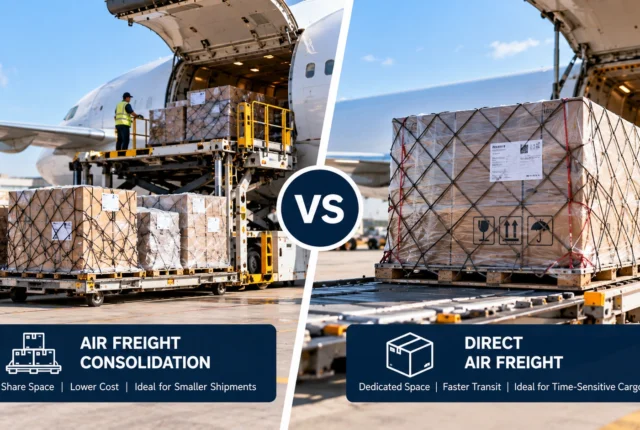
Air Freight Consolidation vs Direct Air Freight: Which Should Your Business Choose?
Compare air freight consolidation vs direct air freight based on cost, speed, ca
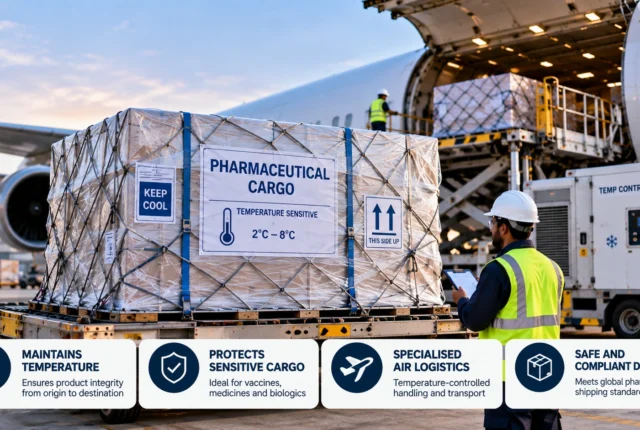
Pharmaceutical Cold Chain Logistics: How to Protect Temperature-Sensitive Air Cargo
Learn how pharmaceutical cold chain logistics protects temperature-sensitive air
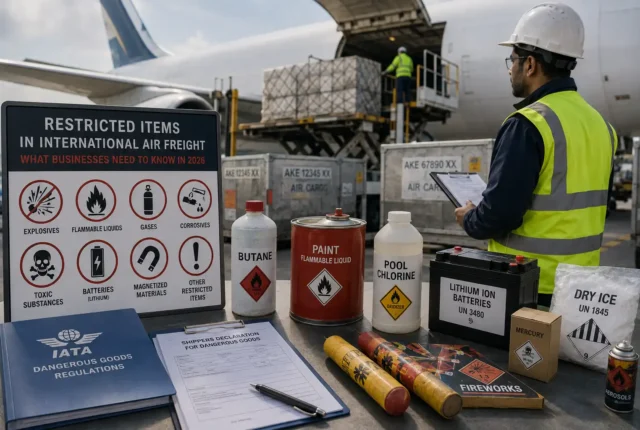
Restricted Items in International Air Freight: What Businesses Need to Know in 2026
Quick Answer: Restricted items in air freight include goods that create fire, ex

Leave a Reply